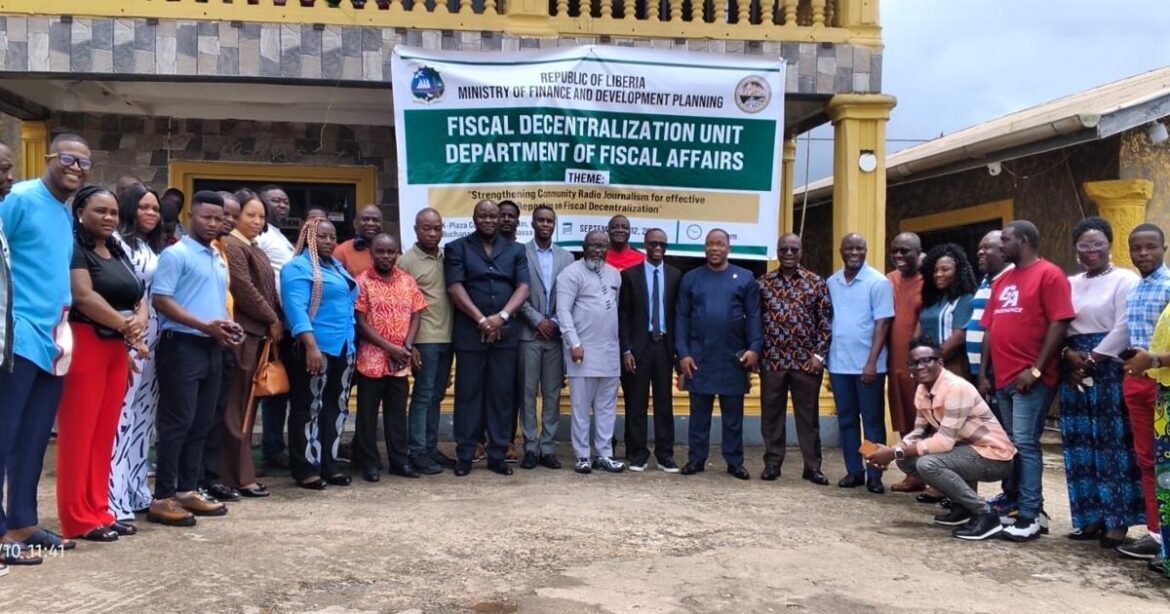
The Government of Liberia has challenged journalists to intensify their watchdog role by tracking public spending, investigating government projects and exposing alleged financial abuses as the country advances its fiscal decentralization program.
The call was made on Thursday, September 10, during the opening of a four-day training program on Strengthening Community Radio Journalism for Effective Reporting on Fiscal Decentralization in Liberia, organized by the Ministry of Finance and Development Planning (MFDP), in collaboration with the Ministry of Local Government, in Buchanan.
Deputy Minister for Fiscal Affairs at the MFDP, Anthony G. Myers, said Liberia’s long history of centralized governance has concentrated national institutions, businesses, international organizations and much of the media in Monrovia.
“For over 170 years or 200 years, if we go back to 1822, everything about our national institutions has been concentrated in Monrovia,” Myers said.
He said the situation has contributed to what he described as “two parallel Liberias,” with citizens in Monrovia generally having greater access to information about government and national affairs than people in rural communities.
Myers acknowledged that the media has also been “unwittingly a party to the culture of overcentralization,” noting that few Monrovia-based radio stations consistently report beyond Montserrado County and that no national newspaper is based outside Monrovia.
According to him, journalists must move beyond Monrovia-centered reporting and pay greater attention to county budgets, public contracts, development projects, service delivery and local government operations as power, money and decision-making gradually shift from Monrovia to Liberia’s 15 counties.
He urged stronger partnerships between national and local media organizations to ensure that issues emerging from remote communities reach national decision-makers.
“Issues from there can quickly be lifted up at the level of national decision makers,” he said.
Myers also called on government institutions to recognize the growing influence of citizen journalism on Facebook and other social media platforms, saying these platforms reach audiences that may not regularly consume traditional media.
He further urged government to widely distribute County Development Agendas in hard and electronic copies so journalists and citizens can understand development priorities across all 15 counties.
Meanwhile, Comptroller and Accountant General of Liberia Elwood T. Nettey challenged journalists to follow public money from allocation to implementation and ensure that government resources are spent for their intended purposes.
“Public funds are taxes paid by media practitioners, I mean, all citizens of Liberia,” Nettey said.
“The media role is to ensure the money goes to where it’s supposed to go,” he added.
Nettey called for continuous financial literacy training for journalists so they can understand budgets, procurement procedures, financial reports and contract management.
“Because if they have the basic understanding of these things, they will follow the money. And they will follow the documentation and those that are implementing for the public,” he said.
He urged journalists to investigate government-funded projects and verify whether projects reported as completed actually exist.
“We said we have built 10 clinics this month, or this budget year. Where are those clinics?” Nettey asked.
He said journalists should track projects from the contract stage through implementation and completion, including infrastructure, hospitals and schools.
Press Union of Liberia President Julius Kanubah said community radio is critical to connecting national fiscal policies with local realities.
“Community radio is more than a channel of communication – it is a bridge between national fiscal policies and local realities,” Kanubah said.
Representing Information Minister Jerolinmek Matthew Piah, Deputy Minister for Technical Services Nat Bayjay urged journalists to simplify financial information and show how budgets affect ordinary citizens through schools, clinics and roads.
Deputy Minister for Administration at the Ministry of Local Government Edward Mulbah said journalists are essential to making decentralization work.
“Power, money and decision-making are supposed to move from Monrovia to the 15 counties and journalists are the bridge that should make that happens,” Mulbah said.
He urged journalists to monitor County Development Funds, Social Development Funds and other county revenues, attend county council meetings and investigate alleged ghost workers, inflated contracts and political interference in procurement.
Mulbah warned that without effective media oversight, decentralization could become “deconcentralization”—simply moving government workers from Monrovia to the counties without transferring meaningful power and resources.
The training is expected to strengthen journalists’ capacity to report on public finance, county development, fiscal decentralization and service delivery while promoting greater transparency, accountability and citizen participation across Liberia.
See more Liberia News Network stories in Google Search by adding LNN as one of your Preferred Sources.
★ Add LNN as a Preferred Source