
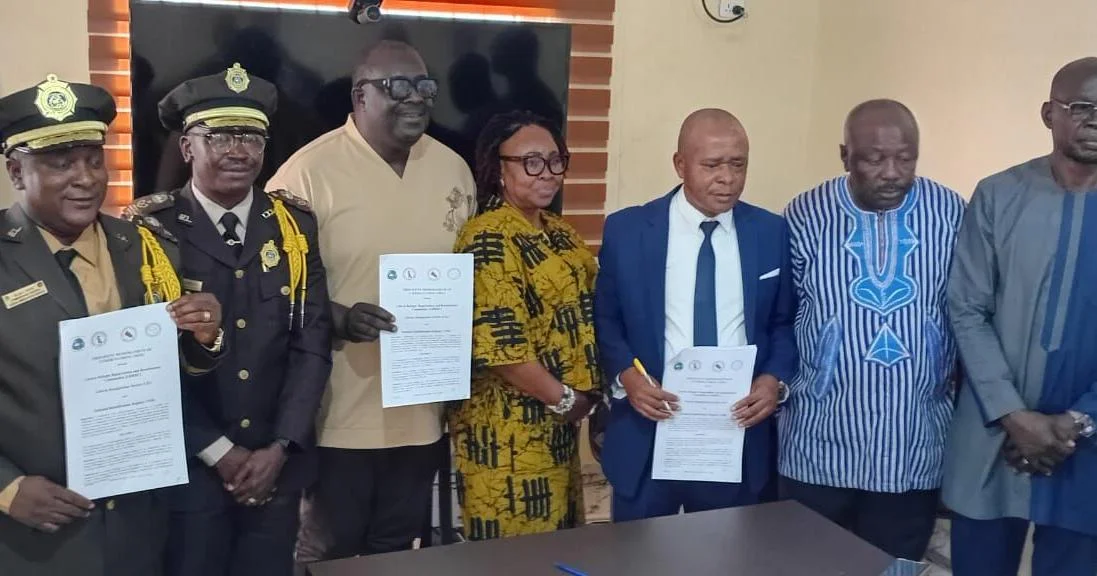
The Government of Liberia has officially launched a coordinated biometric identification framework for refugees following the signing of a landmark Tripartite Memorandum of Understanding (MOU) among the Liberia Refugee Repatriation and Resettlement Commission (LRRRC), the Liberia Immigration Service (LIS), and the National Identification Registry (NIR).
The signing ceremony, held Wednesday, February 25, 2026, at the LRRRC headquarters in Congo Town, marks a decisive national step toward implementing Executive Orders #144 and #147. The Executive Orders provide durable legal solutions for integrated Ivorian refugees and other recognized refugees who have chosen Liberia as their permanent home.
The newly launched framework establishes a harmonized and rights-based system that aligns refugee registration, identity management, immigration regularization, and residency documentation under one coordinated structure.
Through the collaboration, eligible refugees will be issued biometric Resident Permits and Specialized Refugee Identification Cards, ensuring secure, verifiable, and nationally recognized documentation.
Delivering remarks at the ceremony, LRRRC Executive Director Jeror Cole Bangalu described the MOU as a historic milestone in Liberia’s governance and humanitarian architecture.
“This MOU represents a decisive and coordinated national step toward the effective implementation of Executive Orders #144 and #147,” Cllr. Bangalu stated. “It is aimed at securing durable solutions for integrated refugees who have chosen Liberia as their home.”
He emphasized that the agreement reflects more than institutional cooperation.
“Today’s signing symbolizes Liberia’s enduring commitment to humanitarian protection, regional solidarity, and responsible migration governance,” he said.
Under the framework, the NIR will provide the biometric infrastructure to capture and verify refugee identity data, while the LIS will facilitate lawful residency pathways through immigration regularization. The LRRRC will coordinate refugee eligibility verification and overall implementation oversight.
Cllr. Bangalu stressed that biometric documentation is not merely administrative.
“The provision of secure and verifiable identity documentation is not just a technical exercise, it is a gateway to dignity, inclusion, and opportunity,” he noted. “With proper documentation, refugees can access essential services, engage productively in national development, and live without fear of legal uncertainty.”
He added that documentation transforms protection into practical, everyday security.
The coordinated framework is also designed to enhance national governance by harmonizing data systems and ensuring transparency, accountability, and operational efficiency.
The integration of biometric technology strengthens identity integrity, reduces the risk of fraud, and promotes orderly migration management while safeguarding national security.
Cllr. Bangalu commended the Liberia Immigration Service for its steadfast role in facilitating lawful residency and praised the National Identification Registry for its robust biometric infrastructure.
“Humanitarian protection and migration management are mutually reinforcing pillars of national governance,” he asserted.
He further noted that the agreement reaffirms Liberia’s compliance with its international and regional obligations toward refugees while advancing national interests in social cohesion and orderly migration.
Also speaking at the ceremony, Commissioner General of the Liberia Immigration Service, Elijah F. Rufus, reiterated the agency’s commitment to effective reintegration and documentation of refugees.
“We are not only identified by our colors; we are also defined by the travel documents we carry,” Commissioner General Rufus said, underscoring the importance of legal identity in modern governance.
He assured the Liberian people that the LIS stands ready to work closely with the LRRRC and NIR to ensure that all eligible refugees are properly documented.
“We are committed to ensuring that no eligible refugee is left undocumented and that no opportunity for durable integration is lost,” he concluded.
The launch of the coordinated biometric ID framework represents a significant milestone in Liberia’s refugee policy, transitioning from temporary protection mechanisms toward long-term legal integration.
As Executive Orders 144 and 147 move into full implementation, the collaboration among LRRRC, LIS, and NIR is expected to strengthen institutional coordination, enhance data integrity, and provide thousands of integrated refugees with secure legal status and renewed confidence in their future in Liberia.
With this unified approach, Liberia signals that it remains a country committed to protection, legality, and inclusive national development.
