
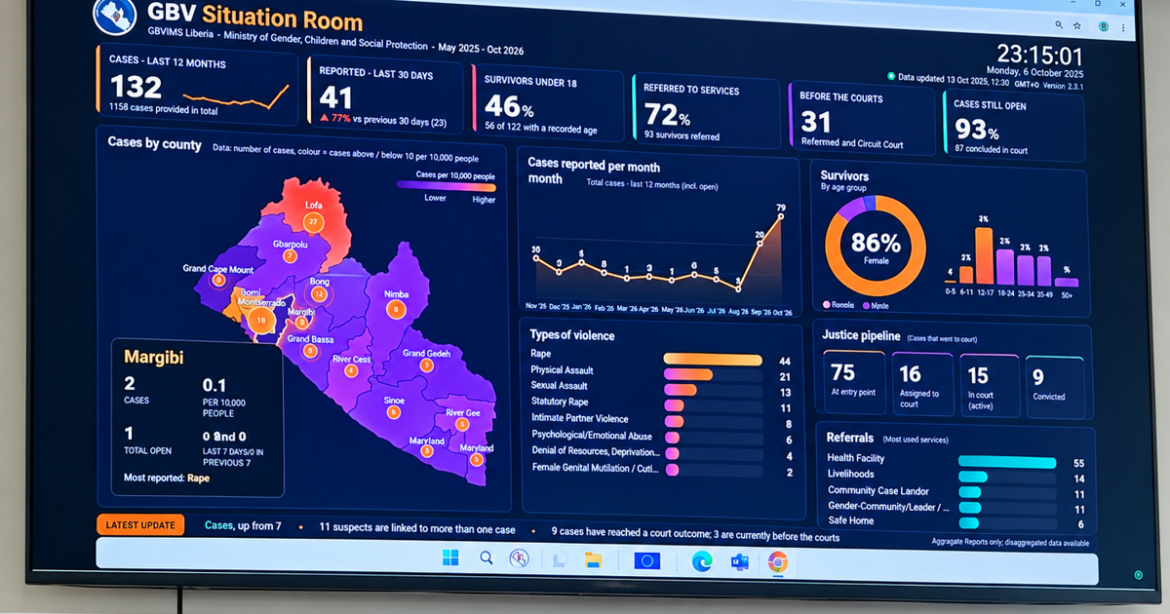
The Government of Liberia, in partnership with the United Nations Population Fund (UNFPA), the European Union (EU), and other development partners, has launched an upgraded Gender-Based Violence Information Management System (GBVIMS) aimed at strengthening data management, improving institutional coordination, and enhancing services for survivors of gender-based violence across the country.
The upgraded system is designed to establish a standardized approach to documenting incidents of gender-based violence, managing sensitive information, and coordinating referrals among healthcare providers, social workers, legal practitioners, security institutions, and other service providers.
Speaking at the launch, UNFPA Country Representative Dr. Mady Baiye described the initiative as a major milestone in Liberia’s efforts to protect human dignity, strengthen accountability, and improve the response to violence against women and girls.
“Today, we are not just deploying a database; we are launching a vital tool for end-to-end accountability for women and girls across Liberia,” Dr. Baiye said.
He emphasized that the system goes beyond technology, offering a practical mechanism for identifying gaps in service delivery, directing resources where they are most needed, and ensuring that survivors receive timely and appropriate assistance.
According to Dr. Baiye, gender-based violence remains a pervasive human rights violation in Liberia, with an average of four women and girls reportedly raped daily, three of whom are adolescents.
He also raised concerns about the limited access to timely medical care following rape, noting that only 47 percent of women and girls raped over the past five years reportedly sought assistance within 72 hours, while 31 percent of those raped received post-exposure prophylaxis (PEP) within the same period.
The figures, he said, underscore the urgent need to strengthen referral systems, improve access to healthcare, and ensure that survivors are not subjected to unnecessary delays when seeking medical attention and other essential services.
Dr. Baiye stressed that behind every statistic is a person in need of safety, medical care, psychosocial support, and justice.
He explained that the absence of safe, standardized, and reliable information management systems has historically constrained institutions’ ability to identify weaknesses in the response to gender-based violence, allocate resources effectively, develop evidence-based prevention strategies, and measure the impact of interventions.
The upgraded GBVIMS is expected to address these challenges through standardized incident reporting, survivor-centered case management, secure information handling, and evidence-based decision-making.
Dr. Baiye said a common system for recording and managing information would help service providers coordinate referrals more effectively, improve response times, and identify gaps requiring immediate attention.
However, he cautioned that collecting information alone would not end gender-based violence without decisive action from the institutions responsible for prevention and response.
“Data alone does not end gender-based violence—action does. But with the GBV-IMS, our actions will be smarter, faster, more targeted, and significantly more impactful,” he said.
United Nations Resident Coordinator in Liberia Christine Umutoni described the launch as a landmark achievement in the country’s efforts to prevent and respond to gender-based violence.
She said the platform would strengthen coordination among institutions providing services to survivors while helping the government and its partners better understand patterns of violence and assess the effectiveness of their interventions.
Umutoni noted that fragmented reporting and the absence of unified information had made it difficult to develop a comprehensive picture of gender-based violence and ensure accountability across the response system.
“When we lack unified and standardized data, when we cannot track the patterns of violence, and when we cannot measure the impact of our interventions, we operate in the dark,” she said.
According to her, the GBVIMS will support prevention, detection, and response by providing a standardized framework for collecting and aggregating information while safeguarding survivors’ confidentiality and dignity.
On prevention, Umutoni said reliable data would enable institutions to identify emerging trends, recognize populations facing heightened risks, and direct public awareness campaigns and other interventions toward communities where they are most needed.
She added that the information could help authorities identify emerging forms of violence and develop more targeted approaches to prevention.
Regarding response, the UN Resident Coordinator said the system would improve coordination among healthcare providers, psychosocial support services, legal institutions, and security agencies, helping survivors navigate the services available to them.
She called on law enforcement officers, healthcare workers, social workers, judicial officials, and civil society organizations to uphold the highest standards of data integrity, confidentiality, and survivor care.
Umutoni also commended the Ministry of Gender, Children and Social Protection for leading the initiative, UNFPA for its technical assistance, and the European Union for supporting the effort through the Spotlight Initiative 2.0.
She emphasized that the system’s long-term success would depend on institutions using the information responsibly and translating it into practical measures that improve protection and support for survivors.
Gender, Children and Social Protection Minister Gbeme Horace-Kollie welcomed the upgraded system, describing its launch as a historic achievement in Liberia’s efforts to address gender-based violence.
The minister expressed appreciation to UNFPA, the European Union, other United Nations agencies, civil society organizations, and national institutions for their contributions to the initiative.
She also commended the joint technical team, consultants, and officials who worked to develop and finalize the platform.
Horace-Kollie said the government was grateful for the partnership and expressed confidence that the system would be effectively used to strengthen coordination and improve the country’s response to gender-based violence.
She disclosed that data collectors and other personnel associated with the system had undergone training before the official launch, with refresher training expected to continue to strengthen their capacity.
The minister said sustained cooperation among government institutions, development partners, and frontline service providers would be essential to ensuring that the platform delivers practical benefits to survivors and communities.
As part of the launch, Dr. Baiye formally handed over assorted Information and Communications Technology (ICT) equipment to the Ministry of Gender, Children and Social Protection to support the operation of the upgraded GBVIMS.
The donation includes four laptop computers, one data server and its accessories, 40 tablets, 60 solar power banks, networking devices and accessories, and the installation of high-speed internet with a one-year subscription.
Dr. Baiye said the equipment was intended to strengthen the ministry’s technical and operational capacity to collect gender-based violence data, manage cases, and coordinate responses more efficiently.
He emphasized that reliable digital infrastructure and effective information management were essential to sound governance, evidence-based policymaking, and improved service delivery, particularly for women, adolescent girls, and other vulnerable populations.
The equipment is also expected to support timely data collection, improve coordination mechanisms, and help extend services to communities across Liberia’s 15 counties.
Dr. Baiye urged the ministry to use the donated assets strategically to improve institutional performance, safeguard sensitive information, and strengthen the delivery of social protection services.
He reaffirmed UNFPA’s commitment to working with the government and civil society organizations to reduce gender-based violence and harmful practices against women and girls.
The UNFPA representative also praised the European Union for its strategic partnership through the Spotlight Initiative, which supported the agency’s technical assistance in developing the information management system.
He extended appreciation to the Ministry of Gender, national institutions, civil society organizations, frontline service providers, and the technical team for their contributions.
See more Liberia News Network stories in Google Search by adding LNN as one of your Preferred Sources.
★ Add LNN as a Preferred Source