
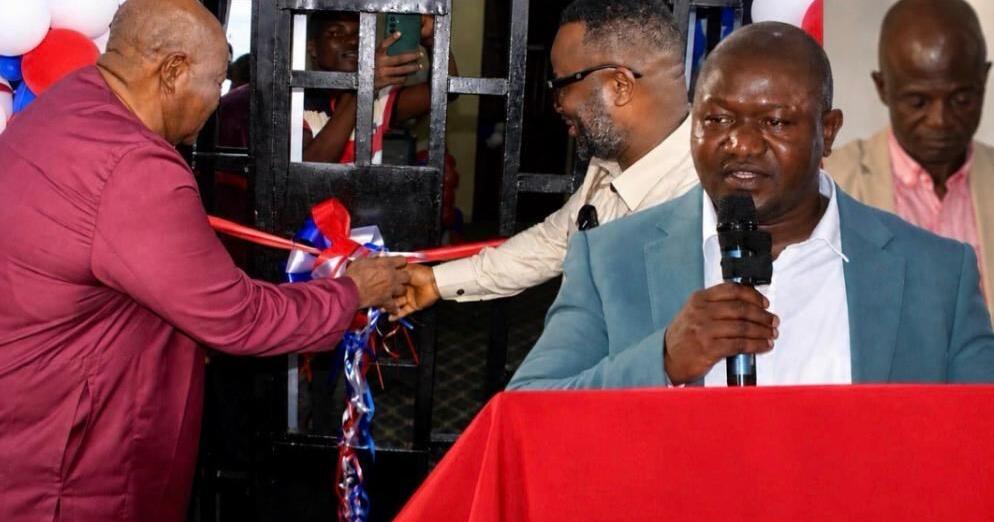
The dedication of the newly renovated headquarters of the Agricultural and Industrial Training Bureau (AITB) has placed Liberia’s technical and vocational education and training (TVET) system at an important crossroads: whether the country can move from producing certificates to producing the skilled workforce its economy actually needs.
The central message emerging from the ceremony was clear. Infrastructure alone will not transform Liberia’s workforce. The real test of the AITB’s renewal will be whether its programs produce competent Liberians who can secure employment, create businesses and meet the changing demands of agriculture, industry and the wider economy.
Representing senior government officials at the dedication, speakers from the Office of the President and Vice President Jeremiah Kpan Koung framed the AITB’s rehabilitation as part of a broader human-capital agenda under the ARREST Agenda for Inclusive Development (AAID).
AITB Director General Abraham Billy, meanwhile, went further, placing the institution’s own credibility under scrutiny and challenging government, industry, training institutions and development partners to collectively close the gap between education and economic opportunity.
Delivering remarks on behalf of the presidency, the Senior Advisor to the President, Dr. Augustine Konneh, presented the renovation as an opportunity to revive the original national purpose of the AITB.
He reminded participants that the institution was established in 1981, following People’s Redemption Council Decree No. 56, as the technical and administrative secretariat of the National Council for Vocational/Technical Education and Training.
Its mandate included occupational and trade standards, curriculum development, apprenticeship, testing and certification, vocational guidance, agricultural and rural retraining and supervisory training.
The historical significance of that mandate, according to the presidential representative, is that Liberia recognized more than four decades ago that economic transformation could not be achieved through academic education alone.
“Today, therefore, we are dedicating much more than a renovated building,” Dr. Konneh, who proxied for the Minister of State for Presidential Affairs Samuel A. Stevquoah, said. “We are renewing an institution whose original mission remains profoundly relevant to the Liberia we are trying to build today.”
The government’s message was not simply that AITB needed better offices. It was that Liberia needs an institution capable of translating national economic priorities into practical occupational competencies.
The President’s Office therefore linked AITB’s renewed role to the AAID’s emphasis on agriculture, education and human-capital development.
Modern agriculture, he argued, requires mechanics, irrigation technicians, food processors, machine operators, electricians, refrigeration specialists, agribusiness managers and digitally skilled entrepreneurs.
Similarly, mining, construction, energy, manufacturing, transportation, hospitality and information technology will require increasingly specialized Liberian workers.
The implication is straightforward—if Liberia’s economic ambitions are not matched by a deliberate skills-development strategy, many of the jobs created by investment could continue to be occupied by workers whose skills are better aligned with industry demands.
Koung: Human Capital Must Accompany Physical Development
The Vice President’s message, delivered by his Deputy Chief of Staff for Administration Dr. Macdonald M. Metzger, reinforced that argument from a broader national-development perspective.
Koung reportedly cautioned that Liberia’s development cannot depend exclusively on roads, bridges, electricity and other physical infrastructure.
The country must also invest in the people who will build, operate, maintain and expand those systems.
Agriculture, manufacturing, construction and energy were identified as areas requiring technicians, mechanics, electricians, welders, equipment operators and other skilled professionals.
This represents a significant shift in the way TVET can be viewed.
Rather than treating vocational education as an alternative for students who do not pursue university education, the messages from the presidency and vice presidency positioned TVET as an essential component of Liberia’s economic transformation architecture.
The question, therefore, is not whether Liberia needs TVET.
It is whether Liberia can build a TVET system sufficiently responsive to the needs of its economy.
Koung’s call for AITB to focus less on enrollment and certificates and more on whether graduates can find employment, establish businesses and become self-reliant goes directly to that challenge.
It also places responsibility beyond AITB.
Employers must help define the skills they need. Training institutions must respond to those needs. The government must provide policy and regulatory leadership. Development partners must contribute technical expertise and resources.
In this model, TVET becomes a shared national responsibility rather than the responsibility of training institutions alone.
Billy’s Challenge: “Give Liberians Not Simply Certificates, But Competence”
If the presidential and vice-presidential messages established the policy direction, DG Abraham Billy provided perhaps the most direct assessment of the institutional challenge facing AITB.
Billy began by rejecting the idea that the renovated building itself represents the transformation.
“Today is not just opening a building,” he said. “It marks a transformation at the Agricultural and Industrial Training Bureau and in the TVET sector.”
Drawing on his own experience, Billy recounted spending years working to finance his education, including operating a small business after secondary school.
His personal story was used not merely as biography, but as an illustration of the larger structural challenge facing young Liberians.
“Education without opportunities creates, raises, and leads to the conditions that our country struggles with,” he said, arguing that young Liberians continue to seek opportunities while confronting a mismatch between their skills and the demands of the labor market.
That mismatch, Billy suggested, is where AITB must intervene.
Billy is effectively arguing that AITB’s legitimacy must ultimately be judged by outcomes rather than activities.
“Success must never be measured simply by the number of TVET trainees or certificates issued,” he said, “but by what is being done to transform training into opportunities.”
Billy therefore drew a direct line between institutional performance and economic outcomes:
“Better offices must produce better services. Better working conditions must produce greater productivity. Greater authority must produce greater accountability.”
Billy also pointed to weaknesses within the TVET system that could undermine the credibility of certification.
According to figures cited in his remarks, 59 percent of instructors teach outside their areas of expertise, 43 percent have limited experience, and 40 percent have not received professional development.
If these figures accurately reflect AITB’s findings, they highlight a problem that cannot be solved simply by renovating buildings.
A modern TVET system requires competent instructors, relevant curricula, functioning workshops and equipment, occupational standards, credible assessments and meaningful industry exposure.
Otherwise, the system risks producing graduates who possess certificates but lack the competencies those certificates are supposed to represent.
Billy captured the distinction in a particularly direct formulation, “We must give Liberians not simply certificates, but competence. Not simply training, but opportunity. Not simply skills, but pathways to productivity and better lives.”
This is the heart of the AITB reform message.
From Classroom to Workplace
Both Dr. Konneh and Metzger, as well as DG Billy converged around one major solution—stronger industry involvement.
The presidential representative proposed a National Skills and Labor Market Partnership through which AITB would regularly consult employers across agriculture, mining, construction, energy, manufacturing, hospitality, transportation and technology.
That would allow curricula to respond to actual labor-market demand rather than assumptions about what young people should be taught.
The government also called for rebuilding a national apprenticeship and work-based learning system.
This could be particularly important for the country. A young person trained as an electrician, welder, mechanic, refrigeration technician or agricultural equipment operator needs more than classroom instruction. Employers need confidence that the graduate can perform the task safely and effectively.
Industry participation can therefore become a bridge between training, experience and employment.
Billy similarly called on companies and private-sector leaders to participate in designing programs, providing internships and creating entry points for graduates.
The message is that businesses should no longer view TVET as somebody else’s responsibility.
If companies complain that graduates lack the skills they need, they also have a stake in helping define and shape those skills.
Another important component of the government’s message was the proposed Agriculture-to-Industry Youth Skills Initiative.
Dr. Konneh argued that agriculture must increasingly be presented to young Liberians not merely as subsistence activity, but as business, technology and industry.
That means training must extend beyond farming itself into mechanization, equipment maintenance, storage, refrigeration, processing, packaging, quality control, marketing and entrepreneurship.
This aligns closely with the government’s emphasis on agribusiness under the AAID.
It also reflects an important reality: agricultural transformation requires an entire technical ecosystem.
A modern farm requires machinery technicians. A food-processing facility requires electricians and equipment operators. Cold-storage systems require refrigeration specialists. Agricultural enterprises require accounting, marketing and logistics.
The opportunity for AITB, therefore, is to position TVET at the center of the agricultural value chain.
Perhaps the strongest convergence between the Office of the President, Vice President Koung and DG Billy was their rejection of certificate-counting as the principal measure of success.
The presidential representative proposed graduate tracking, employment placement, entrepreneurship support, mentorship and links to financing.
Billy similarly argued that the ultimate question is whether graduates can perform the skills they have acquired and whether they can find productive opportunities.
This introduces a much more demanding standard for TVET performance.
So, the dedication of the AITB headquarters therefore carries a significance beyond the physical facility. It represents renewed attention to human capital and workforce development. It also reinforces the argument that physical infrastructure must be matched by investment in people.
It represents, for Billy, an institutional test as to whether AITB can use its renewed capacity to restore confidence in Liberia’s TVET system.
His call for standards, licensing, competency-based training, trade testing, certification and monitoring is particularly significant because trust is central to the value of any qualification.
“If the quality of the TVET programs improves,” Billy argued, graduates can become more employable.
But improving quality requires sustained investment.
See more Liberia News Network stories in Google Search by adding LNN as one of your Preferred Sources.
★ Add LNN as a Preferred Source