
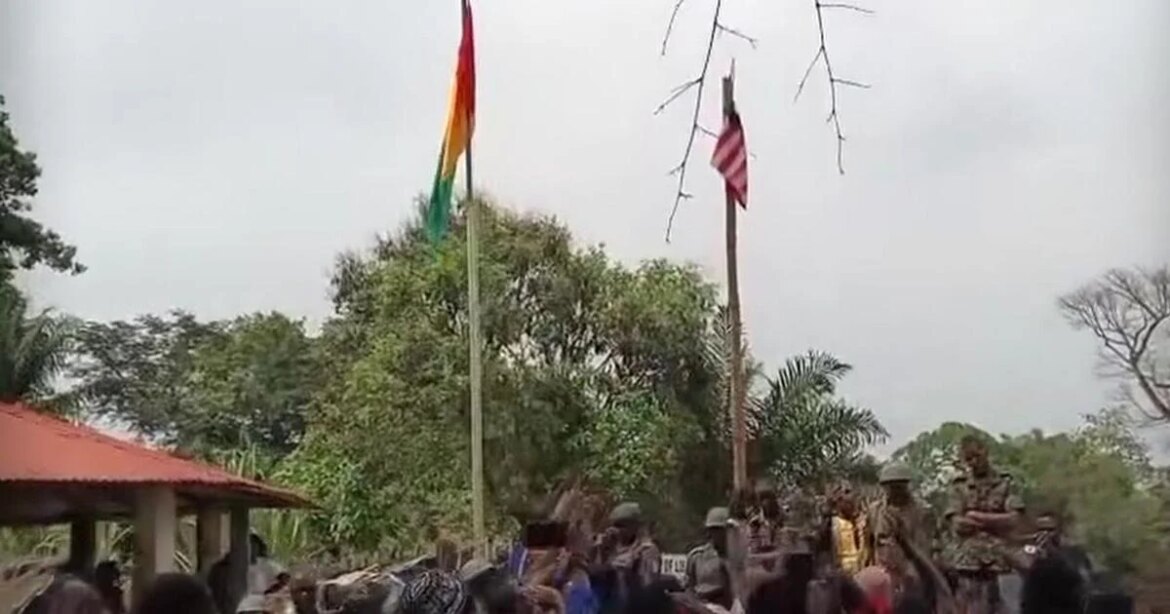
The withdrawal of Guinean troops from a disputed border point in Lofa County has eased immediate tensions along the Liberia–Guinea frontier, but President Joseph Nyuma Boakai is continuing consultations with the Legislature, signaling that the government still regards the incident as a serious national security matter.
Authorities in Monrovia confirmed that Guinean forces have pulled back from the Sorlumba border area, where soldiers had earlier removed the Liberian flag and raised Guinea’s flag in what Liberian officials described as an assertion of territorial claim. The pullback followed diplomatic engagement between officials of the two neighboring countries.
Despite the withdrawal, the Liberian government has maintained a posture of constitutional vigilance.
President Boakai, in his capacity as Commander-in-Chief of the Armed Forces of Liberia, convened consultations with leaders of the 55th Legislature shortly after the incident—an action observers say indicates that the administration is treating the episode not merely as a diplomatic misunderstanding but as a matter with national defense implications.
Under Liberia’s 1986 Constitution, responsibility for national defense is shared between the Executive and the Legislature. Article 34 grants lawmakers’ authority to provide for the security of the Republic, raise and support the armed forces, and declare war where necessary. The President, meanwhile, directs the country’s military response as Commander-in-Chief.
Political analysts say the decision to involve lawmakers places the matter squarely within Liberia’s constitutional national security framework.
“When a president begins consultations with the Legislature over a foreign military incursion, it generally indicates that the matter has moved beyond routine diplomacy into the national defense decision-making space,” one legislator said.
The House of Representatives has already voted to summon Liberia’s Joint Security apparatus to appear before plenary for hearings on the incident.
Although officials say the withdrawal of Guinean troops has reduced the immediate risk of confrontation, the consultations with lawmakers suggest that the Liberian government is continuing to evaluate the broader implications of the episode.
Historical Sensitivities Along the Makona Frontier
The Makona River, which marks much of the boundary between Liberia and Guinea, has long been one of the most sensitive frontiers in the Mano River region. Large portions of the boundary were loosely defined during the colonial era, leaving sections poorly demarcated and occasionally contested.
Border tensions have surfaced periodically over the years.
In 2010, Guinean troops reportedly raised their flag in another area of Lofa County during a separate dispute, triggering diplomatic engagement between the two governments.
Residents in the region say such incidents revive long-standing anxieties about territorial claims.
A Liberian journalist who grew up near the border described the latest standoff as echoing patterns familiar to communities along the frontier.
“All through my childhood in Lofa, the Makona River was the boundary between Liberia and Guinea,” he said. “To now threaten people and ask them to leave land they have always known as their home is deeply troubling.”
Guinea’s Posture Under Doumbouya
The confrontation has also drawn attention to Guinea’s evolving political posture under Mamady Doumbouya, who rose to power following a 2021 coup before later transitioning into the presidency.
Security analysts say military-led governments sometimes adopt assertive positions in territorial matters as part of broader efforts to consolidate domestic authority.
The Liberia–Guinea incident has also drawn comparisons to the long-running territorial dispute between Guinea and Sierra Leone over the border town of Yenga, where Guinean troops maintained a controversial presence for years.
Such precedents have prompted some regional observers to caution that border incidents, even when quickly defused, can leave lasting diplomatic questions.
Government Urges Calm
For now, the Liberian government says diplomacy remains the primary channel for resolving the situation.
In a statement issued through the Ministry of Information, authorities urged citizens to remain calm while discussions with Guinean officials continue.
“The Government assures all citizens and residents that it has taken seize of the situation unfolding along the Liberia–Guinea border and is actively engaging the matter through established diplomatic channels,” the statement said.
A high-level inter-ministerial delegation—including officials from the Ministries of Defense, Foreign Affairs, Justice, and Local Government—has been dispatched to engage Guinean authorities.
Officials also urged citizens to avoid spreading unverified reports that could inflame tensions.
A Test for Future Relations
While the withdrawal of Guinean troops appears to have defused the immediate confrontation, the episode has reopened broader questions about border management and long-term relations between Liberia and Guinea.
Liberia currently serves as a non-permanent member of the United Nations Security Council, a role that places the country within ongoing international discussions about conflict prevention and regional stability.
Security analysts say the government’s response—combining diplomatic engagement with constitutional consultation—reflects an effort to balance restraint with preparedness.
“Restraint should not be mistaken for weakness,” one analyst said. “Diplomacy backed by readiness is often the strongest signal a government can send.”
For communities along the border, however, reassurance remains the most immediate concern.
During the height of the standoff, some families near Sorlumba reportedly began leaving their homes amid fears of escalation.
“What people want most right now is reassurance,” a community elder said. “They want to know that their government will protect them.”
Although the immediate confrontation may have eased, the incident has underscored the strategic importance of Liberia’s frontier regions—and the continuing need for vigilance along borders where history, geography, and politics often intersect.
