
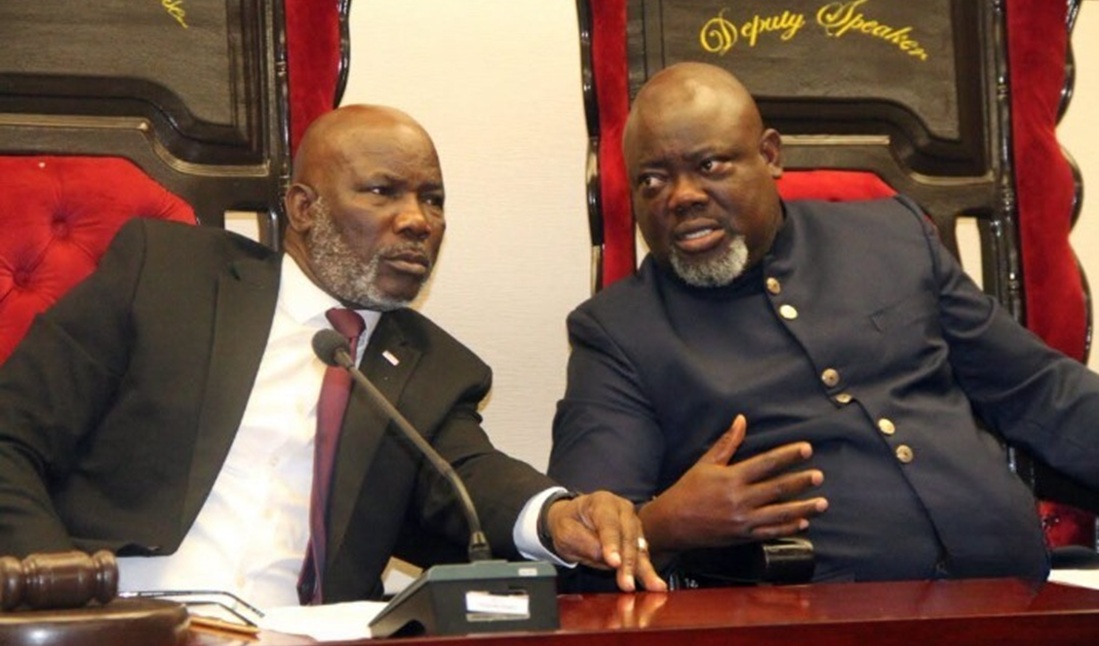
MONROVIA, LIBERIA – Liberia’s House of Representatives is staring down another potentially bruising leadership crisis, as discontent over unpaid legislative benefits and alleged financial misconduct threatens the positions of Speaker Richard Nagbe Koon and his deputy, Thomas P. Fallah.
What started as growing frustration over unpaid benefits has reportedly turned into a coordinated challenge against the House leadership.
Members of the so-called Reformists Movement have been holding separate meetings to question how legislative funds are managed and are pursuing a 12-count resolution aimed at removing both presiding officers.
At least 40 lawmakers are said to have gathered in Paynesville on Friday, October 9, reportedly demanding the leadership’s removal.
While the allegations have not been independently verified, and attendance at the meeting does not necessarily indicate that all participants support the removal of the Speaker and his deputy, the political implications are clear: the House is facing a serious internal struggle at a time when the public expects its elected officials to resume legislative duties.
Fallah’s appeal: Benefits are overdue, but the work must continue
Amid the growing tensions, Deputy Speaker Fallah has delivered a message aimed at reconciliation, recognizing the concerns of lawmakers while encouraging them to return to the chamber.
In a message addressed to colleagues, Fallah conceded that concerns regarding the payment of legitimate benefits are valid and overdue.
“Your voices have been heard, and your call is both fair and justified,” he indicated.
He reassured lawmakers that, under Speaker Koon’s guidance, efforts are underway to engage the relevant government institutions to ensure that the outstanding benefits are processed and paid.
He described the feedback from these discussions as encouraging and expressed optimism that the issue would be resolved soon.
Howbeit, underlying this reassurance was a more pressing appeal: a request for lawmakers to end their absence from the chamber and resume their legislative responsibilities.
“As we have entered the third quarter of our third session, I humbly plead with all colleagues to return to work,” Fallah urged.
His message seems designed to ease an increasingly challenging situation where leadership must tackle not only financial grievances but also the risk that opponents could leverage their numbers to disrupt regular proceedings.
“The benefits will come, but the work of Liberia cannot wait,” he emphasized.
This statement positions Fallah in a complex political balancing act: recognizing the concerns of his colleagues while upholding the continuity of the leadership he shares with Koon.
The money dispute that threatens to shake the Capitol
At the center of the conflict is a call for clarity regarding legislative funds, the benefits received by lawmakers, and the management of House resources.
Reports on the Reformists’ proposed 12-count resolution indicate it raises serious allegations of financial mismanagement, alterations to budget allocations, and concerns about funds and allowances related to constituents.
Lawmakers have claimed that over US$5 million in legislative funds and benefits have not been properly accounted for.
While these are serious claims, they remain just that—claims. The available public information does not prove that Koon, Fallah, or other officials have misappropriated any money, and no assumptions of wrongdoing should be made without proper documentation and a thorough investigation.
The dispute also touches on benefits that lawmakers say were included in the budget but have not been delivered to them.
These benefits reportedly encompass constituency visitation, district project funding, fuel allowances, and medical allowances.
Bong County District #6 Representative Moima Briggs Mensah has confirmed that several issues regarding lawmakers’ benefits are still unresolved.
Representative Dorwohn Twain Gleekia, co-chair of the House budget committee, has also recognized that these concerns warrant attention, while insisting that delays in quarterly government releases do not automatically imply that funds will not be provided.
Thus, the dispute is not merely about lawmakers’ dissatisfaction; it revolves around whether the House leadership can offer a credible explanation for the contested payments, clarify what has been disbursed and what is still pending, and rebuild trust among its members.
For the Reformists, the demand is for accountability, while for the leadership, the pressing challenge is to ensure that this dispute does not hinder the functioning of the institution.
A rebellion with the numbers to block business – but not necessarily remove the leadership
The arithmetic in the House gives this confrontation its immediate importance.
Liberia’s House of Representatives consists of 73 members. According to Article 33 of the Constitution, a simple majority—37 members—is necessary for a quorum.
The attendance sheet from Friday’s separate meeting showed around 40 lawmakers present. If that number remains consistent and those members continue to skip regular sessions, the House may find it difficult to gather the attendance required to conduct its business.
Howbeit, the process of removing the Speaker or Deputy Speaker for cause is a different issue. A two-thirds majority, which amounts to 49 members, is needed for that action.
Therefore, the reported 40–41 supporters would not meet that requirement if they all supported the removal resolution.
The current situation could hinder the House’s ability to operate normally without necessarily generating enough votes to oust either presiding officer.
Consequently, Tuesday’s scheduled session is a significant test of whether the leadership can rally enough lawmakers back into the chamber.
Failing to establish a quorum would exacerbate the crisis, potentially delaying legislative work and raising further doubts about the leadership’s capability to manage a divided House.
The irony of a political playbook returning to haunt its authors
The current confrontation echoes the intense struggle that took place in the House back in 2024, when a group of lawmakers challenged then-Speaker J. Fonati Koffa and ultimately succeeded in electing Koon as his successor.
That period was characterized by competing meetings, disputed authority, and a prolonged sense of institutional instability.
In April 2025, the Supreme Court upheld Koffa’s role as the legitimate Speaker in its ruling regarding the conflict.
Koffa then resigned in May, and Koon was elected as Speaker the very next day.
Now, we see a similar type of political pressure—organized meetings outside the usual chamber and the threat of members not showing up—playing a crucial role in the current leadership crisis.
While the situations are not exactly the same, the current allegations need to be evaluated on their own merits.
Howbeit, the reemergence of quorum politics highlights how internal rifts can hinder the legislature’s work, even when no leadership transition has occurred.
This current dispute is particularly notable because some lawmakers involved in the new challenge were previously part of the coalition that helped bring Koon to power.
The alliance that once solidified his leadership now seems to be experiencing significant divisions over issues like funding, administration, and political trust.
The Vice President’s intervention and the narrowing window for compromise
The confrontation has caught the attention of the executive branch, as the protesting lawmakers reportedly met with Vice President Jeremiah Kpan Koung prior to the House’s reopening.
Multiple sources have revealed that VP Koung gave both sides a week to settle their differences and assured them he would take their concerns to President Joseph Nyuma Boakai.
Howbeit, that timeframe lapsed on Saturday, October 10, without any public confirmation of a resolution.
This intervention highlights the potential national implications of the dispute. A prolonged impasse in the House could hinder discussions on the proposed 2027 national budget, which is one of the legislature’s central responsibilities at this time.
The pressing question now is whether the leadership and the Reformists can come to a credible agreement on how to address the contested benefits and financial issues before the conflict escalates into a long-term institutional standoff.
Fallah’s statement provides a chance for reconciliation, but simply calling for unity may not be enough for lawmakers who are seeking clear answers regarding the funds they claim are owed to them.
What happens next?
The coming sitting could be crucial in deciding if the confrontation stays as a political protest or escalates into a prolonged disruption of legislative activities.
If enough lawmakers return, the leadership might have a chance to reopen discussions, tackle the unresolved benefits, and create a clear process for examining the financial allegations.
Should the boycott persist, the House may encounter ongoing quorum issues, delays in its legislative agenda, and increased uncertainty regarding Koon and Fallah’s political standing.
Even if the Reformists can’t immediately gather the votes to oust the two officials, their reported numbers could provide them with significant leverage over the chamber’s functionality.
For Koon and Fallah, the challenge is twofold: to maintain the House’s ability to operate while also credibly addressing the allegations that have undermined trust among members.
For the lawmakers who are protesting, the task is to back up their claims and figure out if their movement is unified around a call for financial accountability, a leadership change, or both.
Meanwhile, for the Liberian public, the implications go beyond the internal power struggle within the Capitol.
The House is anticipated to examine public spending, discuss national priorities, and represent constituents whose needs don’t cease when lawmakers engage in political disputes.
A House divided, a nation waiting
Fallah’s message concludes with a call for unity and nation-building.
Howbeit, the ongoing crisis indicates that achieving true solidarity will require more than just words. The unresolved issue of unpaid benefits demands clear answers. The financial allegations need substantiation and a thorough investigation. The leadership challenge must follow legal protocols.
Additionally, the House must show that its internal conflicts will not indefinitely hinder its constitutional duties.
The reported attempts to oust Koon and Fallah have not yet resulted in a definitive leadership change, nor have the accusations against them been substantiated.
What is evident is that the House is now in a critical phase where attendance, accountability, and political trust will be key in determining whether its leaders can effectively manage proceedings.
The upcoming session may not resolve all questions regarding finances or leadership, but it will provide a crucial insight into whether Liberia’s House of Representatives can resume its functions or if the ongoing disputes over benefits and authority will lead to another extended crisis.
See more Liberia News Network stories in Google Search by adding LNN as one of your Preferred Sources.
★ Add LNN as a Preferred Source