
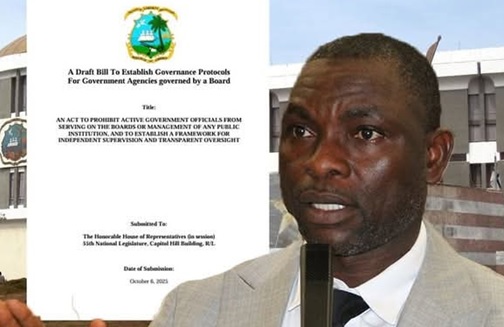
CAPITOL HILL, MONROVIA – The House of Representatives of Liberia has passed a significant piece of legislation aimed at strengthening governance and accountability across public institutions, approving “An Act to Prohibit Active Government Officials from Serving on the Boards or Management of Any Public Institution, and to Establish a Framework for Independent Supervision and Transparent Oversight.”
The decision, reached during the House’s sitting on Tuesday, March 17, 2026, followed the submission of a comprehensive report by the Committees on Judiciary and Good Governance. The joint committee recommended the passage of the bill after what lawmakers described as a thorough review of its provisions and implications for public sector governance.
The newly passed Act is designed to introduce clear and enforceable governance protocols for state institutions, particularly those managed by boards. Lawmakers say the legislation will help ensure that public entities operate with greater independence, efficiency, and transparency, free from undue political interference.
The draft law was introduced by Maryland County Electoral District #2 Representative, Anthony F. Williams, during the House’s First Day Sitting of the Third Quarter of its Second Session. In his communication to Plenary, Representative Williams underscored the urgent need to reform governance structures within public institutions.
According to Williams, the bill seeks to enhance effectiveness, oversight, accountability, and transparency by ensuring that institutions operate under strong and independent supervisory mechanisms. He argued that the absence of such safeguards has historically undermined public trust and weakened institutional performance.
A key provision of the Act targets conflicts of interest by prohibiting active government officials from serving on boards or participating in the management of public institutions. Lawmakers believe this measure will prevent officials from influencing decisions that could benefit them personally or politically.
The legislation also addresses the long-standing issue of double compensation, seeking to eliminate situations where individuals receive multiple payments for overlapping roles within government structures. Proponents say this will promote fairness while ensuring prudent management of public resources.
Beyond governance reforms, the bill is also expected to promote job creation by opening up board positions to a wider pool of qualified professionals. Lawmakers argue that fostering institutional independence will create more opportunities for skilled Liberians to contribute meaningfully to national development.
Additionally, the Act aims to expand funding opportunities for public institutions by enabling independent boards to attract and manage financial and development resources more transparently. This, officials say, could improve service delivery and enhance institutional sustainability.
Following its passage in the House, the legislation has been forwarded to the Liberian Senate for concurrence. The House has reaffirmed its commitment to strengthening governance systems in Liberia, signaling what many observers see as a decisive step toward promoting transparency and ensuring that public institutions operate in the best interest of the Liberian people.
