
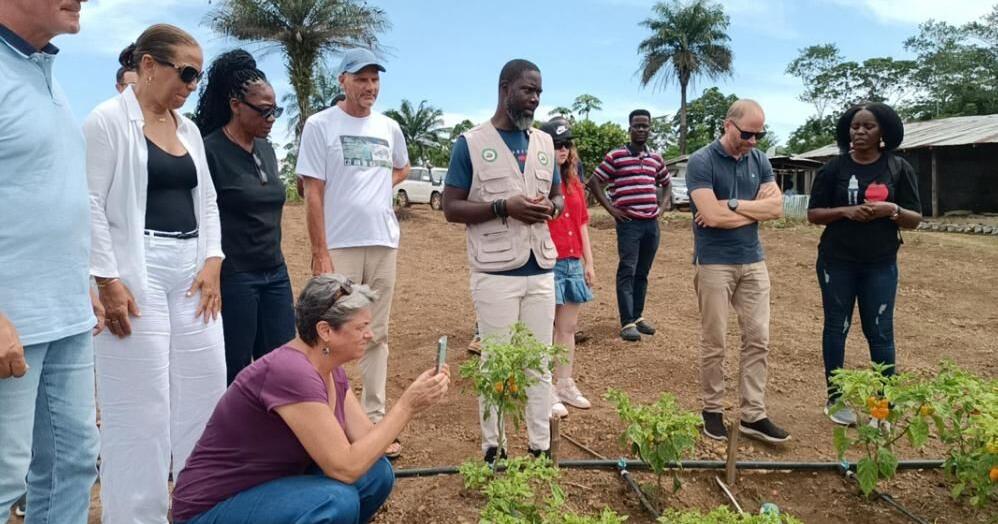
What began as a modest vegetable farm struggling with post-harvest losses has evolved into a case study in agricultural transformation—one now drawing the attention of European policymakers seeking scalable solutions to food insecurity.
A recent visit by European Union delegates, alongside Sweden’s Ambassador to Liberia, Karl Backéus, and representatives of Mercy Corps, to Dukuly International Farm was more than ceremonial. It was a strategic assessment of a locally driven model that is quietly reshaping Liberia’s food systems through skills development, market integration, and community-based support.
At the center of this transformation is Liberian agripreneur Khalil Dukuly, whose farm has transitioned from a production-focused enterprise into a regional training and aggregation hub.
“We started by training just 25 farmers,” Dukuly told visiting delegates. “Today, that number has grown to over 250, and they are now training others. That’s how systems change begins.”
Dukuly’s model is rooted in hard-earned lessons. In its early days, the farm faced a paradox common across Liberia’s agriculture sector: high production, low returns.
“We harvested up to 5,000 watermelons a day, but we couldn’t sell them,” Dukuly recalled. “Transport costs were equal to selling prices. Produce spoiled before reaching the market.”
This experience reflects a broader structural weakness in Liberia’s agricultural economy—where market access, not production, is often the binding constraint.
With support from Mercy Corps under a Sweden-funded initiative, Dukuly Farm pivoted toward a Market Systems Development (MSD) approach. The focus shifted from simply increasing yields to building entire value chains—linking farmers directly to buyers, improving logistics, and reducing post-harvest losses.
Today, the farm supplies institutional buyers including Bea Mountain Mining Corporation, major hotels, and supermarkets in Monrovia—effectively bypassing informal and inefficient market channels.
“Now everything we harvest goes straight to buyers,” Dukuly said. “That’s the difference between farming for survival and farming as a business.”
At the core of the intervention is technical capacity building. Through a six-month training program, farmers—many of them women—received hands-on instruction in land preparation and seedling production, transplantation techniques, integrated pest management and post-harvest handling.
For beneficiaries like Margaret Nigba-Gayedgu, the impact has been transformative.
“Farming looks simple, but it is not,” she said. “Without technical skills, you can invest everything and still fail. Now we have the knowledge—and the confidence—to succeed.”
Beyond training, the program emphasized sustainability through local ownership. Dukuly Farm functions as a continuous support hub—providing inputs, mentorship, and follow-up services long after formal training ends.
“We don’t just train and leave,” explained Rose Blidi Kansuah. “We built Dukuly as a system actor—someone who can sustain the ecosystem.”
EU Perspective: A Model Worth Scaling
For European partners, the visit was part of a broader evaluation of food systems interventions across West Africa. The farm’s integration into the “Team Europe” food systems initiative signals its alignment with global development priorities—particularly resilience, local ownership, and sustainability.
“What you’ve built here fits directly into our vision,” said Jeroen Witkamp. “This is not just a farm—it’s a system.”
Ambassador Backéus echoed that sentiment, emphasizing long-term impact:
“At some point, the project will end—but the skills you’ve gained will remain.”
Their remarks highlight a critical shift in development thinking: from aid dependency to capacity building.
Analytical Lens: Why This Model Matters
It matters because it bridges the Liberian agricultural paradox. The country has vast agricultural potential but struggles with productivity and commercialization. Dukuly’s model addresses this by linking skills + inputs + markets, rather than treating them as separate interventions.
The model also matters because it tends to shape the sector from donor projects focus to local systems initiatives. Unlike traditional projects that collapse after funding ends, this approach embeds sustainability through local leadership and ownership. Dukuly is not just a beneficiary—he is an ecosystem builder.
This model also reduces post-harvest losses which can exceed 30–40% in some value chains. By creating direct supply agreements and exploring storage solutions, the model tackles one of the sector’s most persistent inefficiencies.
It also ensures gender and inclusion gains as with strong female participation, the initiative contributes to inclusive agricultural growth, a key pillar of Liberia’s development agenda.
Despite its successes, the model is not without limitations. Livestock farmers in Bomi County voiced concerns that support remains heavily skewed toward crop production.
“We see support going to vegetable farmers, but livestock farmers are struggling,” one farmer noted, citing high feed costs and lack of veterinary services.
This points to a broader policy challenge: sectoral imbalance within agricultural interventions.
The visit comes at a time when global food systems are under strain—from climate shocks to funding cuts. According to Mercy Corps, the organization reaches over 37 million people worldwide but faces increasing pressure due to shrinking aid budgets.
In that context, Liberia’s emerging locally anchored, market-driven agricultural models offer a compelling alternative.
The Dukuly Farm story is no longer just about one entrepreneur—it is about policy direction.
If scaled nationally, this model could reduce rural poverty, strengthen food security, create jobs for youth and women and position agriculture as a viable economic engine.
But scaling will require coordinated investment in infrastructure, storage, financing, and inclusive sector support.
As Liberia seeks to reposition agriculture at the center of its development strategy, the lessons from Bomi are clear that productivity alone is not enough—systems matter.
“The end result must always be productivity,” Dukuly said. “But productivity must connect to markets.”
The EU visit may have been brief, but its implications are long-term. What delegates saw in Bomi was not just a farm—it was a blueprint for transforming the country’s food systems from subsistence to sustainability.
