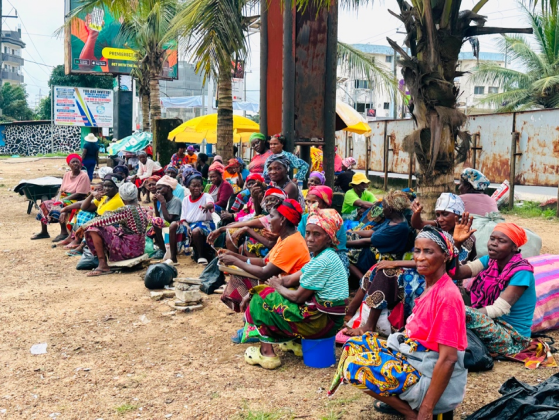
Members of Vamoma group seeking assistance in Monrovia. Photo: Fatu A. Kamara
Summary
- As Liberia’s economy shows signs of recovery on paper, soaring food and fuel prices, worsened by a government fuel surcharge and new health care fees imposed after US aid cuts, have outpaced wage growth.
- Ten Liberians interviewed in Monrovia say growing unemployment, lost livelihoods and financial hardship in the last two years have pushed them to depend on strangers and charitable support to survive.
- Humanitarian organizations and government say they are seeing growing demand for assistance as families struggle with food, school fees, healthcare and other basic needs.
BROAD STREET, Monrovia – It has been a long day for Joseph. The sun is beginning to set, and the 48-year-old father of three has been trawling the streets of Monrovia since morning, asking for money.
On most days, he begs for money to feed his family. Today, he can’t even raise enough to get home to Brewerville, on the outskirts of the city.
“Since this morning, nobody has given me a dime,” he says.
Joseph lost his job in waste management in 2025 after the death of his boss. A high school graduate who earned L$10,000 (US$55) monthly, he spent about a year looking for another job without success.
He says he now has two options: begging or stealing. “It is not fair for me to be begging people in the streets, but I will not go to steal.”
Joseph is one of 10 people interviewed for this story who said they began begging within the past two years. Most said they had no jobs, had lost sources of income or lacked money to start a business. (FrontPage Africa/New Narratives is withholding the names of people in this story to protect them from stigma.)Liberia’s economy grew 5.1 percent in 2025, according to the African Development Bank, a jump from years before, but most families haven’t felt it. Growth came mostly from mining royalties to government, not job creation, and extreme poverty still rose to 35.8 percent.
The crisis deepened when the Trump administration canceled 27 of 29 USAID programs in Liberia in May 2025, cutting nearly US$360 million from health and education. Large cuts by other donors followed too. The government responded by adding a $0.25 per gallon petroleum surcharge and implementing new patient fees for healthcare. For families already struggling to afford food, the surcharge pushed up transport and food costs, and the hospital fees have deterred many from going for treatment or crippled them financially when they face emergencies.
Baba Conteh, an economist, says economic recovery has not translated into meaningful jobs and stable incomes for ordinary households. Aid cuts have trickled down throughout the economy.
“Job loss is one of the most common pathways into poverty,” Conteh says, particularly when the loss continues long enough for families to exhaust their savings and sell productive assets.
In extreme cases, he says, people may become homeless, engage in high-risk survival activities, depend heavily on public charity or even resort to committing crimes.
That is exactly what is happening. At Vamoma house on Tubman Boulevard, in Sinkor, Esther Kamara leads a group of widows, elderly people and people with disabilities who gather to seek assistance. She says the group had about 280 members in 2024 and has since grown by 50.
People living in poverty gather at Vamoma house, on Tubman Boulevard, in Sinkor
“I have even started refusing people because the number just getting plenty and no help is coming,” Kamara says.
After more than a decade of leading the group, Kamara says the past two years have been the toughest. “Many days the women come to me when they or their children are sick and no money to take them to hospital, so we just buy drugs and they take it,” she says. The drugs are usually antibiotics, bought without a prescription and taken with no medical guidance, making the child likely to build antibiotic resistance.
Support groups under pressure from growing demand
The pressure is being felt by organizations that provide assistance. Siakeh Foundation and Kimbo Foundation, two organizations working with vulnerable Liberians, say requests for help have doubled over the last two years.
Four Hunger, a U.S.-registered nonprofit in Liberia, reports an increase in requests from families who previously managed to meet at least some of their basic needs but now struggle with food, school fees, healthcare and other essentials.
“The growing demand has put considerable pressure on our resources. One of the most difficult parts is that we often receive requests we genuinely want to respond to but cannot fully meet,” says co-founder Windell S. King.
At Rescue for Abandoned and Children in Hardship, or REACH, Ne-Suah Livingstone, founder and executive director, says she has also seen families pushed into situations they previously managed to avoid.
“One case that remains with me involved a family whose daughter’s annual school fees were about US$1,000. Her father had previously worked on a USAID-funded project but lost his job after the projects ended.”
She says the fees were far beyond the reach of the small organization.
REACH receives about twice as many requests for assistance as it did two years ago.
“This is one of the hardest tasks I face every day,” says Livingstone. “To say to a person in dire need that neither I nor my organization is able to help you; saying this can be like you have asked me to hurt someone.”
“I won’t steal” but begging comes with humiliation
At Vamoma, Hawa, a 43-year-old widow with two children, says asking for help became a last resort after she lost her husband in 2024. She says her youngest child, 14, is still in school through support from her church. Her older child is at home because she has not found the money to keep him in school.
“People were mocking me in my community because I am poor,” Hawa says. “I felt embarrassed and I could not bear the shame anymore.”
She says Vamoma offers more than the possibility of receiving money or food.
“At least when I am among my friends and we are laughing, the stress goes down,” Hawa says. “I don’t know what I was going to do if I had not joined the group.”
For some members, the hardship goes beyond asking strangers for help. Kamara says some elderly and vulnerable people face stigma in their communities.
“You know when people are like this, you will not find any family member coming around them,” she says. “They can abandon them. Sometimes they call them witches and wizards.”
Larwuo, a member of Vamoma, stands in front of her home. She says she was abandoned by her son.
Last month one elderly member of the group died here. Kamara had to ask government to collect the body.
Government response constrained by limited resources
Officials at the Ministry of Gender, Children and Social Protection have observed the growing need but have little money to help.
“The key gap in addressing the issues affecting these vulnerable groups is limited resources, preventing the ministry from reaching them,” says Alex Divine, the ministry’s assistant director of Programs, Partnership and Resource Mobilization.
The government tried to reduce the rapidly growing number of street children, which hit 366,000 according to a survey in 2023, before the cost-of-living crisis escalated. Through its “Support a Child, Save the Future” initiative, launched in 2024 to remove children from the streets through school enrollment, family reunification and support for caregivers. The government has conceded that it did not raise any of the $15 million cost of the project from donors and only budgeted a total of $1.3m itself. The ministry came under public fire this month when an official posted the names of children who were allegedly helped on Facebook. Since then, the ministry has refused to share details. There has been no independent audit of the project.
Women share cooked food donated by the Jetty company.
“While existing programs provide critical support, the support is insufficient because it reaches a limited number of the overall vulnerable population across the country,” Divine says.
At Vamoma, the group has no permanent shelter. Kamara says members once put together sticks and zinc to create a small shelter, but police later dismantled it.
“When the rain is falling, some people cover themselves with plastic,” she says. “Sometimes you see people trembling with the cold. We are disappointed in our leaders because they are sitting down and the people dying.”
The only help comes in food donations from groups like the Indian company Jeety Rubber or Yamah Brown, a dry goods seller in Red Light, who recently donated two bags of rice.
“They are our mothers. They don’t deserve it, but condition made them like this,” Brown says. “We will continue to help as long as we can afford.”
While assistance is important, Kamara says they want something reliable.
“What we really want is jobs for members, especially the widows, people who are able to work,” she says. “Many of them are strong and able to work, but we all come here and sit from morning to night because there’s nothing to do. If we had jobs, we won’t be here.”
Joseph agrees that breaking the cycle of dependency requires opportunities beyond daily charity.
“Even if I can get money to start a business, I would be grateful,” he says. “And a man is only respected when he provides for his family.”
For now, as the sun sets, Joseph gives up finding enough money to get transport home. He sets out on foot for a walk that may take hours and will end with the faces of disappointed and hungry children. He will wake up tomorrow and try again.
This report is a collaboration with New Narratives as part of the “Investigating Liberia” project. Funding was provided by the Swedish International Development Cooperation Agency which had no say in the story’s content.
See more Liberia News Network stories in Google Search by adding LNN as one of your Preferred Sources.
★ Add LNN as a Preferred Source