
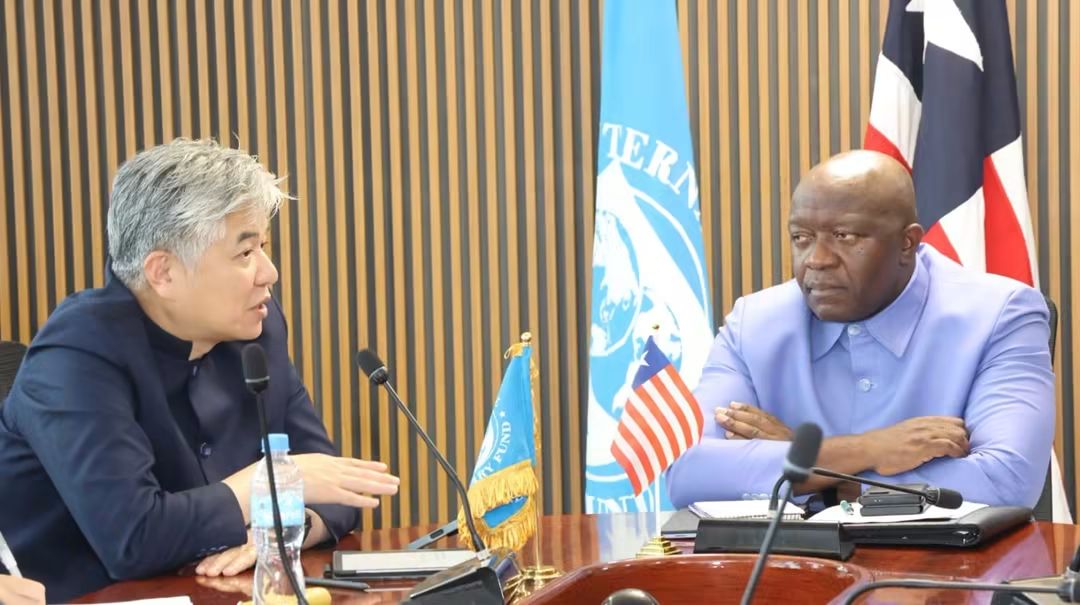
MONROVIA, June 26, 2026 – The International Monetary Fund (IMF) has projected Liberia’s economy to grow by 5.5 percent in 2026, citing continued macroeconomic stability, strong reform implementation, and expansion in key sectors, including mining, manufacturing, and construction.
The assessment was made by IMF Mission Chief for Liberia, Daehaeng Kim, at the conclusion of an IMF staff mission to Monrovia from June 10 to 23 to conduct the Fourth Review under Liberia’s Extended Credit Facility (ECF) Arrangement and the First Review under the Resilience and Sustainability Facility (RSF) Arrangement.
The IMF said Liberia has made “solid progress in macroeconomic stability,” with performance under the IMF-supported program remaining strong and broadly meeting agreed quantitative targets.
According to the Fund, economic growth in 2026 will be driven largely by increased iron ore production, continued manufacturing activity, and ongoing construction projects.
Despite rising global fuel prices, the IMF said inflation has remained relatively contained, increasing moderately to 5.3 percent in May 2026 from 4 percent at the end of 2025.
The Fund attributed the modest rise in inflation to exchange rate stability and limited pass-through effects from higher international fuel prices.
The IMF also praised the government’s commitment to maintaining fiscal and financial stability while expanding capital investments and targeted social spending.
It highlighted ongoing efforts to strengthen domestic revenue mobilization and said fiscal performance is expected to remain consistent with the objectives of the IMF-supported program.
The Fund further acknowledged the government’s investments in health, education, and social protection for vulnerable groups, noting that the initiatives are being supported by improved domestic revenue collection and a one-time US$200 million bonus payment, equivalent to about 3.5 percent of Liberia’s Gross Domestic Product (GDP).
Although Liberia’s current account deficit is expected to widen this year due to increased imports of fuel and capital equipment needed for mining expansion and infrastructure development, the IMF maintained that the country’s medium-term economic outlook remains positive.
Mr. Kim said IMF staff and the Liberian authorities held constructive discussions and reached a broad understanding on the policies underpinning the fourth review of the Extended Credit Facility-supported program, with discussions expected to continue in the coming days.
During the mission, the IMF delegation met with President Joseph Nyuma Boakai, Finance and Development Planning Minister Augustine Kpehe Ngafuan, Central Bank of Liberia Executive Governor Henry F. Saamoi, senior government officials, and development partners.
The Fund thanked the Liberian authorities and stakeholders for what it described as their hospitality and constructive engagement throughout the mission.
The IMF’s latest assessment is expected to boost investor confidence as Liberia continues pursuing economic reforms aimed at sustaining growth, keeping inflation under control, and expanding investment in critical social sectors. -Edited by Othello B. Garblah
