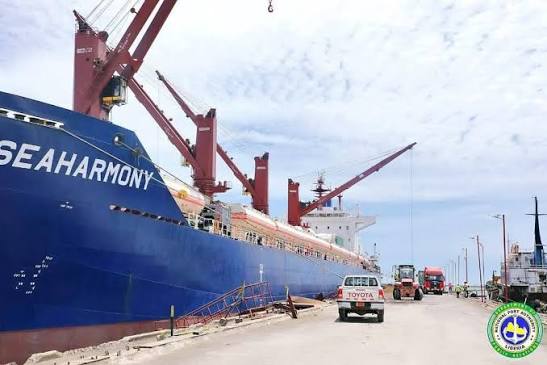
An investigation into vessel delays, container congestion, customs clearance and the growing pressure on the Freeport of Monrovia
MONROVIA, LIBERIA — Liberia’s Freeport of Monrovia is operating under increasing pressure as rising cargo volumes, prolonged container dwell times and delays in cargo clearance expose weaknesses across the country’s principal maritime gateway.
The available evidence does not support the simple conclusion that Liberia is experiencing a shortage of vessels.
As Liberian investigative Journalist Lyndon J. Ponnie, Sr. reports, official port statistics show continuing vessel activity, while port authorities and industry sources point to a different problem: the difficulty of moving cargo efficiently through the port once vessels arrive.
That distinction is at the heart of a developing congestion problem with potential consequences for importers, shipping companies, businesses and ultimately consumers.
According to investihation, the National Port Authority (NPA) recorded 177 vessel calls at the Freeport between January and July 2026, with approximately 3.4 million metric tons of cargo handled during the period. Imports accounted for approximately 2.06 million metric tons, compared with about 1.34 million metric tons of exports.
The figures indicate that maritime traffic remains active. But vessel arrivals tell only part of the story.
THE BOTTLENECK AFTER ARRIVAL
The more consequential question is what happens after cargo reaches the port.
In September 2026, the NPA established a Strategic Technical Committee on port congestion and cargo delays, bringing together the NPA, APM Terminals, the Liberia Revenue Authority, Ministry of Commerce, shipping lines, customs brokers, importers and truckers.
The decision to bring these actors together is significant because the congestion problem extends beyond the physical movement of ships.
The NPA has identified increasing container dwell times, rising yard occupancy and longer truck turnaround times among the problems requiring intervention.
Documentation and cargo-release delays have also been identified as contributors to congestion.
Industry reporting has separately cited vessels waiting offshore because of congestion at the container terminal. Those reports require continued verification by the responsible authorities, but they are consistent with the broader congestion concerns publicly acknowledged by the NPA.
The central issue is therefore not whether vessels are arriving.
It is whether the port can berth vessels, discharge cargo, clear containers and evacuate them quickly enough to maintain uninterrupted operations.
THE CONTAINER-YARD PRESSURE
A container terminal depends on space.
When containers arrive, they must eventually leave the terminal to make room for the next vessel.
If importers do not collect containers promptly, or if clearance procedures take too long, containers remain in the yard.
The consequence is straightforward: available space decreases.
When yard occupancy becomes sufficiently high, the problem can move upstream.
A vessel may arrive with cargo that cannot be immediately discharged because there is inadequate space to accommodate it.
This creates a chain reaction:
Cargo arrives → containers enter the yard → containers remain longer → yard capacity tightens → vessel operations become more difficult → delays increase → costs rise.
The NPA has acknowledged this pressure and is working with other stakeholders on the removal of overstayed and empty containers and improvements in yard management.
But the public needs more precise information.
What is the Freeport’s current maximum container capacity?
What percentage of that capacity is occupied?
How many containers have remained beyond the permitted free period?
How many are awaiting customs clearance?
How many have been cleared but remain because importers have not collected them?
And how many are empty containers awaiting evacuation?
Those figures would help determine where the principal bottleneck lies.
THE CUSTOMS CLEARANCE PROBLEM
One of the most significant indicators comes from the Liberia Revenue Authority.
The LRA has reported a cargo-clearance time of approximately 12 days and 19 hours, while identifying a target of reducing clearance to three days.
That gap is significant.
A port can have sufficient physical capacity, but if cargo remains inside the terminal for nearly two weeks awaiting clearance, effective capacity is reduced.
The question is therefore whether Liberia’s customs and port procedures are keeping pace with the volume of cargo entering the country.
The answer cannot be established simply by blaming Customs.
Cargo clearance involves documentation, payments, inspections, brokers, importers and multiple government procedures.
The investigation therefore requires a breakdown of where the 12-day-plus clearance period is actually spent.
How many hours are attributable to Customs?
How many to importers?
How many to documentation?
How many to physical inspection?
How many to payment?
How many to port procedures?
Without that breakdown, the public cannot determine which part of the system is responsible for the delay.
WHO BEARS THE COST?
Port congestion has an economic consequence.
When cargo remains at a terminal longer than expected, storage and related charges may accumulate.
When vessels remain delayed, shipping costs can increase.
When importers cannot obtain their goods on time, businesses may experience additional expenses.
And when the cost of bringing goods into Liberia increases, some of those costs may eventually be reflected in consumer prices.
The NPA has itself acknowledged concerns about storage and demurrage costs and their potential impact on consumers.
That makes demurrage an important area for further investigation.
How much demurrage are Liberian importers currently paying?
How much was paid in 2025?
How much has been paid during 2026?
Which categories of cargo generate the largest demurrage bills?
And, most importantly, what proportion of those costs results from delays caused by importers, Customs, terminal operations, shipping schedules or other factors?
Without this information, public discussion remains largely anecdotal.
APM TERMINALS: OPERATOR OR PART OF A LARGER SYSTEM?
APM Terminals Liberia operates the container terminal and therefore occupies a central position in the congestion debate.
But establishing responsibility requires distinguishing between terminal operations and the broader port system.
A terminal operator may control container handling and yard management without controlling Customs clearance, importer documentation, tax payments or the availability of trucks outside the terminal.
Conversely, congestion within the terminal can affect every other participant.
The appropriate investigative question is therefore not whether APM Terminals is responsible for congestion in general.
It is:
Which elements of the congestion fall within the terminal operator’s contractual and operational responsibilities, and which fall elsewhere?
The answer should be measurable against the company’s concession obligations and performance standards.
That documentation should be available for public scrutiny.
THE NPA’S RESPONSIBILITY
The National Port Authority remains the government institution responsible for the administration and management of Liberia’s port system.
Its responsibility therefore extends beyond counting vessels.
The NPA must ensure that the port’s infrastructure, navigation facilities and broader operating environment can support the country’s commercial needs.
The authority has identified dredging, infrastructure improvement, port modernization and operational efficiency as important areas requiring attention.
The Freeport’s age adds urgency to the discussion.
The facility was constructed during the Second World War and has since become Liberia’s principal commercial gateway.
The country’s economy, population and trading requirements have changed substantially since then.
The question is whether the infrastructure has changed quickly enough.
THE DEPTH OF THE HARBOR
One of the longer-term issues is dredging and navigational depth.
The NPA has identified dredging as an infrastructure priority, while Liberia’s 2026 National Infrastructure Conference report also identified dredging and quay rehabilitation at the Freeport among planned interventions.
This matters because global shipping has changed.
Modern vessels are larger and shipping lines increasingly seek ports capable of handling greater volumes efficiently.
Liberia cannot compete for larger vessels merely by advertising its geographic position.
It needs adequate channel depth, reliable berths, cargo-handling equipment, storage capacity, road connectivity and efficient clearance procedures.
THE EXPORT PARADOX
Liberia also faces a structural trade challenge.
During the first seven months of 2026, NPA figures show imports exceeding exports through the Freeport.
Approximately 2.06 million metric tons of imports were recorded compared with 1.34 million metric tons of exports.
This means the port remains heavily dependent on imported cargo.
A modern maritime strategy cannot focus exclusively on improving the movement of imports.
Liberia also needs to increase the volume and value of goods leaving the country.
Agriculture, rubber, minerals, timber and processed products could contribute to a stronger export base, provided the necessary production, infrastructure and market conditions exist.
A port that efficiently handles imports but lacks sufficient export cargo does not fully exploit its potential as a regional logistics and trading hub.
THE NUMBERS THE PUBLIC NEEDS
The congestion debate would benefit from greater transparency.
The NPA, APM Terminals, LRA and other responsible institutions should regularly publish comparable operational indicators.
These should include:
– Average vessel waiting time at anchorage.
– Average vessel turnaround time.
– Number of vessels waiting to berth.
– Container-yard occupancy.
– Average container dwell time.
– Number of containers exceeding the free period.
– Average Customs clearance time.
– Average truck turnaround time.
– Number of containers cleared but not collected.
– Number of overstayed and empty containers.
– Monthly demurrage and storage charges.
– Number of vessels affected by terminal congestion.
– Cargo throughput by month.
– Import and export volumes.
These indicators would allow the public to determine whether the problem is improving or deteriorating.
THE GOVERNMENT’S NEW TEST
The NPA’s establishment of a multi-stakeholder technical committee is an acknowledgment that the problem cannot be solved by one institution alone.
But a committee is not the solution by itself.
The public will ultimately judge the intervention by measurable outcomes.
If clearance time falls from more than 12 days toward the LRA’s three-day target, that would demonstrate progress.
If container dwell time falls, yard occupancy declines and truck turnaround improves, the pressure should ease.
If vessel waiting times decline, shipping reliability should improve.
But if the same problems persist, the government will need to explain why.
THE UNANSWERED QUESTIONS
This investigation leaves several questions requiring direct answers from the institutions responsible for Liberia’s maritime trade.
To the National Port Authority:
What is the Freeport’s current container and berth capacity?
How many vessels have waited offshore during 2026, and what has been the average waiting time?
How many vessels have experienced delays attributable specifically to terminal congestion?
To APM Terminals Liberia:
What is the current yard occupancy rate?
How many containers are currently beyond the permitted free period?
How many containers are awaiting Customs clearance?
How many containers have been cleared but remain inside the terminal?
What are the company’s average vessel and truck turnaround times?
To the Liberia Revenue Authority:
Why does cargo clearance currently take approximately 12 days and 19 hours?
Where exactly does the clearance process lose time?
What steps are being taken to reach the three-day target?
To the government:
When will dredging and quay rehabilitation be completed?
What investments are being made to increase the Freeport’s effective capacity?
What independent mechanism exists to monitor compliance with port performance standards?
And perhaps the most important question:
Is Liberia planning for the Freeport that the country has today, or for the larger trading economy it says it wants tomorrow?
CONCLUSION
The evidence currently available does not establish that Liberia is experiencing a shortage of ships.
It establishes something more complicated.
Vessels continue to call at the Freeport, while the NPA, LRA and industry participants acknowledge problems involving cargo clearance, container dwell time, yard occupancy and truck movement.
Independent port-monitoring data has also reported significant vessel waiting times, although those measurements should be assessed alongside official Liberian statistics.
The emerging picture is therefore one of a functioning port under pressure rather than a port without ships.
That distinction matters.
The Freeport is the principal gateway through which much of Liberia’s international commerce passes. Its efficiency affects importers, exporters, shipping companies, businesses and consumers.
The immediate task is not to determine who can be blamed.
It is to establish, with verifiable data, where the system is breaking down, who has responsibility for each part of the process, how much the delays cost the Liberian economy, and what measurable steps are being taken to correct them.
Until those questions are answered, the public will continue to see the ships.
But it may not see the full cost of what happens after they arrive. Watch out for part Two of the investigation.
See more Liberia News Network stories in Google Search by adding LNN as one of your Preferred Sources.
★ Add LNN as a Preferred Source