
Published: November 6, 2026
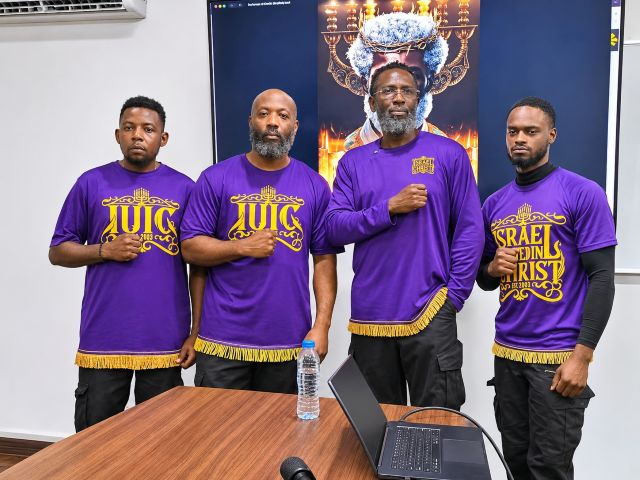
MONROVIA — Bishop Nathanyel Ben Israel, leader and founder of the religious organization Israel United in Christ (IUIC), has sharply criticized the Liberian government over its handling of foreign concession agreements, accusing authorities of failing to protect citizens from what he described as economic exploitation by Firestone Liberia.
Addressing a major news conference in Monrovia on Thursday, Bishop Ben Israel alleged that some workers at Firestone’s rubber plantation earn as little as US$80 monthly, questioning why Liberian authorities continue to allow foreign companies to benefit from the country’s natural resources while ordinary citizens face economic hardship.
The religious leader said members of his delegation visited Firestone’s plantation Wednesday, where they reportedly received information about the wages of some employees.
“Firestone is still here. We went by the plantation yesterday, and they said they get paid $80 U.S. a month,” Bishop Ben Israel alleged.
He described the reported wages as exploitative, comparing the alleged monthly earnings of workers with the retail price of automobile tires in the United States.
“That’s slave wage, slave wage, because one tire in U.S. is $400. So imagine $80 U.S., $400 the price. That’s slave wage. But your leadership sees nothing wrong with that,” he declared.
The bishop did not identify the workers who reportedly provided the information or specify their employment categories. His claims about Firestone’s wages could not be independently verified from the information presented at the news conference.
Beyond the wage allegations, Bishop Ben Israel accused Liberian authorities of failing to negotiate concession agreements that adequately benefit citizens, particularly those whose labor and communities contribute to the country’s natural resource industries.
He argued that Liberia should receive greater economic benefits from agreements involving foreign companies, insisting that government officials have a responsibility to prioritize workers’ welfare and national development.
“If you’re going to make a deal with a country with America, make sure if the resources come from here, you get the biggest wage that benefits the people. You understand?” he said.
Bishop Ben Israel also made allegations about Firestone’s historical operations, claiming that differences in the treatment of communities contributed to divisions among Liberians.
“Firestone paid certain tribes X amount of money to produce rubber at slave wages and did not help other tribes. This is where your civil war came,” he alleged.
He argued that foreign economic interests can exploit divisions within African societies without resorting to direct military intervention.
“They may not lift a hand against you, but the way I can conquer you, if I’m white man, I’ll get this side of the room to fight that side of the room, and whoever wins, I win. That’s what happened during the Civil War,” he stated.
His suggestion that Firestone’s historical operations contributed to Liberia’s civil conflict was not accompanied by documentary evidence during the presentation.
The IUIC leader further blamed Liberia’s prolonged civil conflict for educational setbacks, arguing that the destruction caused by the war continues to affect citizens’ economic opportunities.
He maintained that the country must reconsider how foreign investment agreements are structured to ensure that Liberia’s natural resources contribute directly to improved living conditions.
Bishop Ben Israel also criticized the government’s reliance on foreign contractors, particularly Chinese companies involved in road construction, while many young Liberians remain unemployed.
Drawing comparisons with a visit to Bougainville in the Pacific region, he questioned why African governments continue to engage foreign companies without ensuring that local workers acquire technical skills and employment opportunities.
“We drive through. We see Chinese people building your roads, right? You got that here, right? But the young black men, you see, all these young black men are strong, able-bodied, no work,” he said.
He urged Liberian authorities to prioritize technical training and create opportunities for citizens to participate directly in infrastructure development.
“You have intellect here, you have resources here. You could build your own streets so that there’s no potholes. You could build your own buildings,” Bishop Ben Israel stated.
The religious leader also cited former Libyan leader Muammar Gaddafi’s management of oil revenues as an example of what he considered a government prioritizing the economic welfare of its citizens.
“That’s what Gaddafi did. Their oil, when America or countries bought oil from Gaddafi, the majority of the money went to the citizens when they got married. Their education,” he claimed.
Bishop Ben Israel maintained that Liberia’s economic challenges cannot be separated from decisions made by its political leadership, particularly regarding foreign investment, employment and resource management.
“So when your people are broke, starving, the children have no shoes on their feet. It’s your own fault. You cannot blame anybody but you,” he said.
Meanwhile, the IUIC leader used the news conference to outline the organization’s religious mission, emphasizing obedience to biblical commandments, repentance and faith in Jesus Christ.
Founded in New York in 2003 by Bishop Nathanyel Ben Israel, also known as Nathaniel Ray, IUIC emerged from the Israeli School of Universal Practical Knowledge and is associated with the Black Hebrew Israelite movement.
The organization teaches that people of African, Hispanic and Native American descent are descendants of the biblical 12 tribes of Israel. Its teachings draw primarily from the 1611 King James Bible, including the Apocrypha, and emphasize repentance, observance of biblical commandments and the restoration of what it considers the historical identity of Israelites.
IUIC operates through a hierarchical leadership structure comprising bishops, deacons and officers, with religious classes and outreach activities in the United States, Africa, the Caribbean and other regions.
The organization has attracted criticism from civil rights watchdogs, including the Anti-Defamation League, over aspects of its religious teachings and rhetoric. IUIC, however, rejects characterizations of the organization as a hate group, maintaining that its mission centers on repentance, family reunification and adherence to biblical law.
During Thursday’s news conference, Bishop Ben Israel defended the organization’s religious practices, explaining that IUIC relies on voluntary donations rather than mandatory tithing.
“We don’t do 10% like the lie that the Christian church teaches. We don’t do the tithes was never about money. It was about your crops. It was never about money. We do donations, straight donations,” he said.
He also challenged Christmas celebrations and urged Liberians to reject religious practices he believes are inconsistent with biblical teachings.
“We must keep God’s commandments. We have to keep the commandments of the Bible in the faith of Christ to receive salvation. That’s the only way we’re going to get salvation,” he said.
Bishop Ben Israel further warned of what he described as the approaching destruction of existing world powers through a third world war, which he linked to his interpretation of biblical prophecies concerning the second coming of Jesus Christ.
“The third world war is how God is going to destroy the ruling powers and then set up his kingdom. In the middle of World War III is when Christ is going to make his second return,” he declared.
See more Liberia News Network stories in Google Search by adding LNN as one of your Preferred Sources.
★ Add LNN as a Preferred Source