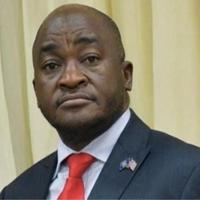
The prosecution has opened its case in the high-profile Saudi humanitarian rice diversion trial before Criminal Court “C,” with the State’s first witness alleging that former Foreign Minister Dee-Maxwell Saah Kemayah Sr. created an unauthorized inter-ministerial committee to investigate the disappearance of donated rice and subsequently facilitated the removal of the remaining consignment from its lawful custodian.
John Kumeh, an investigator assigned to the Anti-Theft Squad of the Liberia National Police, testified under oath that Kemayah and his former Deputy for Administration, Thelma Duncan Sawyer, established the committee despite the Ministry of Foreign Affairs having no statutory authority over disaster relief commodities.
At the center of the case is a consignment of 29,412 bags of 25-kilogram rice donated to Liberia in April 2023 by the King Salman Humanitarian Aid and Relief Center of Saudi Arabia for disaster-affected and vulnerable Liberians.
The rice was formally turned over to the National Disaster Management Agency (NDMA), which prosecutors maintain is the statutory institution responsible for the custody and management of disaster-related commodities.
According to the Assets Recovery and Property Retrieval Taskforce (AREPT), approximately 25,054 bags valued at US$425,918 were allegedly diverted, misapplied or distributed without lawful authorization.
AREPT further alleges that 13,895 bags were improperly removed from NDMA warehouses and transferred to the General Services Agency (GSA) following a series of closed-door meetings.
Kumeh told the court that the controversy began after reports emerged that Saudi-donated rice intended for vulnerable Liberians was being sold on the Monrovia market.
Rather than referring the allegations to the institutions legally mandated to investigate such matters, Kumeh said, Kemayah and Sawyer established an inter-ministerial committee under the Ministry of Foreign Affairs.
“Instead of referring the matter to the Liberia National Police, the Liberia Anti-Corruption Commission, or allowing NDMA’s own internal control mechanisms to function, Defendants Sawyer and Kemayah unilaterally constituted an inter-ministerial committee under the Ministry of Foreign Affairs,” Kumeh testified.
The witness said the committee subsequently reached a finding that no theft had occurred at the NDMA.
However, according to the prosecution, Kemayah subsequently ordered that the remaining rice be removed from NDMA, despite the agency being the lawful custodian of the humanitarian consignment.
Kumeh emphasized the alleged lack of legal authority by the Ministry of Foreign Affairs.
“The Ministry of Foreign Affairs absolutely has nothing to do with NDMA issues,” he testified.
The prosecution further alleges that Kemayah verbally instructed his Special Assistant, Robert Sirleaf, to facilitate the removal and transfer of the rice to the GSA.
Kumeh testified that the transfer was not supported by a Cabinet directive, presidential mandate, written GSA requisition, NDMA release voucher or resolution of the NDMA Board.
“It was administrative fiat, not law,” Kumeh told the court.
The prosecution argues that the alleged actions amounted to an abuse of official authority because the Ministry of Foreign Affairs had no statutory custodial or distributive role over the rice.
Prosecutors are also expected to argue that the committee was legally invalid because the ministry allegedly assumed the role of investigator and decision-maker in a matter involving a donation that had passed through the ministry during the official handover.
The State’s case invokes the principle nemo judex in causa sua, meaning that no person or institution should act as a judge in a matter in which it has an interest.
The prosecution contends that the alleged diversion satisfies elements of several offenses, including Abuse of Office, Criminal Conspiracy, Theft of Property, Misapplication of Entrusted Property and Economic Sabotage.
According to the State’s legal theory, criminal liability does not necessarily depend on proving that Kemayah personally benefited from the rice.
Instead, prosecutors contend that diverting humanitarian property entrusted for vulnerable beneficiaries to an unauthorized custodian can constitute theft and misapplication under Liberian law.
Kemayah, who served as Foreign Minister under former President George Weah and currently leads the opposition Movement for Economic Empowerment (MOVEE), has denied the allegations.
Following his detention at the Monrovia Central Prison in June 2025 alongside former GSA Director-General Mary Broh and former NDMA Executive Director Henry O. Williams, Kemayah characterized the case as a “public witch-hunt.”
He has maintained that the government has failed to establish that he personally benefited from the rice or acted with criminal intent.
MOVEE has also condemned his arrest and prosecution as politically motivated and undemocratic.
The defense is expected to argue that Kemayah acted within the broader responsibilities of his office to protect a bilateral humanitarian donation and preserve Liberia’s diplomatic relationship with Saudi Arabia after concerns emerged over the rice.
The defense is also expected to challenge the prosecution to establish criminal intent and demonstrate how Kemayah personally benefited from the alleged diversion.
The trial has assumed wider political significance because it forms part of President Joseph Nyuma Boakai’s broader anti-corruption campaign.
AREPT, headed by Cllr. Edwin K. Martin, has pursued cases against several former senior officials of the previous Coalition for Democratic Change (CDC) administration.
Among those prosecuted are Kemayah, Broh and former Internal Affairs Minister Varney Sirleaf.
The Boakai administration has presented the asset-recovery campaign as part of its effort to strengthen accountability and recover public resources allegedly lost through corruption.
Critics, however, have accused AREPT of selectively targeting opposition figures and using anti-corruption enforcement as a political instrument.
The outcome of the Saudi rice case could therefore carry implications beyond the individual defendants.
A conviction would strengthen the administration’s argument that former officials misused public resources, while an acquittal could reinforce opposition claims that the cases are politically motivated.
For Kemayah, the trial represents a major legal and political battle.
The central issue now before Criminal Court “C” is whether the former Foreign Minister had the legal authority to establish an investigative committee over disaster commodities outside his ministry’s statutory mandate and subsequently facilitate the removal of rice entrusted to the NDMA.
As the prosecution continues presenting its evidence, the defense will have an opportunity to challenge the State’s witnesses, documents and interpretation of the law before the court determines whether the allegations have been proven beyond a reasonable doubt.
See more Liberia News Network stories in Google Search by adding LNN as one of your Preferred Sources.
★ Add LNN as a Preferred Source