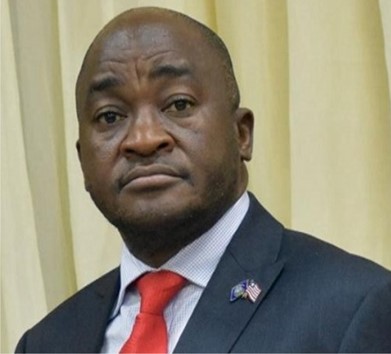
MONROVIA – Former Foreign Minister Dee-Maxwell Saah Kemayah, Sr. has carried Liberia’s quarrel over accountability to an international peace platform. He addressed a virtual summit on the International Day of Peace. He warned that prosecutions seen as political could unravel two decades of hard-won peace. His argument, however, cuts both ways. Former officials must answer for wrongdoing, he said, but only on credible evidence and through due process. The timing is pointed. A jury-tampering inquiry clouds former Finance Minister Samuel Tweah’s acquittal, and a former Vice President faces narcotics charges. The government denies any witch-hunt. Kemayah’s real question is whether Liberia’s national institutions still command enough trust to settle such disputes peacefully. THE ANALYST reports.
Kemayah, who served as Minister of Foreign Affairs and Dean of the Cabinet under former President George Manneh Weah, delivered the warning on Monday, September 21, 2026, as Special Keynote Speaker at the First International Peace Summit 2026. The virtual summit was organized by the International Human Rights Commission (IHRC) and its affiliated bodies to commemorate the International Day of Peace.
Speaking on the topic “Peace in a Fractured World: Restoring Dialogue, Justice and Confidence in Institutions,” he told diplomats, government officials, representatives of international organizations and civil society that lasting peace requires three things above all. These, he said, are credible diplomacy, justice under the rule of law and institutions in which people can place their confidence.
A Warning Rooted at Home
“Liberia knows the terrible cost of institutional collapse,” Kemayah said. After 14 years of devastating civil conflict, he noted, the country has spent more than two decades rebuilding a fragile peace, yet troubling signs are now emerging.
“Political tensions are rising amid highly charged prosecutions of former Government officials,” he said. Questions surrounding the administration of justice and the politicization of accountability, he argued, are deepening mistrust between the government and the opposition. Where political persecution and witch-hunts appear to be the emerging trend and citizens begin to doubt the impartiality of national institutions, he warned, “the foundations of peace may be dangerously vulnerable.”
He set out the possible consequences in stark terms. Politically, he said, mistrust could harden divisions and make future elections more confrontational. Socially, growing frustration could move grievances from institutions to the streets, and from a security perspective, demonstrations could escalate into clashes, retaliation and wider instability. “In a post-conflict society, even isolated incidents can become dangerous when they occur in an atmosphere of deep mistrust,” he said.
“Conflict does not begin when a first gun is fired,” Kemayah told the summit. “It begins when trust dies, institutions lose credibility, political opponents become enemies, and citizens cease to believe that justice will protect them equally.”
“We have paid too high a price for peace to gamble with it again,” he said. Liberia, he urged, must act before political tension becomes political crisis, and before political crisis becomes national instability. “We have traveled this road before. We know where it can lead.”
Kemayah did not name specific cases. His remarks come as prosecutions of former officials of the Weah administration remain a political flashpoint. Former Finance Minister Samuel D. Tweah, Jr., acquitted by a jury in May, has accused the government of a political witch-hunt after the court moved to investigate jury-tampering allegations, while former Vice President Jewel Howard-Taylor was charged on August 19 in a narcotics-trafficking case that remains before the courts.
The Boakai administration has consistently rejected claims that its prosecutions are politically motivated, maintaining that it has the evidence to prove its charges in court. Information Minister Jerolinmek M. Piah has said the government will not hesitate to pursue proven corrupt officials, former or present.
Accountability Without Persecution
Kemayah framed accountability as a test with two sides. “No individual should be above the law. But equally important, no individual should be denied the protection of the law,” he said, adding that the principle becomes particularly important during changes of government.
Democratic elections, he said, must be free, fair, transparent and inclusive, and transitions should never become opportunities for settling political scores. “Former public officials must remain accountable for their actions. Where credible evidence of wrongdoing exists, the law must take its course,” he said. “But accountability must be evidence-based, transparent, impartial, and consistent with due process. Otherwise, prosecution can be persecution in disguise.”
When political actors begin to believe that losing an election could mean losing their freedom through politically motivated charges, he argued, the stakes of political competition become dangerously high. A functioning democracy, he said, must therefore reject two extremes: impunity on one side and political persecution on the other. “The answer to impunity is credible justice; not selective justice and political witch-hunt.”
Courts as Institutions of Peace
The former minister described the courts as institutions of peace as well as institutions of law, because they provide an orderly alternative to confrontation. Disputes can move from the streets to the courtroom, he said, and where elections are contested, judicial institutions can prevent political disputes from escalating into violence.
The judiciary therefore carries an extraordinary responsibility and requires comprehensive support, Kemayah said. Such support, he argued, must be given priority because it is an investment in national stability.
Diplomacy as First Line of Defense
Drawing on his years in diplomacy and public service, Kemayah said one lesson has remained constant: it is always less costly to prevent a conflict than to resolve one. Once armed conflict starts, he said, positions harden, trust disappears, economies collapse, infrastructure is destroyed and populations are displaced, while grievances that might once have been negotiated become generational wounds.
Diplomacy, he insisted, must be preventive rather than an emergency tool activated after violence begins, with greater investment in early warning, mediation, confidence-building and sustained dialogue. He rejected the view that dialogue signals weakness. “Dialogue is not capitulation. Negotiation is not surrender. Diplomacy is not weakness,” he said, describing diplomacy as “the disciplined search for alternatives to destruction.”
Even where parties fundamentally disagree, he said, communication must remain possible. It is precisely when relationships are most difficult, he added, that diplomatic channels are most necessary.
Leaders Must Lower the Temperature
Kemayah said responsible political leadership is a duty that cannot be delegated to institutions alone. “Words spoken by leaders matter. Political rhetoric can lower tensions or inflame them,” he said.
Leaders, he argued, must recognize that political opponents are not necessarily enemies of the state, and that government and opposition may disagree profoundly while remaining partners in the constitutional order. A healthy democracy, in his view, requires a government capable of tolerating criticism and an opposition capable of challenging government within constitutional boundaries.
He said the same principle applies between states, which will disagree over territory, security, trade, ideology and foreign policy without that disagreement having to end in confrontation. “The ultimate test of statesmanship is not the ability to defeat every opponent,” he said. “Sometimes, it is the ability to create sufficient common ground for former adversaries to coexist.”
Double Standards Abroad
Kemayah extended his argument to the international system. The world cannot effectively advocate the rule of law at home while appearing inconsistent in applying it internationally, he said, and smaller states, developing countries and vulnerable populations must be confident that international law protects them as meaningfully as it protects powerful actors.
When similar conduct attracts different international responses depending on who commits it, he said, confidence diminishes and skepticism grows. “The answer is not to weaken international institutions. The answer is to strengthen their credibility through greater consistency, transparency, representation, and respect for international laws.”
A Five-Point Agenda
Peace, Kemayah said, requires architecture, and he offered five practical steps. First, he called for stronger preventive diplomacy, with early-warning systems that track disputed elections, rule-of-law violations, inflammatory political rhetoric, restrictions on civic space and sudden deterioration in relations among political actors. Early warning, he stressed, is useful only when it leads to early action.
To that end, he proposed that regional and international organizations maintain standing mediation teams of experienced diplomats, constitutional experts, women leaders, youth representatives and civil society figures, ready for rapid deployment. He also urged confidential channels between governments and political parties, along with regular cross-party consultations and parliamentary dialogue. “Do not wait for the fire before building the fire brigade,” he said.
Second, he urged protection of the independence of the judiciary, electoral bodies, legislatures and public accountability institutions through both law and practice. Appointments, he said, should follow transparent, merit-based procedures, removal from office should require lawful process rather than political convenience, and institutions should receive adequate and predictable funding so that financial dependence does not undermine political independence.
He also called for what he termed “institutional restraint,” warning political leaders against using every available legal or administrative instrument against opponents simply because the law technically permits it. The spirit of constitutional democracy, he said, requires more than legality.
Third, he called for consistent application of the rule of law, with accountability applying equally to those who hold power and those who have left it. Investigations, he said, must follow established legal procedure and rest on credible evidence, while every accused person retains due process and the presumption of innocence. “Justice must be firm enough to confront impunity and restrained enough to prevent injustice,” he said.
International partners, Kemayah added, can support that goal through judicial cooperation, anti-corruption assistance and stronger systems for asset declaration, procurement transparency and independent oversight. The aim, he said, should be institutions that make wrongdoing harder to commit and easier to detect, not merely punishment after the fact.
Fourth, he proposed permanent national dialogue mechanisms bringing together government, opposition parties, civil society, business leaders, youth, women and traditional authorities, alongside regional mediation panels of respected former heads of state, senior diplomats and jurists. He urged political parties to adopt internal dispute-resolution mechanisms and commit to nonviolent competition.
He also assigned a role to the media, saying responsible journalism should give citizens facts rather than deliberately deepen political divisions. Social media platforms and technology companies, he said, should work with governments and civil society against coordinated disinformation and incitement without compromising legitimate freedom of expression.
Fifth, he called for restoring confidence in multilateralism through stronger consultation with smaller and developing states, greater support for regional organizations and clearer public communication by international bodies. Peace initiatives, humanitarian programs and election-support missions, he said, should carry clear objectives, measurable outcomes and public accountability. States, he added, cannot demand strong international institutions while refusing to support them politically, financially and diplomatically.
One World, One Humanity
In conclusion, Kemayah said the pursuit of peace is not an event but a continuous responsibility. Peace is preserved, he said, when governments exercise power responsibly, when opposition is respected, when courts are independent, when justice is impartial and when diplomacy stays open even in moments of profound disagreement.
He urged leaders to choose dialogue over confrontation, diplomacy over escalation, justice over vengeance, institutions over personalities and cooperation over isolation. “Lasting peace cannot be imposed by force alone,” he said. “It must be built through trust, protected by justice, sustained through dialogue, and anchored in institutions that command the confidence of the people they serve.”
He closed by invoking the summit’s declaration: “One World. One Humanity. One Future.” The challenge, he said, is not only to end the wars already underway but to build national and international systems capable of preventing the next conflict.
A Global Platform
The summit, convened virtually from Istanbul and Geneva, was opened by IHRC World Chairman Ambassador Dr. Muhammad Shahid Amin Khan and moderated by Emaan Amjid Abbasi. Organizers listed among its special guest speakers former Pakistani Prime Minister and current Senate Chairman Syed Yousaf Raza Gilani, former Mauritian President Dr. Ameenah Gurib-Fakim, former Ecuadorian President Dr. Rosalía Arteaga Serrano and former Nepalese Prime Minister Jhala Nath Khanal.
Other invited speakers included former Guinea-Bissau Prime Minister Rui Duarte de Barros and former Maldivian Foreign Minister Dunya Maumoon. The IHRC said the summit aimed to develop recommendations for negotiators and mediators and to encourage parties to ongoing conflicts to pursue peaceful solutions rather than prolong hostilities.
See more Liberia News Network stories in Google Search by adding LNN as one of your Preferred Sources.
★ Add LNN as a Preferred Source