
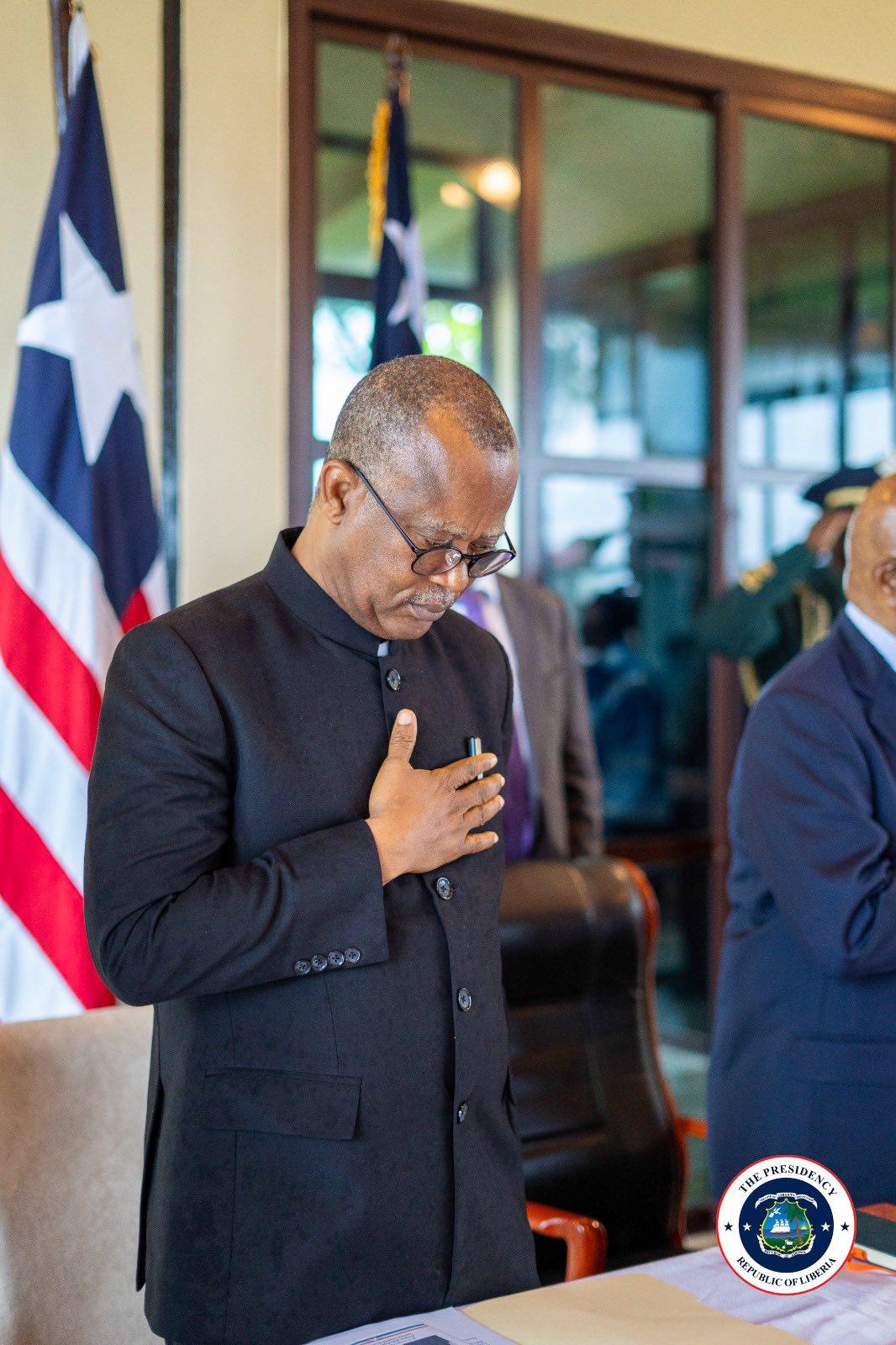
MONROVIA – For nearly two decades, Liberia’s security architecture has operated under a framework developed in the aftermath of war, when immediate stabilization and state reconstruction dominated national priorities. But the threats confronting the country today are markedly different, ranging from cybercrime and climate shocks to transnational criminal networks, economic insecurity, and social vulnerabilities. Against this backdrop, National Security Advisor Samuel Kofi Woods II says Liberia must fundamentally rethink how it defines and delivers security. As THE ANALYST reports, the launch of a new National Security Strategy therefore represents more than a policy update; it signals a deliberate shift toward a human-centered model that places citizens, rights, resilience, and prevention at the core.
WOODS DECLARES NEW SECURITY ERA
National Security Advisor Samuel Kofi Woods II has declared that Liberia is entering a new era of security governance following the official launch of the country’s updated National Security Strategy, a comprehensive framework designed to confront emerging threats while placing citizens at the center of national security planning and implementation.
Speaking at the Executive Mansion during the official unveiling of the National Security Strategy of Liberia, Woods described the occasion as a defining moment in the country’s democratic and security evolution, emphasizing that the framework seeks to reposition Liberia to effectively address both present and future threats.
The veteran statesman and security expert noted that Liberia’s previous National Security Strategy became operational in 2008 and was developed within a vastly different security environment.
“I am proud to be the National Security Advisor to the President of Liberia at this historic moment in our country,” Woods declared. “Our last National Security Strategy became operational in 2008. It has been more than a decade; much has changed.”
His remarks reflected a broader consensus among policymakers that the security landscape confronting Liberia today bears little resemblance to the conditions that informed security planning nearly two decades ago.
TWO YEARS OF NATIONAL CONSULTATIONS
Woods revealed that the newly launched strategy is the outcome of an extensive two-year consultative process involving government institutions, security agencies, development partners, legal experts, community leaders, civil society organizations, and ordinary citizens across Liberia.
According to him, the process was intentionally designed to ensure that the strategy reflected national realities rather than institutional assumptions.
“Over the past two years, our nation has undertaken a deliberate and inclusive process to define what security means for Liberia in the 21st century,” Woods stated.
The National Security Advisor explained that technical working groups were established to assess threats, identify institutional gaps, and evaluate Liberia’s preparedness to respond to evolving security challenges.
These groups brought together security professionals, civil servants, legal practitioners, and policy specialists tasked with examining the country’s operational environment from multiple perspectives.
At the same time, consultations were held with regional organizations and international development partners to ensure that Liberia’s security posture aligns with evolving regional and global security architectures.
VOICES OF ORDINARY LIBERIANS INCLUDED
One of the most significant aspects of the review process, according to Woods, was the deliberate effort to incorporate the views of ordinary citizens.
He disclosed that government teams organized town hall meetings, focus group discussions, listening sessions, and community engagements throughout Liberia’s fifteen counties.
The consultations included youth organizations, women’s groups, traditional leaders, community-based organizations, members of the private sector, and other stakeholders.
“We held widespread national consultations, town halls, focus groups, and listening sessions in Monrovia and across our counties so that ordinary Liberians, youth groups, women’s organizations, community leaders, and the private sector could identify their security priorities, share lived experiences, and help shape strategic choices,” Woods explained.
The result, he said, is a truly national document.
“It is a national product that reflects the voices and interests of our people and partners,” he emphasized.
SHIFTING FROM REACTION TO PREVENTION
Among the most significant policy changes contained in the strategy is a decisive shift away from traditional security models that focus primarily on responding to crises after they occur.
Woods explained that Liberia is now embracing what he described as an integrated, anticipatory, and whole-of-society security architecture.
The new approach prioritizes prevention, preparedness, and resilience building.
Instead of waiting for threats to emerge before responding, government institutions will increasingly invest in early warning systems, risk-informed planning mechanisms, and preventive interventions designed to reduce vulnerabilities.
“This Strategy embeds a new and decisive trend in our national approach,” Woods said.
He explained that modern threats often emerge gradually and therefore require governments to identify risks before they escalate into full-scale crises.
Security analysts attending the launch noted that this preventive approach mirrors evolving international best practices increasingly adopted by governments around the world.
ADDRESSING COMPLEX MODERN THREATS
Woods said the review process identified a broad spectrum of challenges facing Liberia.
These include border vulnerabilities, maritime security concerns, cyber threats, transnational organized crime, climate-related risks, and long-standing social and economic factors that contribute to instability.
Unlike earlier security frameworks that concentrated primarily on traditional threats, the new strategy seeks to address the interconnected nature of modern insecurity.
The National Security Advisor emphasized that land, sea, airspace, cyberspace, and socio-economic sectors must now be viewed as components of a single integrated security ecosystem.
Consequently, the strategy promotes stronger collaboration among institutions responsible for health, education, justice, local governance, economic planning, and security.
According to Woods, no single institution can effectively manage contemporary threats in isolation.
PEOPLE CENTERED SECURITY TAKES ROOT
At the heart of the strategy lies what Woods repeatedly described as a commitment to people-centered security.
“Security must serve the people, and the people must be an active part of delivering security,” he declared.
He argued that genuine national security cannot be achieved solely through military strength or law enforcement capacity.
Rather, it depends upon public trust, accountable institutions, respect for human rights, effective governance, and access to economic opportunities.
“We affirm that a secure Liberia is not achieved by instruments of force alone; it is secured when citizens trust institutions, when communities participate in safety planning, when the rule of law protects rights, and when opportunities reduce incentives for crime and conflict,” Woods stated.
The philosophy represents a notable departure from traditional security doctrines that prioritize state protection over citizen well-being.
HUMAN RIGHTS AND ACCOUNTABILITY EMPHASIZED
The strategy places considerable emphasis on human rights protections, accountability, and institutional legitimacy.
Woods disclosed that reforms under the framework will include expanded human rights training across security institutions, strengthened oversight mechanisms, and the introduction of community complaint systems designed to improve transparency and public trust.
He argued that security institutions perform more effectively when they enjoy public confidence.
“Our vision is to redefine and reconceptualize the traditional security model and focus on human security with respect for human rights at the core of our efforts,” he declared.
Rejecting the notion that security and human rights are incompatible, Woods maintained that both objectives reinforce one another.
“Those who believe that respect for human rights and security are antithetical are wrong; both are mutually reinforcing,” he asserted.
YOUTH, WOMEN AND COMMUNITIES PRIORITIZED
Recognizing the social drivers of insecurity, Woods said the strategy prioritizes youth empowerment, education, employment opportunities, and social reintegration initiatives.
These programs are intended to address root causes of crime, violence, and recruitment into criminal networks.
The framework also mainstreams gender considerations throughout national security planning.
According to Woods, the safety, participation, and leadership of women and girls will become central components of future security interventions.
Additionally, public awareness campaigns, digital literacy programs, and community-based early warning systems will be expanded nationwide.
Officials believe these initiatives will strengthen citizen participation while improving the country’s ability to detect and respond to emerging threats.
IMPLEMENTATION WILL DETERMINE SUCCESS
While celebrating the launch of the strategy, Woods cautioned that policy documents achieve little without effective implementation.
“A strategy is only as good as its implementation,” he warned.
To ensure execution, government plans to establish a detailed implementation roadmap featuring measurable targets, timelines, institutional responsibilities, and performance indicators.
The government also intends to review agency mandates, strengthen coordination mechanisms, secure sustainable financing, and publish regular progress reports.
These measures are expected to promote transparency while enabling citizens and stakeholders to monitor implementation progress.
PARTNERSHIPS REMAIN CRITICAL
Woods acknowledged the role played by international partners in supporting the development of the strategy.
He specifically thanked the Folke Bernadotte Academy, the Government of Sweden, ECOWAS, the United Nations, the United States Government, and other development partners for their support.
According to him, continued collaboration with international institutions will remain essential for strengthening Liberia’s security capacity and institutional effectiveness.
He stressed, however, that ultimate ownership of the strategy must remain firmly in Liberian hands.
CALL FOR COLLECTIVE NATIONAL ACTION
As he concluded his remarks, Woods called upon government institutions, traditional leaders, civil society organizations, businesses, development partners, and ordinary citizens to embrace the strategy and actively support its implementation.
“I call on every stakeholder in this room and across our nation to embrace this strategy, to act on its priorities, and to work together in the spirit of shared responsibility,” he urged.
The National Security Advisor argued that security should no longer be viewed as the responsibility of government alone.
Rather, he said, it must become a shared national undertaking capable of strengthening democratic governance, fostering economic growth, and promoting social resilience.
“When our people feel secure, Liberia’s democratic institutions deepen, our economy grows, and our collective future becomes more prosperous and resilient,” Woods concluded.
With the launch of the strategy, Liberia is seeking to move beyond conventional security paradigms and embrace a broader vision rooted in prevention, inclusion, accountability, human dignity, and national resilience. Whether that vision succeeds will depend on the government’s ability to translate ambitious policy commitments into measurable improvements in the lives and security of ordinary Liberians.
