
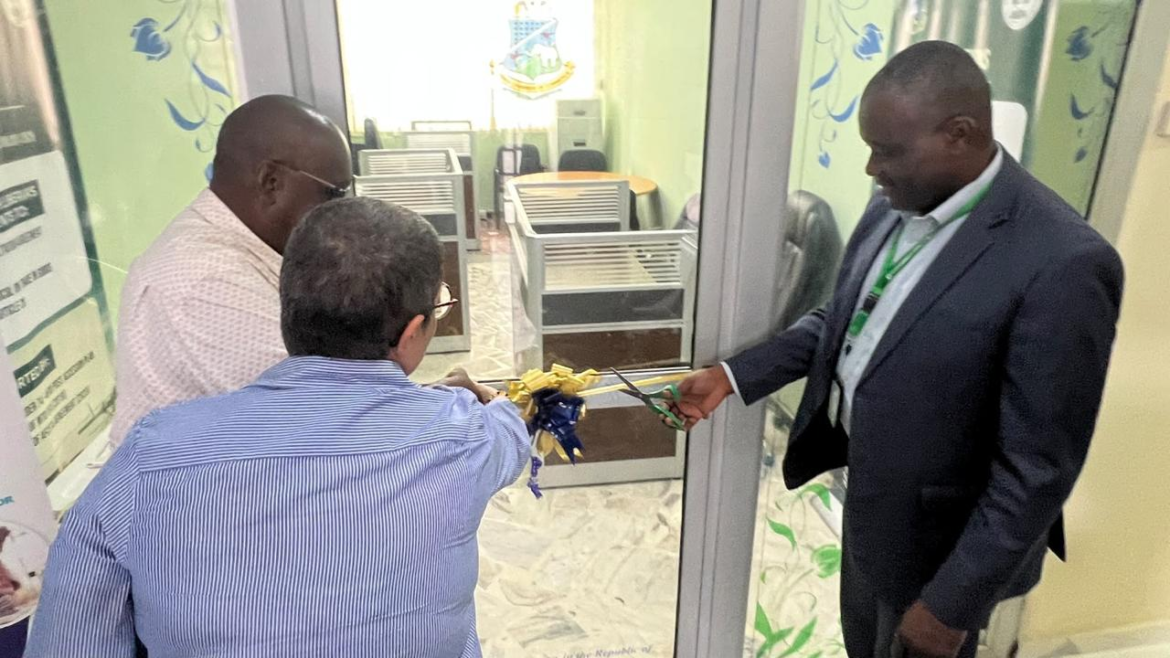
MONROVIA — The Liberia Chamber of Commerce (LCC), with support from the European Union (EU), has dedicated a renovated office for the National Trade Facilitation Secretariat (NTFS), in a move aimed at strengthening public-private sector collaboration, improving trade procedures, and creating a more conducive business environment in Liberia.
The dedication ceremony, held on Thursday, October 29, also recognized logistical support provided by the EU Delegation to Liberia through the Private Sector Development Project, implemented by Expertise France.
Speaking at the ceremony, LCC President O. Natty B. Davis said hosting the Secretariat demonstrates the Chamber’s commitment to bringing government institutions and private businesses together to address challenges affecting investment and economic growth.
“Hosting the National Trade Facilitation Secretariat is a demonstration of our commitment to strengthening collaboration between government and the private sector. We believe that bringing these institutions closer to businesses will help address the challenges affecting investment and economic growth,” Davis said.
He expressed appreciation to the Government of Liberia, the EU Delegation, Expertise France, the Ministry of Commerce and Industry, and the Liberia Revenue Authority for their support toward the initiative.
Davis emphasized that businesses require clear regulations, consistent policies, and predictable government services to make sound investment decisions, particularly for projects involving substantial capital and long-term commitments.
“Businesses need certainty. Investors must be able to operate within a system where policies are consistent, regulations are clear, and government services are predictable,” he stated.
Referencing discussions at the recent Liberia International Mining and Energy Conference, Davis identified inadequate coordination among government institutions as a major concern for private-sector operators.
He said the Secretariat’s presence at the Chamber would provide an opportunity to strengthen institutional relationships and ensure that business concerns receive greater attention in national trade policy discussions.
Davis also disclosed that the office would complement the Chamber’s Trade Desk, which is expected to improve businesses’ access to reliable statistics, trade-related information, and other services necessary for investment and expansion.
Meanwhile, Dimitri De-Pues, Regional Hub Investment Officer at the EU Delegation to Liberia, welcomed the completion of the renovated facility, describing it as an important milestone in the partnership between the European Union and the Liberia Chamber of Commerce.
De-Pues said the collaboration between the two institutions had lasted nearly two years and reaffirmed the EU’s commitment to supporting the initiative throughout the remaining three years of the project.
“Our commitment to supporting private-sector development in Liberia remains strong. We recognize the importance of working together with the Chamber, the Ministry of Commerce and Industry, and Expertise France to create opportunities for businesses and improve the country’s trade environment,” De-Pues said.
He stressed the importance of continued cooperation among implementing partners to ensure the project achieves its intended objectives.
Also speaking, Deputy Minister of Commerce and Trade Wilmot A. Reeves, Chairman of the National Trade Facilitation Committee, welcomed the Chamber’s decision to host the Secretariat, describing it as an important contribution to improving Liberia’s business climate.
Reeves explained that the EU-supported Private Sector Development Project promotes business growth through interventions targeting key value chains, including wood processing, fisheries, and cassava.
“Government cannot do it alone. Our responsibility is to create an enabling environment where the private sector can operate, expand, create opportunities, and contribute meaningfully to national development,” Reeves emphasized.
He said the project also prioritizes public-private dialogue and the removal of barriers that prevent businesses from reaching their full potential.
Another speaker, Buku, underscored the importance of private-sector participation in trade modernization, noting that involving businesses early in the reform process helps ensure that policies address practical challenges encountered by operators.
“Trade reforms must reflect the realities of the business community. When the private sector is involved from the beginning, we are better positioned to identify challenges and develop solutions that respond to the actual needs of businesses,” Buku said.
He welcomed the dedicated workspace, noting that it would strengthen the Secretariat’s ability to coordinate activities and communicate business concerns during trade policy discussions.
The National Trade Facilitation Secretariat operates under the National Trade Facilitation Committee, chaired by the Ministry of Commerce and Industry.
Its presence at the Liberia Chamber of Commerce is expected to strengthen engagement with businesses, improve access to trade-related information, and enhance coordination among relevant institutions.
The initiative is expected to contribute to reducing trade barriers, attracting investment, and supporting sustainable private-sector growth.
However, its long-term impact will depend on the ability of the Secretariat and its partners to translate their commitments into practical reforms that improve Liberia’s business and trading environment.
See more Liberia News Network stories in Google Search by adding LNN as one of your Preferred Sources.
★ Add LNN as a Preferred Source