
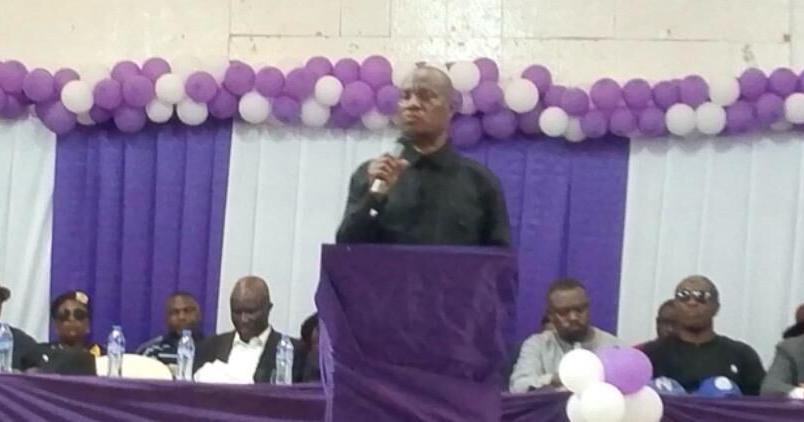
A funeral ceremony meant to honor the life and legacy of former Nimba County Superintendent Nelson Korquoi evolved into a broader public debate over traditional forgiveness, political responsibility, and the limits of public authority after Senator Samuel G. Kogar made a controversial declaration regarding allegations contained in a General Auditing Commission (GAC) report.
Speaking at Korquoi’s funeral service in Ganta last week, Senator Kogar announced that any outstanding issues or liabilities associated with the late former superintendent in connection with the GAC audit should be considered waived, arguing that the decision was necessary to allow the deceased to “rest in peace.”
The declaration immediately became the most talked-about moment of the funeral, drawing mixed reactions from mourners, political actors, civil society voices, and members of the public.
While some viewed the senator’s remarks as a culturally rooted gesture of forgiveness and respect for the dead, others questioned whether allegations involving public funds could be erased through a funeral declaration or traditional practice.
Korquoi, who died in early June 2026 after a brief illness, was among several former Nimba County officials named in a GAC audit report that raised concerns over the management and alleged misapplication of more than US$4 million in county development funds.
However, at the time of his death, Korquoi had not been convicted of any crime, and no court had established legal liability against him.
It was against this backdrop that Senator Kogar’s remarks attracted national attention.
“Even though it is not confirmed whether he is guilty or not, if he is confirmed guilty in the near future, I want to say, he is free of any charges so his soul can rest in peace,” Senator Kogar told mourners.
The Nimba County senator explained that his statement was rooted in customary funeral practices where communities reflect on unresolved matters involving the deceased, including debts owed by or to the departed.
According to Kogar, such moments provide opportunities for forgiveness, reconciliation, and emotional closure.
“So based on this, I want to say here clearly that all debts on Mr. Korquoi based on the GAC report are hereby waived,” he declared.
The senator’s statement has opened a larger conversation in Nimba and beyond about the intersection between customary values and modern systems of public accountability.
Supporters of Kogar’s position argue that the remarks should be understood within a cultural context — as an expression of compassion toward a deceased person whose reputation remained contested at the time of his passing.
They maintain that Korquoi deserved dignity in death, particularly because he had not been found guilty by any court.
However, critics argue that audit findings involving public resources are not private disputes that can be settled through symbolic gestures.
They contend that accountability for the management of public funds is a matter of law and institutional responsibility, rather than an issue that can be resolved through traditional declarations.
For many observers, the controversy highlights a longstanding tension in Liberia between customary approaches to reconciliation and formal mechanisms designed to promote transparency in public governance.
Despite the backlash, Senator Kogar insisted that his remarks should not be interpreted as opposition to accountability.
He said he has consistently supported efforts to investigate the management of county development funds and pointed to his role in pushing for audits of local government officials.
“I have been one of those behind the auditing of past and present local government officials over the management of the County Development Funds,” Kogar said.
The senator also disclosed that he took action against a member of his own office after the individual was mentioned in the GAC audit report.
“With the releasing of the GAC audit report, I asked my Chief of Office Staff to resign his position because he was also linked,” he said.
Kogar maintained that his comments were motivated by concerns over Korquoi’s wellbeing before his death and conversations he had heard regarding the former superintendent’s emotional state during the audit controversy.
Before his death, Korquoi had been among former Nimba County officials whose management of county Social Development Funds came under scrutiny.
The GAC report reportedly raised questions about financial transactions involving millions of dollars and linked several former county officials to alleged irregularities.
Korquoi, however, maintained his willingness to participate in the audit process and defend himself against any concerns raised.
His supporters said he cooperated with auditors and was prepared to respond to questions surrounding the report.
But the timing of the audit’s release and his declining health meant he was unable to publicly address the findings before his death.
Beyond the controversy surrounding the audit, Korquoi’s death marked the passing of one of Nimba’s most recognizable political figures.
A longtime supporter of the Coalition for Democratic Change (CDC), Korquoi joined the party in 2005 and gradually rose through its ranks, eventually becoming CDC Chairman for Nimba County.
Following the CDC’s victory in Nimba during the 2017 general elections, he emerged as one of the county’s most influential political actors.
In 2018, after the inauguration of former President George Manneh Weah, Korquoi was appointed Commerce Inspector for Nimba County before later becoming County Superintendent, a position he held from 2020 to 2023.
During his tenure, supporters associated him with several major infrastructure projects, including the Ganta–Saclepea Highway, the Saclepea–Tappita Road, and other county development initiatives.
His supporters described him as a leader who consistently advocated for greater government attention to Nimba’s infrastructure and economic needs.
Outside politics, Korquoi was known as a community advocate, sports enthusiast, and founding member of Concerned Nimbians, a group that advocated for the implementation of the ArcelorMittal Mineral Development Agreement.
Beyond the debate over Kogar’s remarks, Korquoi’s funeral also reflected the political divisions that have long shaped Nimba County.
Some government officials and political figures were absent from portions of the funeral activities, prompting criticism from CDC supporters who accused political differences of influencing participation in honoring the late superintendent.
The body of Korquoi was removed from Gompa Funeral Home on Friday, July 3, 2026, and transported to Sanniquellie, where it was laid in state at the Administrative Building for about two hours before returning to Ganta.
The official funeral program was organized by Nimba County Superintendent Kou Meapeh Gono, although she did not attend some subsequent activities. County Administrative Officer Daniel Zekpeh delivered the official government tribute on his behalf.
The funeral service was held on July 4 at the Ganta Methodist Gymnasium, followed by burial in his hometown near Ganta.
Businessman Prince Howard of Ganta criticized what he described as the politicization of Korquoi’s funeral.
“We are greatly disappointed for politicizing the funeral of someone who worked tirelessly for the county because he was a CDCian,” Howard said.
“This is something we should desist from and hold together as one county, regardless of political affiliation.”
Born on June 5, 1972, in Makinto Town near Yekepa, Nelson Korquoi studied Business Management at the Liberia International Christian College.
He leaves behind his wife, Mrs. Alice Paye Korquoi, five children, one grandchild, siblings, and other relatives.
