
MARSHALL, Margibi County — President Joseph Nyuma Boakai has pledged to use Liberia’s upcoming Presidency of the United Nations Security Council to push for stronger international protection of seafarers caught in armed conflicts and other maritime security threats.
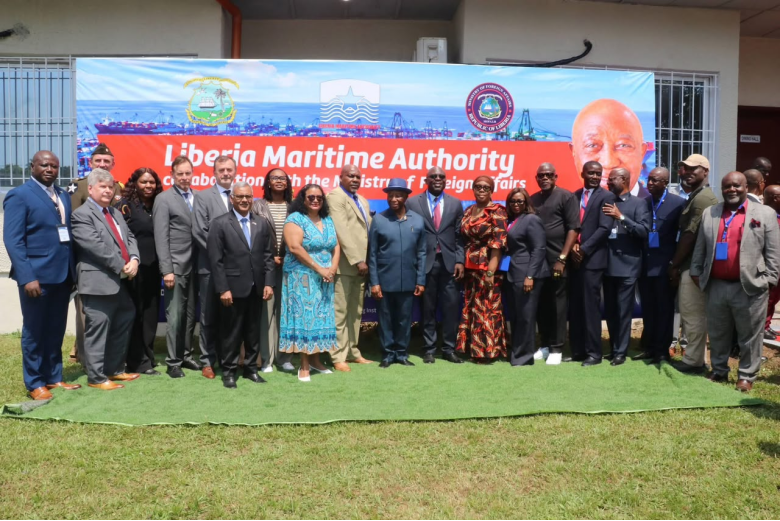
Speaking Thursday at the Marshall High-Level Dialogue on Global Maritime Safety, Security and Welfare of Seafarers at the Liberia Maritime Training Institute in Marshall City, Margibi County, President Boakai said Liberia’s position on the Security Council presents an important opportunity to influence global discussions on maritime safety and international peace.
Liberia is expected to assume the rotating presidency of the UN Security Council on December 3, 2026, marking its return to the Council’s leadership for the first time in more than six decades.
The President disclosed that his government intends to use the opportunity to draw international attention to the dangers confronting civilian seafarers in conflict zones, including through a high-level open debate at the United Nations.
He stressed that seafarers are ordinary workers who transport goods across international waters and should never be treated as participants in armed conflicts.
“They sign on to deliver cargo, not to go to war,” President Boakai said.
He warned that armed conflicts, piracy, drug trafficking, illegal fishing, cyberattacks, and other criminal activities continue to threaten maritime transportation and the lives of people working at sea.
The President emphasized that seafarers, including cooks, engineers, deck officers, and captains, are civilians who deserve protection under international humanitarian law.
“When the sea is calm and safe, Liberia thrives. When it is troubled, our national security is threatened,” he said.
Liberia’s Maritime Responsibility
President Boakai also highlighted Liberia’s position as the world’s largest maritime registry by tonnage, with more than 300 million gross tons registered under its flag.
He said Liberia’s responsibility extends beyond the commercial benefits of operating one of the world’s largest ship registries to ensuring the safety and welfare of people working aboard vessels flying its flag.
“Our flag is not just a business. Every ship flying the Liberian flag carries our name and our pride. The people on board, in a real sense, are under our care,” he added.
He called for stronger international cooperation to facilitate medical evacuations, crew changes, and the safe return of seafarers stranded in conflict-affected areas.
The Liberian leader also underscored the need to strengthen the country’s Coast Guard, fisheries authority, maritime institutions, and justice system to improve its capacity to respond to maritime threats and prosecute criminals operating in its waters.
On regional security, Boakai called for closer cooperation among countries in the Gulf of Guinea, stressing that no single country can effectively secure the region’s maritime space alone.
He reaffirmed Liberia’s commitment to working with ECOWAS, neighboring countries, and international partners under the Yaoundé Code of Conduct.
Liberia Eyes High-Level UN Debate
Foreign Minister Sara Beysolow Nyanti, who delivered the keynote address, described maritime security as critical to Liberia’s national interests and the stability of the global economy.
She noted that approximately 80 percent of global trade by volume is transported by sea, making the safety of shipping routes essential to the movement of food, fuel, medicine, and other basic commodities.
Nyanti warned that attacks on commercial vessels and disruptions along major shipping routes can increase the cost of goods and affect ordinary people, including those living far from coastal communities.
She identified piracy, armed robbery at sea, and illegal, unreported, and unregulated fishing as major threats to national revenue, local markets, and food security.
The Foreign Minister further noted that nearly two million seafarers keep global supply chains moving but continue to face kidnapping, attacks, abandonment, and other dangers while performing their duties.
Drawing from her personal experience traveling by vessel between Aden and Djibouti, Nyanti recalled the security precautions taken aboard ships amid threats from Somali pirates, including briefings on safe rooms and citadels.
She disclosed that Liberia had launched a “Group of Friends” initiative with India in New York to promote international discussions on maritime security and shipping safety.
Nyanti also announced that Liberia intends to convene a high-level debate on maritime security at the UN Security Council on December 3, 2026, under President Boakai’s chairmanship.
She said Liberia would use its position to amplify the concerns of coastal and flag states while working with the International Maritime Organization and regional partners to strengthen maritime security.
UN Warns Maritime Insecurity Affects All Nations
The United Nations Resident Coordinator in Liberia, Christiane N. Umutoni, said maritime security should not be regarded as an issue affecting only countries with coastlines.
She explained that landlocked countries also depend on the sea because international trade, communication systems, energy supplies, and food security are closely connected to maritime activities.
“We are all maritime nations, whether we have a coastline or not, because we all depend on the sea,” Umutoni said.
She pointed to the importance of oceans in supporting global trade and hosting critical infrastructure, including undersea communication cables and gas pipelines.
Umutoni warned that piracy, human and narcotics trafficking, illegal fishing, cyber threats, and environmental crimes have consequences that extend far beyond coastal communities.
According to her, attacks on shipping routes, illegal fishing, and damage to undersea cables can disrupt the availability of medicine, internet services, fuel, and other essential supplies.
She reaffirmed the United Nations’ commitment to supporting Liberia in maritime governance, regional cooperation, security, peacebuilding, development, and environmental protection.
She identified the International Maritime Organization, the UN Office on Drugs and Crime, the UN Development Programme, and other international institutions as important partners in addressing maritime challenges.
Umutoni also urged cadets at the Liberia Maritime Training Institute to recognize that their professional responsibilities extend beyond operating vessels, as they will play an important role in protecting the global maritime system.
Maritime Authority Raises Alarm Over Seafarers’ Safety
Earlier, Commissioner of the Liberia Maritime Authority, Cllr. Neto Zarzar Lighe, welcomed participants on behalf of the Authority and the Liberia Maritime Training Institute.
Lighe thanked the Ministry of Foreign Affairs for collaborating in organizing the dialogue, describing it as an important part of Liberia’s preparations for its upcoming presidency of the UN Security Council.
He emphasized that shipping remains central to the transportation of essential commodities, including fuel and rice, while seafarers constitute the human force behind the global maritime industry.
The Commissioner identified the Black Sea, Red Sea, Strait of Hormuz, and Gulf of Guinea as areas where armed conflicts, piracy, cyberattacks, and drug smuggling continue to expose seafarers to serious risks.
Citing reports from the Liberia Maritime Authority and the International Maritime Organization, Lighe said there had been approximately 100 attacks or attempted attacks on commercial vessels, resulting in the deaths of at least 25 seafarers.
He also referred to United Nations estimates indicating that approximately 6,000 seafarers were stranded in conflict regions.
“Beyond every number is a human being,” Lighe said.
He highlighted the human consequences of maritime insecurity, including families waiting anxiously for loved ones, children growing up while their fathers are away at sea, and young officers performing their duties under the constant threat of attacks.
Lighe stressed that seafarers did not create the conflicts threatening their lives and should not become forgotten victims of violence at sea.
He called for stronger international cooperation, noting that no single government or institution can effectively address the growing threats confronting the maritime industry.
The dialogue was held under the theme, “Enhancing Global Maritime Security and the Welfare of Seafarers for International Peace and Shared Prosperity in a Period of Heightened Insecurity.”
It also marked the inaugural celebration of Liberian Maritime Week, bringing together government officials, international partners, maritime professionals, and cadets to discuss strategies for improving maritime safety, security, and seafarers’ welfare.
In his closing remarks, President Boakai urged cadets to take their training seriously, assuring them that Liberia would continue to advocate for the safety and welfare of seafarers around the world.
He subsequently declared the Marshall High-Level Dialogue officially open.
See more Liberia News Network stories in Google Search by adding LNN as one of your Preferred Sources.
★ Add LNN as a Preferred Source