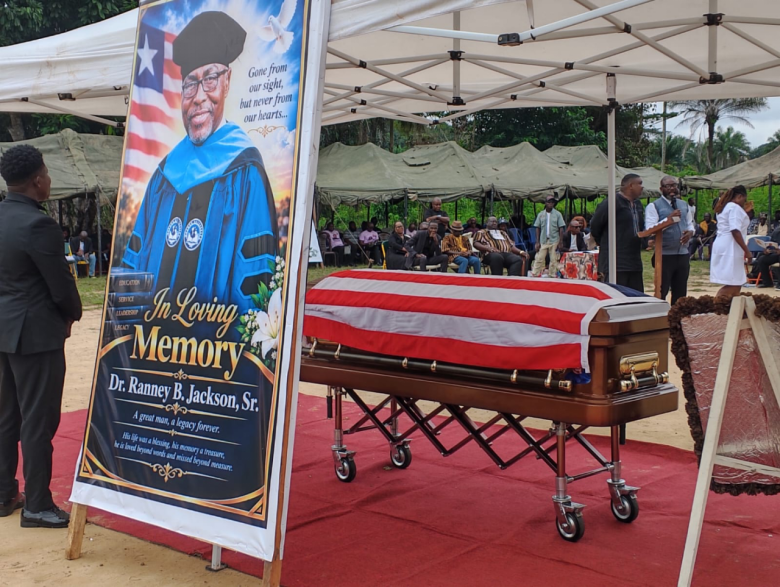
Jackson asked Bong County for a seat four times and did not get it. On Saturday, in the town where he was born, Bong gave him something that no election could: a crowd of people, speaking one after another, telling him that he had mattered. He was 74. He could not hear it. The county, at last, said it anyway
PELELEI, Zota District, Bong County – The women came first, and they came together. Members of the Bong County Women Organization filed into the funeral grounds in Pelelei on Saturday carrying a gratitude that had been years in the making. Behind them came former players, former students, elders, businessmen and young people from Gbarnga, all gathered to bury a man who had asked Bong County for something four times and never received it.
Dr. Ranney Banama Jackson Sr. was 74 when he died. He served as Superintendent of Bong County from 2006 until January 28, 2011, a stretch of years when the county was still finding its feet after the long civil war. He then sought the county’s Senate seat in 2005, 2011, 2014 and 2023, and each time the voters sent someone else to Monrovia. On Saturday, in the town where he was born, the same county that had turned him away filled the program with the words it had held back.
The hall that keeps giving
Madam Olivia Weetol, the former head of the Bong County Women Organization, stood before the mourners and spoke about a building. Jackson, she said, built the county’s first Women Center, a place where the women of Bong gather to hold meetings in the interest of the county.
Then she told them what the hall is doing now. Jackson is no longer around, she said, but the women still rent out the center, and the money they collect goes to needy women of the county who are desperately in need. Somewhere in Bong tonight, a woman who never met him may be eating because of a hall he raised. It was one of the quietest moments of the day, and for many people listening it was the hardest to bear. A man was being lowered into the ground, and something he built was still reaching for the hands of strangers.
The night he slept in the camp
Lincoln Gbaindeh did not come to talk about buildings. He came to talk about a night in 2008. Gbaindeh was a player on the Bong County team that reached the final of the National County Meet that year. He told mourners that Jackson did not stay in Gbarnga waiting for news. According to Gbeinteh, the superintendent literally slept in their camp, sitting among the young men and urging them to fight for the county and win it. That moment, Gbaindeh said, inspired them.
Bong won its first National County Meet soccer trophy that year. People who follow the county’s football say no superintendent has led Bong to that feat since. A county that rarely had anything to celebrate suddenly had a trophy, and a young man who had been afraid of the final had a superintendent beside him. Gbaindeh spoke for a few minutes, but he spoke like someone who had carried the memory for fifteen years, waiting for a place to put it down.
Tributes from every corner of Bong
One by one, others came to the podium, and every voice added something new. A Gbarnga resident, Gormah Flomo, said Jackson understood that the office of superintendent was not about sitting in Gbarnga and waiting for instructions from Monrovia. He believed the superintendent had a duty to bring development closer to the people. Flomo remembered improvements to public facilities, the work around the David Kuyon Sports Stadium and the efforts that helped improve electricity in Gbarnga. Those things may sound ordinary today, the resident said, but at the time they represented meaningful change for Bong County.
A resident of Suakoko District, Clyde Saul, spoke about young people. Jackson invested in them, the resident said, supporting education and scholarships so that many young Bongese could keep studying. More than 600 students reportedly benefited from a county scholarship initiative tied to his leadership, according to a biography from the AREPT organization. For families who could not afford school fees, the resident said, that help meant more than politics. It meant hope for their children.
A former student, Foster Peabody, stood up and made it personal. Some public officials are remembered because they held powerful positions, the former student said, and others because something they did touched ordinary people. When a child gets support to stay in school, that child can grow into a professional who contributes to society. That, Forkpah said, is why Jackson’s education work must remain part of Bong’s history.
A young resident, Jonathan McGill, of Gbarnga said Jackson showed that someone from Bong could rise through public service and still stay connected to home. His scholarship efforts, his development work and his later national service proved that his interest in public affairs went beyond one office. The young man hoped today’s leaders would take the lesson and invest more in education and opportunity for the next generation.
Remembering the ruins he inherited
Several speakers asked the crowd to remember the time Jackson served in. A Gbarnga businessman said Jackson arrived when Bong was trying to recover from the destruction and stagnation of the war years. He understood that development needed government facilities, investment and basic services, the businessman said. Whether people backed his politics or not, it is hard to talk about that chapter of Bong’s history without mentioning what happened under his watch.
The former Chiarman of the Bong Legislative Caucus, Attorney George Mulbah, said Liberia was coming out of a devastating civil war and Bong had enormous challenges. Jackson inherited a county that needed rebuilding, the resident said, and worked to restore public confidence and basic government functions. His contribution was not that everything was perfect, the resident said. His contribution was that he became part of the rebuilding.
Published accounts credit his administration with helping bring electricity to parts of Gbarnga and with renovating the presidential compound and rehabilitating the superintendent’s compound there. They also credit him with work at the David Kuyon Sports Stadium, though accounts differ on whether that was fencing or construction. Jackson himself once told a local radio audience in Gbarnga how he got it done. He clashed with members of the then Bong Legislative Caucus, some of whom opposed the idea, and he fenced the stadium anyway. Before that, residents had cut palm branches to ring the field on match days and big occasions.
A 2026 account says Jackson negotiated two multimillion-dollar rubber-processing plants for Gbarnga in 2008 and helped formalize the Sister States relationship linking Maryland in the United States with Liberia’s Bong and Maryland counties.
Those claims rest on that account and have not been independently verified, but they fit the portrait mourners painted of a man who looked beyond the county line.
The wound he carried
The people who loved him did not pretend he had never been hurt. In 2008, President Ellen Johnson Sirleaf suspended Jackson after an audit by the General Auditing Commission examined the management of county funds. Reports said he was accused of irregularities, including the use of US$10,000 of county money for a trip to the United States. He later repaid the money.
People who follow the county’s football say no superintendent has led Bong to that feat since. A county that rarely had anything to celebrate suddenly had a trophy, and a young man who had been afraid of the final had a superintendent beside him. Gbaindeh spoke for a few minutes, but he spoke like someone who had carried the memory for fifteen years, waiting for a place to put it down
Those close to the story say the journey had a purpose. Jackson and then Caucus Chair George Mulbah traveled with money from the Bong Social Development Fund to negotiate the sister-state relationship with Maryland, and one result was a dump truck from the State of Maryland that Bong County kept using. His political rivals, his supporters say, used the trip against him with the president. Sirleaf later explained, at a public forum in Gbarnga reported by FrontPage Africa, that she suspended him because he acted unilaterally, not simply because the money was spent.
A Bong County elder, William Kollie, spoke gently about all of this. Jackson was not perfect, the elder said, and like every public official his administration had controversies. But those controversies, the elder said, should not erase the things he did for the county. He carried Bong with him wherever he went.
Four times he asked
Behind the warmth of Saturday sits a record that is hard to read. In 2005, Jackson ran on the COTOL ticket and received 13,931 votes, or 7.8 percent, finishing fourth. In 2011, running for the Unity Party, he received 29,023 votes, or 25.56 percent, and finished second to Henry Willie Yallah, who received 29,804. The final margin from the National Elections Commission was 781 votes.
Seven hundred and eighty-one. It is a number small enough to fit in a single crowded church. It is the distance between the Senate and a long goodbye.
After that near miss, the support slipped away. In 2014, again as a Unity Party candidate, Jackson received 4,038 votes, or 10.4 percent, and finished third behind Jewel Howard-Taylor, who won with 13,672. In 2023, under the Rainbow Alliance, he received 6,552 votes, or 3.70 percent, and finished fifth in a race won by Johnny K. Kpehe with 78,122 votes. For a man who had once come within a whisper of the Senate, it must have been a lonely thing to watch the numbers shrink.
Bong has always been a difficult county to read. Sirleaf herself once said the people of Bong had been deceitful to her, after the 2011 returns. She received 48,374 votes there in the first round, or 42.9 percent, against 37,787 for Winston Tubman of the Congress for Democratic Change. In the November runoff her support climbed to 52,949 votes, or 83.45 percent, after the CDC declared it would not participate. With 467,561 people according to the 2022 census, Bong is Liberia’s third most populous county, and its voters have never been predictable.
Why gratitude does not always become a vote
Many people at the funeral wondered quietly why the love of Saturday had not appeared on election day. Nobody had a single answer. Elections turn on political alliances, party loyalty, personalities, changing priorities and the arrival of new faces. A politician can oversee projects that serve thousands and still fail to turn that record into votes years later.
But a funeral asks a different question. A ballot asks who should lead next. A funeral asks what a person meant. The woman who sits in the hall Jackson built, the player he encouraged, the student who stayed in school were not choosing between candidates on Saturday. They were answering for a life, and the answers came easily.
What love asks of the living
A community leader said the thing many in Pelelei were thinking. History will eventually judge every public official, the leader said, but Jackson deserves to be remembered for the development work done during his time as superintendent. He helped advance projects that touched public infrastructure, education and basic services. The best way to honor him,
the leader said, is not merely to praise him at his funeral, but to preserve the lessons of his service and keep building a better Bong County.
It is a heavy request, and a fair one. Love that comes late is still love, and the people of Bong showed on Saturday that theirs was real. But a hall that feeds the needy needs hands to keep it open. A scholarship needs someone to remember it. A stadium that no longer needs palm branches needs someone to remember why.
Jackson asked Bong County for a seat four times and did not get it. On Saturday, in the town where he was born, Bong gave him something that no election could: a crowd of people, speaking one after another, telling him that he had mattered. He was 74. He could not hear it. The county, at last, said it anyway.
See more Liberia News Network stories in Google Search by adding LNN as one of your Preferred Sources.
★ Add LNN as a Preferred Source