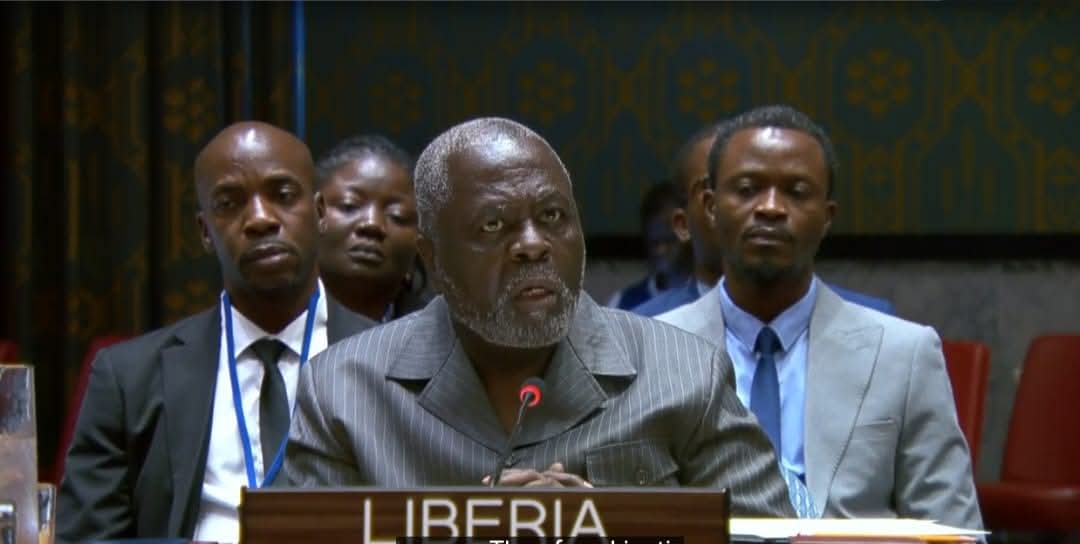
WASHINGTON, D.C., September 15, 2026 — Liberia has condemned attacks on humanitarian operations in Sudan, including the destruction of two World Food Programme (WFP) trucks carrying 50 tonnes of food aid, and called for an immediate and unconditional halt to the country’s ongoing conflict.
Liberia also rejected attempts to divide Sudan or establish parallel governing structures, warning that continued external support to the warring parties is helping to prolong the conflict.
Liberia’s Permanent Representative to the United Nations, Amb. Lewis G. Brown, presented the government’s position Monday during an informal United Nations Security Council dialogue on international mediation efforts in Sudan.
The meeting, convened by Denmark and the United Kingdom, focused on translating international mediation commitments into concrete action to address the conflict.
Brown told the gathering that Sudan does not need another warning, but an immediate cessation of hostilities and a credible return to a political process.
His comments followed an August 30 aerial attack outside Dilling that destroyed two clearly marked WFP trucks carrying 50 tonnes of food destined for Kadugli.
The supplies were intended to provide assistance to nearly 6,000 people facing severe hunger. According to information presented during the meeting, the incident marked the eighth attack on WFP operations this year despite advance de-confliction notifications.
Brown said attacks on essential infrastructure, healthcare facilities and civilians across El Obeid, Darfur and the Kordofans, as well as reports of widespread conflict-related sexual violence, remain unacceptable.
“Liberia condemns all violations of international humanitarian and human rights law in the war. De-confliction notifications must never serve as targeting data,” Brown said.
“We call on both the warring parties to halt hostilities unconditionally, open all humanitarian corridors, and respect the unity, sovereignty, and territorial integrity of Sudan,” he added.
Brown also warned against efforts to divide Sudan or establish competing governing structures.
“Liberia firmly rejects any attempts to divide the nation or establish parallel governing structures,” he said.
The Liberian diplomat argued that the conflict is no longer sustained solely by resources within Sudan, pointing to the flow of weapons, unmanned aerial systems, financing and illicit networks from outside the country.
“This conflict is no longer sustained solely by internal resources; it is supplied from abroad,” Brown said. “Therefore, accountability must address not only those who pull the trigger, but those who put that trigger within reach.”
Turning to international sanctions, Brown said the approaching October 9 expiration of UN Security Council Resolution 2828 should prompt consideration of measures capable of disrupting supply networks supporting the conflict and increasing pressure on the parties to return to negotiations.
He said Liberia supports a strengthened and adequately resourced Panel of Experts, stronger monitoring mechanisms, explicit coverage of unmanned systems and their operators under existing measures, and greater coordination among regional sanctions regimes.
Brown also called for stronger coordination among international and regional diplomatic initiatives seeking to end the conflict.
He commended the African Union, the Intergovernmental Authority on Development (IGAD), the Quintet and the UN Secretary-General’s Personal Envoy, but said the various initiatives should converge around a coordinated peace process owned by the Sudanese people.
“Multiple initiatives must coalesce into a single, coordinated track—one genuinely owned by the Sudanese people, especially women and youth,” Brown said.
Drawing on Liberia’s experience with civil conflict, Brown said the country’s wars ended through regional engagement, pressure on external suppliers and sustained advocacy by Liberian women rather than a decisive military victory.
“There was no military victory in Liberia, and there will be no durable military victory in Sudan,” he said.
Brown urged the international community to identify concrete steps over the next 90 days to reduce civilian suffering and improve coordination among the African Union, IGAD, League of Arab States, European Union and United Nations.
“The Sudanese people did not choose this war, and this Council cannot end it for them,” Brown said. “It is this Council’s duty, however, to make the continuation of this war far more costly than its end.”
He said Liberia remains prepared to work with international and regional partners toward ending the conflict.
See more Liberia News Network stories in Google Search by adding LNN as one of your Preferred Sources.
★ Add LNN as a Preferred Source