Published: September 4, 2026
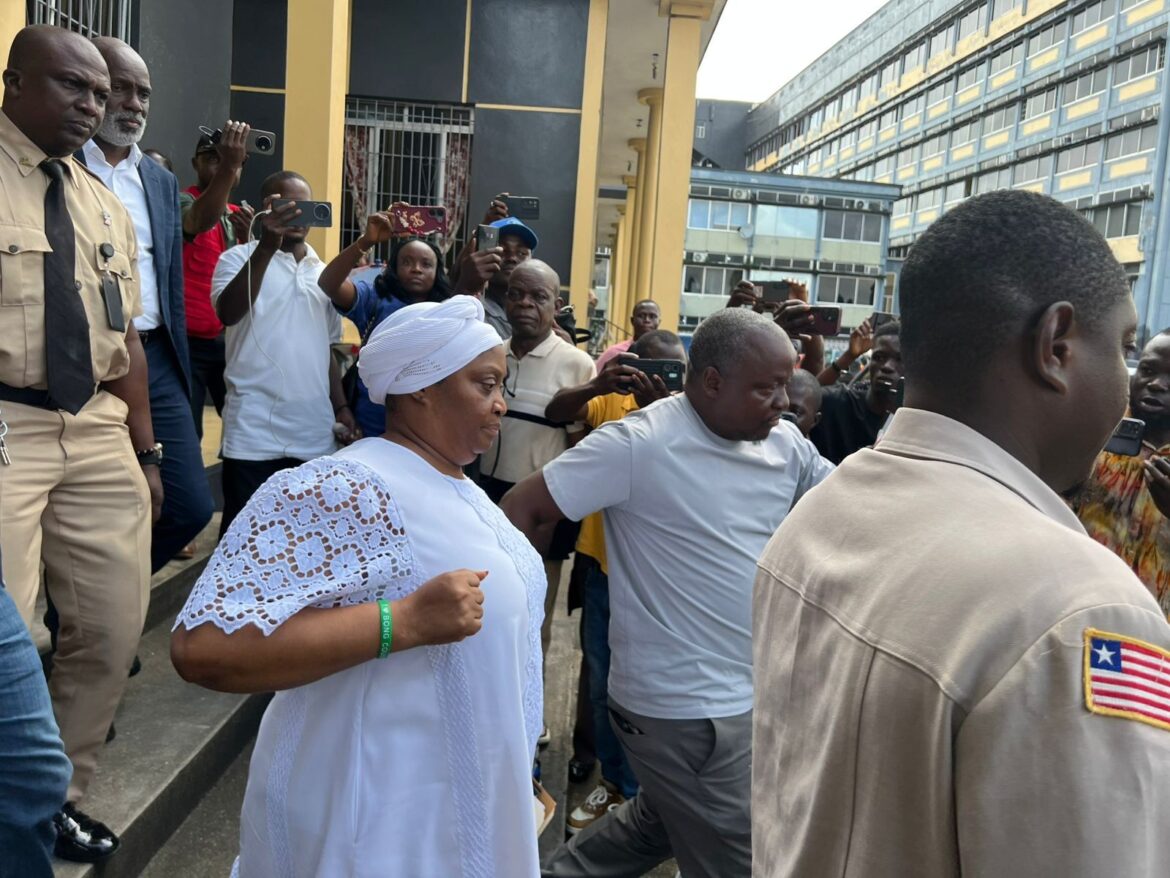
MONROVIA – Former Vice President Jewel Howard-Taylor will leave the Monrovia Central Prison for guarded detention at her Sinkor residence after Criminal Court “C” granted her compassionate medical release Friday, relief the government prosecuting her had itself asked the court to grant.
Judge Ousman F. Feika ordered that Howard-Taylor be taken directly from the central prison to her home on Tubman Boulevard and held there under nine conditions, including 24-hour police security at the residence, surrender of all her travel documents to the sheriff of Criminal Court “C,” a single family caregiver who may not be swapped without the court’s approval, and a bar on leaving the house except by court order or for an approved medical appointment.
She remains in detention. Feika said the release is not a dismissal, an acquittal, a pardon, immunity or a termination of the case, and that she can be returned to the central prison if court-appointed physicians or her own doctor find her condition has improved appreciably. Violating any condition can void the release.
The judge consolidated two applications seeking the same outcome, a motion by Howard-Taylor for bail on compassionate medical grounds and a bill of information filed by the Republic of Liberia through the Ministry of Justice asking that she be released on those grounds. Feika said the prosecution’s position substantially supported her claim, and he placed considerable weight on the fact that the state did not object and had asked for the relief itself.
Feika rejected the law she relied on. Howard-Taylor cited Chapter 34, Section 34.20 of the Criminal Procedure Law, which allows leave from prison for illness. That provision covers people already indicted, tried, convicted, sentenced and committed to prison, the judge said, and Howard-Taylor is a pre-trial detainee who has not been indicted by the Montserrado County grand jury. He granted the release anyway, resting instead on Section 1.2 of the Criminal Procedure Law, which calls for the just determination of criminal proceedings and for fairness, procedural simplicity and the avoidance of unjustifiable expense and delay.
The ruling also addressed why the Monrovia City Magisterial Court had refused the same request. That court lacked subject-matter jurisdiction over the charges, Feika said, citing Chapter 12, Sections 12.1 and 12.2, and its role was limited to the procedural requirements of a defendant’s initial appearance. Its refusal was therefore consistent with law.
Howard-Taylor’s motion said she has a life-threatening condition requiring continuous care unavailable at the detention facility, and that she has had it for an extended period. It was supported by a medical report filed with the court.
Under the conditions, her physician may visit by appointment, with notice to the prosecution. Other visitors will be admitted on a schedule to be developed by the Republic of Liberia, modeled on the visitation system the Bureau of Corrections uses at the central prison, and authorities must keep a full record of visitors with their telephone numbers and addresses. Any movement for medical care must be communicated to the court and the prosecution in time for the court to approve it.
She faces charges of importation of controlled drugs, unlicensed exportation of controlled drugs and substances, unlicensed sale and transportation of controlled substances, abuse of office, illicit trafficking, criminal conspiracy, criminal facilitation, criminal solicitation, money laundering and aiding the consummation of crime. The proceedings continue while she is held at home.
See more Liberia News Network stories in Google Search by adding LNN as one of your Preferred Sources.
★ Add LNN as a Preferred Source