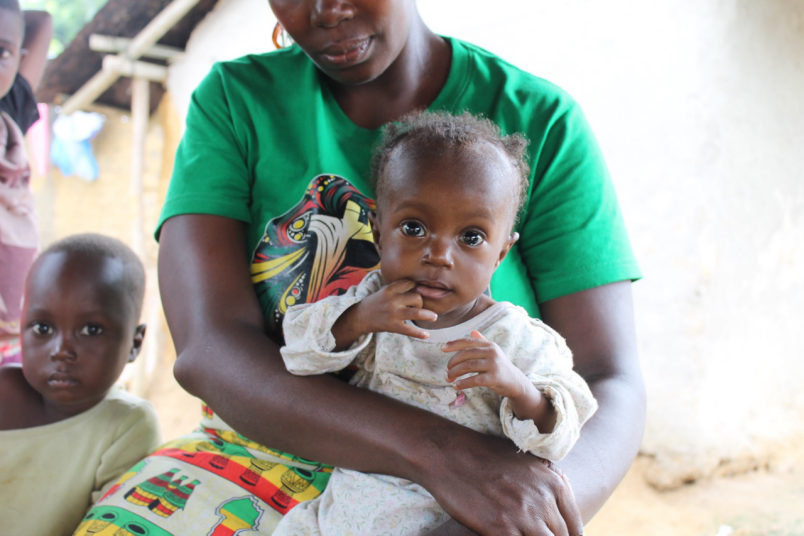
Eight-month-old Helen is showing signs of acute malnutrition because her mother does not have food to feed her.
Summary
- Aid cuts and rises in the costs of food and health care have contributed to a tripling of childhood malnutrition prompting an outcry from government officials and aid groups.
- A recently released national survey found that most Liberian families do not have enough money to buy the food they need. Nearly one in four children are dangerously malnourished, and more than one in four are stunted—causing lifelong mental and physical impacts.
- In a new essay a government official warns it is a crisis that will impact the country for generations and rob it of the human capital it needs to grow jobs and build the economy
By Nemenlah Cyrus Harmon, climate and environment reporter with New Narratives
GBAA-GAYE TOWN, Grand Bassa County – Eight-month-old Helen does not play the way babies usually do. She lies against her mother’s chest, as they sit under a palaver hut in this remote village surrounded by forest and accessible by one hand-cut road. Helen’s legs are as thin as reeds, her belly is swollen, her hair yellowing, and her eyes are too large for her face.
Helen cries weakly until her mother, Naomi, lifts a breast to her mouth. Helen should be eating solid food now. But her mother doesn’t have money for her food.
“That food we can get is food for ourselves to eat, but the one for the baby to eat, we don’t get that,” Naomi said grudgingly through an interpreter.
Naomi and her husband – who make charcoal and cut palm for as little as LD$7500 (US$40) a month – have six other living children. Naomi, 35, shows a reporter the mud hut where she shares a single mattress with five children. There’s no mosquito net. Helen was born on this bed and has never been to a clinic since, including for vaccinations.
Naomi knows Helen needs to go to the clinic – a two-hour walk away on muddy paths through the forest. But program manager Alfred Kekula, here with the Irish nonprofit Concern, doubts she will. Just talking appears to come with a psychological weight for Naomi. Kekula says she shows clear signs of post-partum depression.
“She does not value the life of the child,” he says. “Maybe she does not want the child to survive.”
Naomi with Helen inside the mud hut they share with five other children
Kekula and his team are seeing a growing number of mothers and babies in this state across Grand Bassa County. Once upon a time, the nearest clinic would have given a baby like Helen antibiotics and several months’ supply of Plumpy’Nut – the nutrient-dense, prepackaged food that has brought babies here back from the brink of death for decades.
But since the Trump administration closed USAID in 2025, Plumpy’Nut is long gone. In 2025, the government announced that services that were once free at health clinics now cost fees, a deterrent to the extremely poor like Naomi. Concern staff says babies in a critical state would be served free, but that information has not reached Naomi. Advocates here say they are seeing something they have not seen in years – babies dying.
Health advocates are now raising an alarm. A recently released Comprehensive Food Security and Nutrition Survey, done last year, found the number of children under five suffering acute malnutrition had nearly tripled to 8.5 percent, up from 3 percent in the 2020 Demographic and Health Survey. Most families do not have enough money to buy the food they need; nearly one in four children under five are dangerously malnourished, and more than one in four are stunted—too short for their age because they have not eaten well for years. (The survey has not been published online.)
And that likely got worse this year. Hunger changes with the seasons. When crops fail, or before the harvest, when roads flood in the rainy season and food cannot move, hunger gets worse. An analysis called the Cadre Harmonisé—used by aid organizations across West Africa to predict hunger—estimated that there would be a jump of nearly 100,000 people to 506,000 or 9 per cent in acute food crisis during this rainy season, when family food stores run empty and the next harvest has not yet come in.
Outside Naomi’s dwelling
The situation prompted Sayba Yawai Tamba, director of food security at the Ministry of Agriculture, to publish a searing essay this month warning that the country’s future is on the line.
“Malnutrition today becomes poverty tomorrow,” Tamba warns. When children do not eat well in their early years, their bodies and brains do not develop properly. They fall behind in school and face lifelong challenges: lower earnings, worse health, and less opportunity for success. According to UNICEF, stunted children carry this damage into adulthood, “reinforcing cycles of poverty across generations. For Liberia, where improving human development remains central to achieving inclusive economic growth, addressing malnutrition is an essential investment in the country’s human capital.”
The damage spreads beyond individual families. When hunger is widespread, communities become fragile. People are sick more often, miss work and school, and cannot earn enough to survive. This strains government services, removes workers from the economy, and slows growth. A country cannot build prosperity if its people are hungry and sick, Tamba says. Liberia needs a healthy, educated, and productive population to compete and create jobs. Without enough nutritious food, that future becomes impossible.
“Babies are dying”
Today’s crisis is compounding decades-old problems here that have never been properly addressed.
Most women here were teenagers when they had their first child. They have access to family planning in the form of injections given free at the clinic, but many women gave it up because of the cost of getting there and family pressure to keep having children. There’s no reproductive health education in schools here, if a girl like Naomi went at all. Parents say it is not their place to teach it. By 13 young girls here are usually out of school, unclear how pregnancy happens, and vulnerable to the attention of boys and older men.
Concern’s Kekula flags commercial bike riders as a problem. They come through towns, find short term girlfriends and disappear when she becomes pregnant.
At a ministry of health training on malnutrition in Gbaa-Gaye Town not one mother is in the audience. It is made up of men and a few grandmothers.
The young girls don’t know how to raise a baby, and misinformation abounds. Babies cannot absorb nutrients from food and water in the first six months of life. Water and food introduce germs that their bodies are unable to handle. Only breast milk is safe. But health workers here concede that few mothers follow the rules, if they ever hear them at all. Most babies are given rice and unsafe water from their earliest days.
Some mothers believe prolonged breastfeeding drains their bodies of nutrients. Others worry it will flatten their breasts and make them unattractive. Others believe babies need water and solid food to thrive. One grandmother told a reporter here recently that her own children were given water and family foods, from a young age, and none died or needed hospital care.
“People can hear plenty funny things in the city,” she said. “But in the bush, you will not hear it, don’t give the baby this one, give the baby that one.”
Another baby showing signs of acute malnutrition in Gbaa-Gaye Town
That leaves babies malnourished and vulnerable to malaria, infections, and other illnesses. The damage to their development then leads to the cycle beginning again. Women can be grandmothers here at 26; great-grandmothers before they reach 40. Another factor: many families don’t invest resources into children until they are five years old, believing only those who survive are strong enough to justify the cost.
Before, the closure of USAID supplemental formula for those under six months, and Plumpy’Nut for those older, was providing a lifesaving stopgap measure when it made it to mothers like Naomi. (Much of it did not. Stories of truckloads of supplies disappearing and reappearing for sale in markets here are common.)
But now that stopgap is gone.
“No Plumpy’Nut, the baby will obviously die,” Kekula says frankly. “Babies die and will continue to die in the absence of Plumpy’Nut.”
Clinics powerless to help
At the clinic in nearby Bokay Town, officer-in-charge J. Alaska O. Madeh says staff here are facing heartbreak daily. Plumpy’Nut supplies dwindled in 2025; by the start of this year it was gone.
Without therapeutic food, health workers are left providing only counselling and advice. Few think it will be followed when they leave. “Even if we even treat them, most of them will lose their life,” Madeh says.
J. Alaska O. Madeh, head of the nearby Bokay Town clinic, measures a child’s arm width, one of the determinants of malnutrition
Naomi is in an area covered by Concern, which supports the clinics here to ensure at-risk babies are identified and brought to the clinic. In another area of the county, there is no such help.
Babies are already dying
In Tepenneh Town, a two-hour bike ride on a heavily damaged road from the closest clinic at Compound 2, in District 2 of Grand Bassa County, babies are already dying. At a recent gathering of the community here, Concern’s Alfred Kekula identified several children with clear signs of malnutrition.
Climate change has devastated farmers here who live on what they grow. That once would have got them through the full year with money for medical costs and school. But now they run out of food early. Rice and vegetables will not be ready for several months. Cassava, which grows year-round, is not yielding enough to sustain them.
“Now at this present moment we are buying food,” says Tepenneh’s women’s leader, Naomi Vorgar, through an interpreter.
Diets consist of rice and cassava – not enough variety to provide nutrients needed for growing children. Chicken, eggs, milk and other nutrient-rich foods are out of reach.
A measles outbreak ran through this area in June this year. Mamie’s two-year-old son was already malnourished. Babies are usually given their first vaccines after birth, if they are born in a health facility. But they need to come back to complete the series. Measles vaccines are given at nine months.
A toddler recovering from malnutrition. She was one of the last babies here to receive Plumpy’Nut.
All mothers interviewed here never went back for vaccines. The cost they believed they had to pay at the clinic and the cost of the motorcycle to get there were barriers that were just too big. Though a 2022 study claimed half the households in the country have treated mosquito nets, no one here has seen one in use.
When Mamie’s son became sick with measles, she had no money to take him to the clinic. He soon died.
Another mother named Hannah sits with her malnourished seven-month-old son in her lap. In June he was a twin. The second baby became sick, and so that’s when Hannah took him to the clinic for the vaccine, she says. Like most mothers interviewed here, Hannah thought the vaccine was a treatment, not a preventative. It will not cure a child who is sick. The boy soon died.
Several mothers told us they had never heard that babies could only have breast milk for six months or that they need more food after that period. Malnutrition would have made the children more vulnerable to infection.
“When breast milk is lacking, and at the same time food is lacking, definitely it worsens the condition,” says Kekula.
In her essay, Tamba lauds the Boakai administration’s National Agricultural Development plan, which seeks to transform Liberia’s agriculture sector by increasing productivity, strengthening food systems, improving market access, promoting private sector participation, and building resilience to climate change. But she warns that food security and nutrition cannot be achieved by increasing food production alone. The country must pursue an integrated approach, with every part of society contributing: individuals and families through diversified household food production and improved infant and young child feeding practices; local governments through strengthening community health services and water and sanitation infrastructure; the national government through continued investment in agriculture, nutrition, maternal and child health, climate adaptation, rural infrastructure, and social protection; and development partners through long-term investments that strengthen national capacity and help the country become more self-reliant.
“Success will be measured not only by reductions in malnutrition rates, but by the changes people experience in their daily lives,” writes Tamba. “This means children growing up healthy and ready to learn, families having reliable access to affordable and nutritious foods, farmers earning better incomes from productive and resilient farms, and communities being better prepared for future shocks. It means a Liberia where every child has the opportunity to reach their full potential and where nutrition becomes a foundation for stronger families, healthier communities, and sustainable national development.”
For Helen and other babies born into extreme hunger in Liberia, this overhaul needs to get moving fast. For now, the number of babies dying and being harmed for life looks set to get worse.
This story was produced in collaboration with New Narratives as part of the Investigating Liberia Project. Funding was provided by the Swedish International Development Cooperation Agency. The funders had no say in the story’s content.
See more Liberia News Network stories in Google Search by adding LNN as one of your Preferred Sources.
★ Add LNN as a Preferred Source