The parties accuse the Boakai-Koung government of losing territory in Foya to Guinea, running selective anti-corruption and anti-drug campaigns, defying the Supreme Court and using the new Cybercrime Act to muzzle critics. They are setting up an Opposition Political Parties’ Joint Technical Committee (OPPJTC), with two members from each party, to draft a common agenda. They stopped short of an electoral alliance.
MONROVIA – Liberia’s opposition moved from talk to paper on Sunday. Five political parties signed a joint communiqué accusing the government of President Joseph Nyuma Boakai of losing Liberian land to Guinea, fighting corruption and drugs selectively, and steering the country toward what they called a police state.
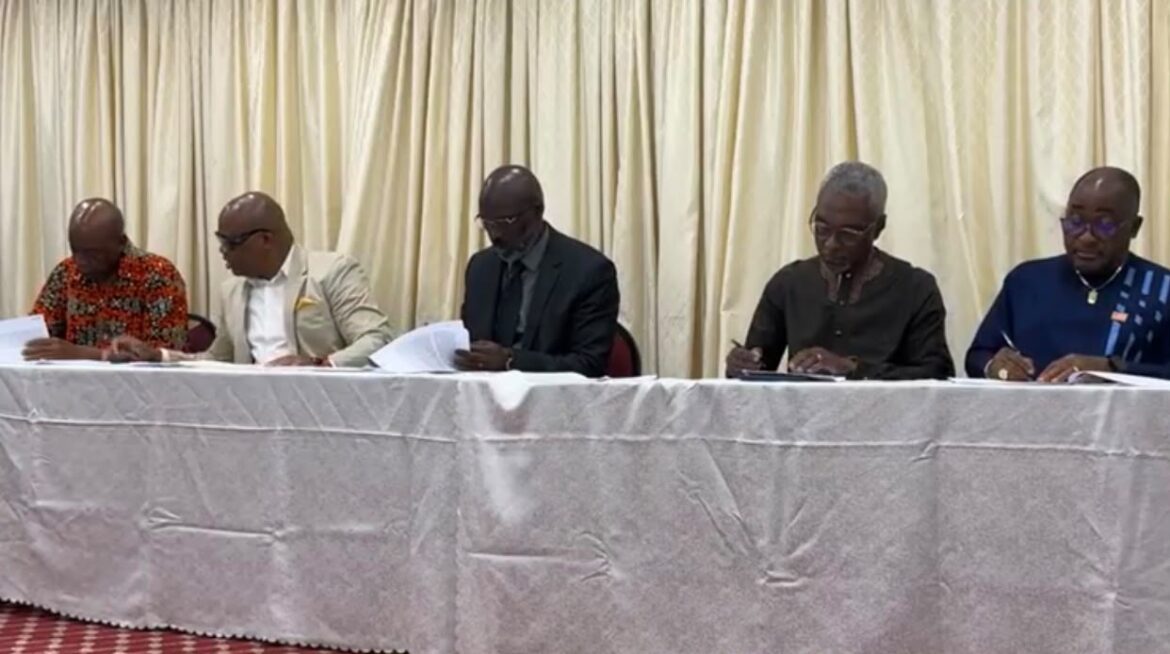
The eight-page document was signed at the Sinkor Palace on Tubman Boulevard at the close of a second opposition roundtable, hosted by Movement for Progressive Change (MPC) political leader Simeon C. M. Freeman. Alongside Freeman, it bears the signatures of former President George Manneh Weah of the Coalition for Democratic Change (CDC), Alexander Benedict Cummings of the Alternative National Congress (ANC), Amb. Dee-Maxwell Saah Kemayah, Sr. of the Movement for Economic Empowerment (MOVEE), and Jonathan A. Mason of the Union of Liberian Democrats Party (ULDP).
“Our objective is not simply to oppose government, but rather, to help build a Liberia in which government works,” the leaders wrote. They pledged to “jointly and constructively hold the Boakai-Koung-Unity Party-led Government accountable for its stewardship of the Republic.”
A Committee, Not Yet a Coalition
The parties were careful not to call what they have formed an alliance. Each will keep its own identity and autonomy. Instead, they created the Opposition Political Parties’ Joint Technical Committee (OPPJTC), made up of two representatives from each party. The committee will draw up an implementation agenda, set up thematic working groups and reach out to opposition lawmakers, civil society, professional groups and communities in all 15 counties.
The document is plain about why the parties are moving slowly. They say they have studied earlier attempts at opposition collaboration that failed, only partly succeeded or fell apart, and promise to build trust through real consultation “rather than attempting to manufacture opposition political unity by declaration.” If the partnership works, they say, it will “naturally inform the 2029 electoral agenda.”
Foya and the Guinea Border
The communiqué leads with national sovereignty. The parties charge that Guinea is occupying Liberian territory in Foya District, Lofa County, and that the government has failed to resolve the matter diplomatically or to push ECOWAS, the African Union and the United Nations to act. Liberians read about losing land in the 1800s, the leaders wrote, but will not accept it “in this 21st century.”
Corruption: The Foya Project and the SIB Transfer
The parties call the fight against corruption selective, aggressive toward the past government and blind to the current one. They single out a US$10 million construction project in Foya, President Boakai’s hometown, which they call “a flagship of corruption.” They say procurement and budget rules were violated, that funding sources remain unexplained, and that the Mano River Union has denied any link to the project despite government claims.
The ANC wrote to the Liberia Anti-Corruption Commission (LACC) about the project in May. In June, the LACC replied that it would carry out a “preliminary assessment.” The opposition says nothing has happened since.
The parties also want an investigation into the US$8 million in reserve money the Central Bank of Liberia transferred to SIB Liberia in May 2024 under an April 18, 2024 directive from President Boakai. They note that SIB, which emerged from the failed FIBLL, has been accused of financing Boakai’s 2023 campaign. They urged the LACC to act “without fear or favor,” pointing out that its commissioners cannot be removed by a president without a majority vote of the Senate.
The Drug Busts
On drugs, the leaders are calling for an independent inquiry into the US$19 million and US$317 million cocaine busts. They lean on Inspector General of Police Gregory Coleman’s own statement that senior officials “at the highest level” were involved, and want him taken off the investigation. They propose a commission drawn from the Liberia National Bar Association, the Press Union of Liberia, civil society, the Liberia National Muslim Council, the Liberia Council of Churches and members of the diplomatic community.
They accuse the government of letting dismissed security officials roam free while it has “summarily and arbitrarily charged, imprisoned and disgraced a Former Vice President” without an indictment after more than a month. The communiqué does not name her, but the reference is to former Vice President Jewel Howard-Taylor, who faces multiple criminal charges arising from the investigation; her lawyers have rejected the allegations as politically motivated, while the government denies the prosecution is politically driven.
Courts, Free Speech and the Airport
The leaders say the government has ignored Supreme Court opinions protecting tenured officials and backed the so-called Majority Bloc in the House after the Court called its actions “ultra vires.” They warned that if the Court’s word is not law, Liberia is “heading in a dangerous direction of lawlessness.”
They condemned the recent arrest of a young Liberian, under the new Cybercrime Act, for allegedly spreading an AI-generated image of the Vice President. They say they support a law aimed at real internet crimes but not one used to shield officials from criticism and ridicule, which they say Article 15 of the Constitution protects. They also cited the Legislature’s no-confidence votes against critics and what they called insults from the Ministry of Information.
The communiqué also condemns what it calls a threatening show of force by armed joint security officers when Weah returned home through Roberts International Airport on September 2.
Diplomats and Deportees
The parties point to the Government’s March 2026 request that the EU recall its Ambassador, Nona Deprez, after she called for more transparency in the mining sector. The EU has yet to name a replacement, which they called “an international embarrassment.” They also cited the rejection of advice from an ECOWAS delegation during the legislative crisis that began in October 2024.
They demand full disclosure on the arrangement with the United States to take in up to 1,200 third-country nationals facing deportation from America.
Economy, Evictions, Schools and Clinics
The document does give the government some credit, commending it for crossing US$1 billion in domestic revenue, but says ordinary Liberians are not feeling it. The parties accuse the government of failing to enforce rules that separate wholesaling from retailing and failing to protect business opportunities reserved for Liberians.
They say more than 200,000 Liberians have been affected by demolitions, and quote President Boakai as saying “God is not giving new land.” They also allege that Liberian firms scoring highest in public tenders have been rejected over opposition ties. On health and education, they say many health workers are still on voluntary payroll and there is no plan to lift teachers’ salaries in step with revenue.
NEC and 2029
Recalling that Weah handed over power after losing by about 20,567 votes, roughly 1.28 percent, in 2023, the leaders said they are alarmed by what they see as intentions by the new leadership of the National Elections Commission to de-register political parties. Any such attempt, they warned, “will be resisted in the strongest term.”
How We Got Here
The Sunday signing is the product of a process Weah set in motion shortly after his return. In an August 27 statement, the CDC announced his return and disclosed plans for an opposition leaders’ roundtable on the country’s political, economic, security and governance challenges. Weah arrived on September 2 after months of international engagements and was met by large crowds at RIA and along the road to Monrovia.
The first round was held September 5 and 6 at Weah’s Jamaica Resort in Paynesville. Among those present was Nimba County Senator Samuel G. Kogar, recently expelled from the Movement for Democracy and Reconstruction. Participants discussed national issues and possible cooperation but did not form an electoral coalition or agree on a 2029 ticket. They agreed to set up a steering committee of two representatives from each party to draft a framework for working together, the body now formalized as the OPPJTC. Freeman said at the time the leaders would reconvene within two weeks at another venue.
The process has already stirred trouble outside the room. The National Patriotic Party suspended three senior partisans for allegedly using its letterhead to endorse the Weah-led roundtable. The ruling party has brushed the effort aside: Unity Party Secretary General Amos B. Tweh, launching the Boakai 2029 Reelection Movement, said the gathering posed no serious threat to the party or the President’s reelection.
One Empty Chair
The communiqué carries five signatures, not six. On Thursday, September 24, the Citizens Movement for Change (CMC) said it had informed Weah and the other leaders that it would not endorse the draft communiqué or remain in the coalition process. The CMC says it backs opposition cooperation but wants it anchored in a clearly defined national reform program, including changes to the system of government, institutions and laws.
It was the latest turn for Rep. Musa Hassan Bility. He first rejected the roundtable, arguing that opposition unity cannot begin with predetermined leadership, then reversed himself and attended on September 6. At the press conference afterward, he said the aim was to rescue Liberians from the “so-called rescuers.”
The shadow of the collapsed Collaborating Political Parties (CPP) also hangs over the effort. The current talks bring together figures who once stood on opposite sides of opposition alliances, including Cummings, whose ANC was at the center of the old CPP, now working with Weah’s CDC.
What’s Next
The parties say they will keep holding roundtables and consultations “in good faith, with mutual respect, shared ownership, transparency and a commitment to Liberia and the Liberian People,” and called on all Liberians who believe in constitutional democracy and equal justice to join what they called a national conversation.
See more Liberia News Network stories in Google Search by adding LNN as one of your Preferred Sources.
★ Add LNN as a Preferred Source