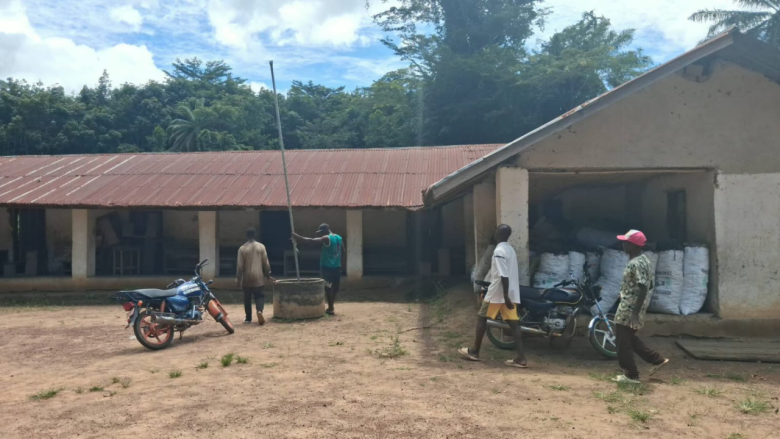
There is a bitter symmetry to this image that is hard to ignore. The very resource being mobilized to save the school is, in the meantime, occupying and potentially damaging the space that school needs to function. Residents watching this unfold are left with a daily, physical reminder of the gap between their aspirations for their children and the economic reality constraining them — a school building slowly becoming indistinguishable from a warehouse, its educational purpose paused indefinitely while it earns its keep as storage space instead.\n
Kpolokplah Public School relied entirely on volunteer teachers since the government never assigned staff, leaving the PTA to fund salaries through farming and charcoal sales. A failed harvest cut this income, teachers went unpaid for six months, and struck—closing the school. Government response has focused elsewhere, leaving the crisis unresolved.
\n
DISTRICT TWO, BONG COUNTY – In Kpolokplah Town, deep in Bong County District Two, mornings no longer begin with the shuffle of small feet down dirt paths toward a schoolhouse. There is no morning assembly, no recitation of lessons drifting from open windows, no chalk dust settling on wooden desks. Instead, an entire generation of children sits at home, their school year suspended not by war, not by disaster, but by a debt of a few thousand Liberian dollars that a struggling farming community simply cannot pay.
\n
By Selma Lomax, [email protected]
\n
Nearly a month after schools reopened across Liberia for the 2026/2027 academic year, Kpolokplah Public School remains locked in limbo — a casualty not of policy failure alone, but of a bad harvest, a broken funding model, and a government that, by the community’s own account, has left it to fend for itself.
\n
When Volunteers Become the Whole System
\n
To understand how one poor farming season could shutter an entire school, one must first understand what kept that school running in the first place. Kpolokplah Public School, principal Jeremiah D. Yarkpawolo revealed, has no government-assigned teachers at all. Every single instructor who has ever stood before its students in recent memory has been a volunteer — recruited, retained, and paid not by the Ministry of Education, but by the community’s own Parent-Teacher Association.
\n
This is a detail easy to skim past but impossible to overstate. In towns with even a partial complement of government teachers, a dispute with volunteer staff might cause disruption, but rarely total closure.
\n
In Kpolokplah, there was no fallback plan, because there was no government presence to fall back on. The PTA was not merely supplementing the school’s teaching staff — it was the entire staffing infrastructure, quietly substituting for a state responsibility that never arrived. When that substitute system broke down, there was nothing behind it to catch the fall.
\n
The Arithmetic of Desperation
\n
The economics behind the crisis are almost painfully modest. According to David Gorlormator, head of the Parent-Teacher Association, each of the four volunteer teachers is owed just LD$5,000 a month for six months — a sum that would draw little notice in a national budget but has proven beyond the reach of a community whose income depends entirely on unpredictable harvests and the sale of charcoal burned from their own forests.
\n
Gorlormator’s account is one of a community trying, and failing, to outrun its own poverty. Parents and PTA members turned to farming, charcoal-making, and whatever small trade they could manage, funneling proceeds toward teacher salaries in what amounted to a grassroots, informal payroll system. It worked, imperfectly, for a time. But this year’s farming season faltered, yields dropped, and the trickle of income the PTA depended on dried up along with it. What emerges is not a story of mismanagement or unwillingness to pay, but one of a community whose entire financial safety net for education was tied to the whims of rainfall and soil — a safety net that has now visibly frayed.
\n
Four Teachers, One Ultimatum
\n
For the four volunteer teachers at the center of this dispute, patience has run out. Principal Yarkpawolo says they have made their position unmistakably clear that no back pay, no classroom. It is a stance that is difficult to fault. These are people who gave their labor, month after month, to a community that could not always guarantee they would be compensated for it — and who now find themselves being asked to continue that arrangement indefinitely, with no resolution in sight.
\n
Their refusal is not simply the withholding of labor; it is the collapse of the only mechanism keeping the lights on, so to speak, at Kpolokplah Public School. And because that mechanism was never backed by any parallel government staffing, its failure has not dented the school’s operations — it has ended them entirely, at least for now.
\n
From Classroom to Charcoal Depot
\n
Nowhere is the toll of this standoff more visible than inside the school itself. With no students and no teachers, the physical building has quietly taken on a new identity, a storage site for charcoal, the same commodity residents are burning and selling in a desperate bid to raise the money needed to reopen the school. The classrooms meant to hold desks, chalkboards, and children now hold sacks of fuel bound for market.
\nThere is a bitter symmetry to this image that is hard to ignore. The very resource being mobilized to save the school is, in the meantime, occupying and potentially damaging the space that school needs to function. Residents watching this unfold are left with a daily, physical reminder of the gap between their aspirations for their children and the economic reality constraining them — a school building slowly becoming indistinguishable from a warehouse, its educational purpose paused indefinitely while it earns its keep as storage space instead\n
There is a bitter symmetry to this image that is hard to ignore. The very resource being mobilized to save the school is, in the meantime, occupying and potentially damaging the space that school needs to function. Residents watching this unfold are left with a daily, physical reminder of the gap between their aspirations for their children and the economic reality constraining them — a school building slowly becoming indistinguishable from a warehouse, its educational purpose paused indefinitely while it earns its keep as storage space instead.
\n
A Town That Has Already Buried Too Much
\n
Kpolokplah’s current struggles do not exist in isolation from its past. This is a town that carries the weight of Liberia’s civil war within its history, having been the site where several residents were killed during the 1994 massacre — one of many dark chapters etched into Bong County’s collective memory. For a community that has already endured such loss, the slow erosion of its children’s access to education represents not just a present-day crisis, but another entry in a long history of hardship that seems to have outlasted the war itself.
\n
Residents, understandably, see the school closure as part of a broader pattern — one in which promises of post-conflict rebuilding and development have been slow to reach communities like theirs, leaving basic services like education perpetually just out of reach.
\n
A Lawmaker’s Balancing Act
\n
The predicament in Kpolokplah has not gone entirely unnoticed at the political level. Hon. James M. Kolleh, Representative for Bong County Electoral District 2, has publicly acknowledged the education and water challenges facing communities under his watch, responding to reports that span not just Kpolokplah but other struggling schools such as Barsee Kpangbai Public School in Blemeyea, which reportedly operates with just two teachers for its entire student body.
\nIn Kpolokplah, there was no fallback plan, because there was no government presence to fall back on. The PTA was not merely supplementing the school’s teaching staff — it was the entire staffing infrastructure, quietly substituting for a state responsibility that never arrived. When that substitute system broke down, there was nothing behind it to catch the fall.\n
Rep. Kolleh’s response has focused heavily on Barsee Kpangbai, where he has pledged to work toward deploying two additional teachers, while more broadly promising to assess the needs of other schools across the district — a commitment that, for now, leaves Kpolokplah’s specific staffing vacuum without a direct answer.
\n
He pointed to past efforts, including last year’s distribution of 5,000 armchairs to area schools, and indicated plans to expand on that furniture initiative this year. Whether
\n
such efforts will translate into the one thing Kpolokplah actually needs — salaried government teachers — remains an open question.
\n
On water access, another pressing concern in the district, Rep. Kolleh was more specific about Kpolokplah itself, confirming that the town is slated to benefit from ongoing water projects and promising, in the interim, to repair the community’s existing hand pump. He framed his broader approach as one of continued responsiveness to constituent needs, describing service to the district as central to his mandate as its elected representative.
\n
Waiting for a Callback
\n
What remains missing from this story is an official accounting from the very body responsible for staffing and overseeing public education in the county. FrontPage Africa contacted County Education Officer David Boakai, who answered the call and indicated he would follow up with a fuller response. That callback never came before publication.
\n
In its absence, silence from the Ministry of Education’s local representative stands in stark contrast to the noise Kpolokplah’s crisis has already generated — a community publicly airing its struggle, a lawmaker publicly responding to it, and, at the center of it all, a county education office that has, for now, said nothing at all. For the children of Kpolokplah, still waiting for a return to their classrooms, that silence may prove just as costly as the unpaid wages that emptied them in the first place.
See more Liberia News Network stories in Google Search by adding LNN as one of your Preferred Sources.
★ Add LNN as a Preferred Source