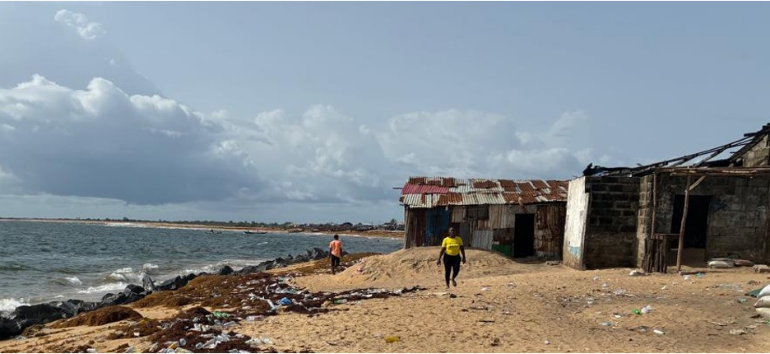
The sea continues to wash away at homes in the West Point township, in Monrovia. Credit: Allison Hunter for New Narratives
Summary
- Scientists warn that a historically severe El Niño – a climate pattern that disrupts weather around the world – could bring erratic rainfall, and severe flooding, extreme heat, fishing and agricultural disruption to Liberia in coming months.
- Experts say the government needs to invest in preparedness strategies now to protect people from to extreme heat and weather in coming months with extreme heat alone predicted to kill 450,000 people globally by February.
- Liberia lacks adequate weather stations and relies heavily on global models, limiting its ability to issue accurate, community-specific warnings and meaning millions of Liberians will be left vulnerable.
The sea off Liberia turns a deceptive shade of calm every year around this time as the rains give way to the dry season – warm, glassy, inviting.
But Nathaniel Blama, Liberia’s former chief environmental regulator, has learned to read that as a warning rather than an invitation.
“When you see the water very warm during that period, it’s time to be afraid because having storm surge, the movement of the current is completely different than normal,” he said. “A lot of people, children, go on the beach. They don’t come back.” Houses and livelihoods are also swept away.
But this year is shaping up to be much worse. New data by climate researchers shows the world is experiencing an exceptionally powerful weather pattern called El Niño—likely the strongest in at least 1,000 years—layered on top of human-caused climate change from burning fossil fuels. This combination means 2027 is expected to be the hottest year ever recorded by scientists.
The climate crisis is already making extreme weather more intense and deadly. Rising heat is now killing one person every minute globally. The El Niño will make this worse, intensifying heatwaves, droughts, and floods across the planet, including Africa. Newly released data from the U.S. based Climate Impact Lab estimates that more than 450,000 people are projected to die globally from the additional heat brought by the super El Niño by February, more than 30,000 in Nigeria alone.
“So, in many places around the world we will see never-before-experienced heat extremes, with all their consequences on health, food security and water stress,” Prof. Friederike Otto of Imperial College London told The Guardian.
In West Africa, where millions rely on rain-fed agriculture, those shifts can be especially damaging. For Liberia, changes in the timing and intensity of rainfall could threaten crops, worsen flooding and increase pressure on already vulnerable communities.
“Farmers could face unreliable rainfall, while hotter, drier conditions threaten crops, water supplies, hydropower and increase the risk of bushfires in places like Wologizi and Foya,” said Isaac Nyaneyon Kannah Teah, a Liberian climate expert.
El Niño is a natural climate pattern that occurs when waters in the Pacific Ocean become unusually warm, disrupting weather patterns across the world. It can shift rainfall, intensify heat and bring drought to some regions while causing heavy rains and flooding in others.
Some experts are calling this a “monster” weather event. Temperatures in the Pacific at the heart of El Niño reached a record 3.05C in September. Forecasts project the warming could peak at about 4 C in November and December. A rise above 2C is classified as a very strong, or “super,” El Niño.
Teah said the full impact of the developing El Niño on the country’s current rainy season, ending this month, remains uncertain, but changes in weather conditions in coming months appear certain.
“El Niño may contribute to a hotter and drier January-to-March dry season, placing pressure on water supplies, agriculture, forests and electricity generation,” Teah said. It could also make the beginning of the farming season less predictable, including false rainfall starts followed by prolonged dry spells that damage newly planted crops.
Farmer Oretha Weatoe of James Town, River Cess, looks on as her crops struggle to grow. Photo Eric Opa Doue/New Narratives.
Nearly seven out of 10 Liberians depend on farming for what they eat, so disrupted rainfall could threaten both food and income. Four in every five Liberians is already facing food insecurity. Just 1.6 percent is irrigated, leaving farmers heavily dependent on the rains.
At Liberia’s Meteorological Service, forecasters are already watching the signal build, but they are severely limited by a lack of sophisticated equipment. “We are not even having a marine weather station to give us the actual sea surface temperature,” said Albert Momolu Sherman, director of Liberia’s Meteorological Service, which operates under the Ministry of Transport. “We normally rely on global models.”
Those global models are consistent enough to worry him. He described how an intensifying El Niño fools farmers into planting too early.
“Farmers think that, ‘Okay, the rainy season has started,’ not knowing that this is just a false start,” Sherman said. Then, once the West African monsoon reasserts itself, the rain that finally does come arrives harder and more suddenly than usual, raising the risk of seedlings being waterlogged and communities swamped by flash flooding in a country whose drainage systems were never built for it.
Unlike other countries in the region, the Liberian government does not have a mechanism for warning Liberians about coming heatwaves and heavy rains. The Meteorological Service publishes a ten-day agricultural bulletin meant to guide farmers’ planting decisions. But reaching the people who need it most – in communities without reliable radio, internet or electricity – depends on partnerships with the Liberia Telecommunications Authority, the National Disaster Management Agency and the Red Cross that have yet to fully materialize.
It should not have been like this. International donors made a fund of $10 million available to establish a warning system six years ago. FrontPage Africa/New Narratives documented the suspected corruption and lack of capacity under the Weah administration that led to four-year delays in the project. The Boakai administration reports that it has got the project moving but it has also faced delays.
Teah said it is still too early to determine its effect on Liberia’s entire 2027 season but even if the farmers are spared, they’ll be hit by impacts elsewhere. Because Liberians depend on imports for 80 percent of their food, they could also face higher food prices as El Nino reduces agricultural production in countries from which we import rice and other foods.
Excessive heat will add another dimension. In addition to impacting farming, heat makes it harder for people to work—farmers, fishermen, and construction workers will tire faster in extreme temperatures, earning less money to buy food. Water sources dry up or become contaminated, spreading waterborne diseases that weaken children’s bodies and make malnutrition even more deadly.
A satellite weather-monitoring system used to forecast weather at Roberts International Airport. Photo credit: Liberia Meteorological Service.
For the millions of Liberians who are already food insecure, already eating less nutritious food because they cannot afford better, an intense heat wave could push families from precarious to catastrophic: crops will fail, prices will spike, work will become impossible, and children will face acute hunger. The rural communities hit hardest by heat—with no air conditioning, limited access to clean water, and no cushion of savings—will be the most vulnerable.
The knock-on effects reach further than the farm gate. St. Paul River which supplies the Mount Coffee Hydropower plant near Monrovia can run low as evaporation increases, threatening the electricity supply. It has already reduced electricity generation in recent years as dry-season water levels in the river fell, contributing to widespread power cuts across Liberia. This coming dry season could be worse.
Fishermen monitor the weather as their canoes sit offshore at West Point. Photo by Nemenlah Cyrus Harmon.
Offshore, artisanal fishers face a quieter but no less consequential disruption: warming waters altering fish stocks and pushing dangerous sea conditions closer to shore, threatening both catches and the fishers themselves.
Rising heat brings its own toll for humans: heat stress and other health complications for a population with limited access to cooling or medical care. It will be dangerous for the elderly, infants and those weakened by illness.
Experts said the government has a role to play in helping communities prepare for possible weather-related challenges.
“Closely monitor forecasts from the Liberia Meteorological Service and strengthen preparedness for heat, water shortages, bushfires, agricultural losses and possible flooding,” says Sherman.
The government can also put in measures to save lives including including cooling centers where people can shelter, increased staffing for medical facilities at the hottest times and protections for outdoor workers.
President Joseph Boakai will be immersed in discussion of climate change and the super El Nino during his time at this month’s UN General Assembly. The issue has been a central topic of the meeting with world leaders approving a new declaration to tackle sea level rise with 770 million people live in coastal areas affected by sea level rise. 230,000 Liberians will lose their homes by the end of the century, according to UN models.
Experts said they hope the president comes home from the assembly with a renewed vigor and new ideas to protect Liberians in coming months.
This story was produced in collaboration with New Narratives as part of the Investigating Liberia Project. Funding was provided by the Swedish International Development Cooperation Agency. The funders had no say in the story’s content.
See more Liberia News Network stories in Google Search by adding LNN as one of your Preferred Sources.
★ Add LNN as a Preferred Source