
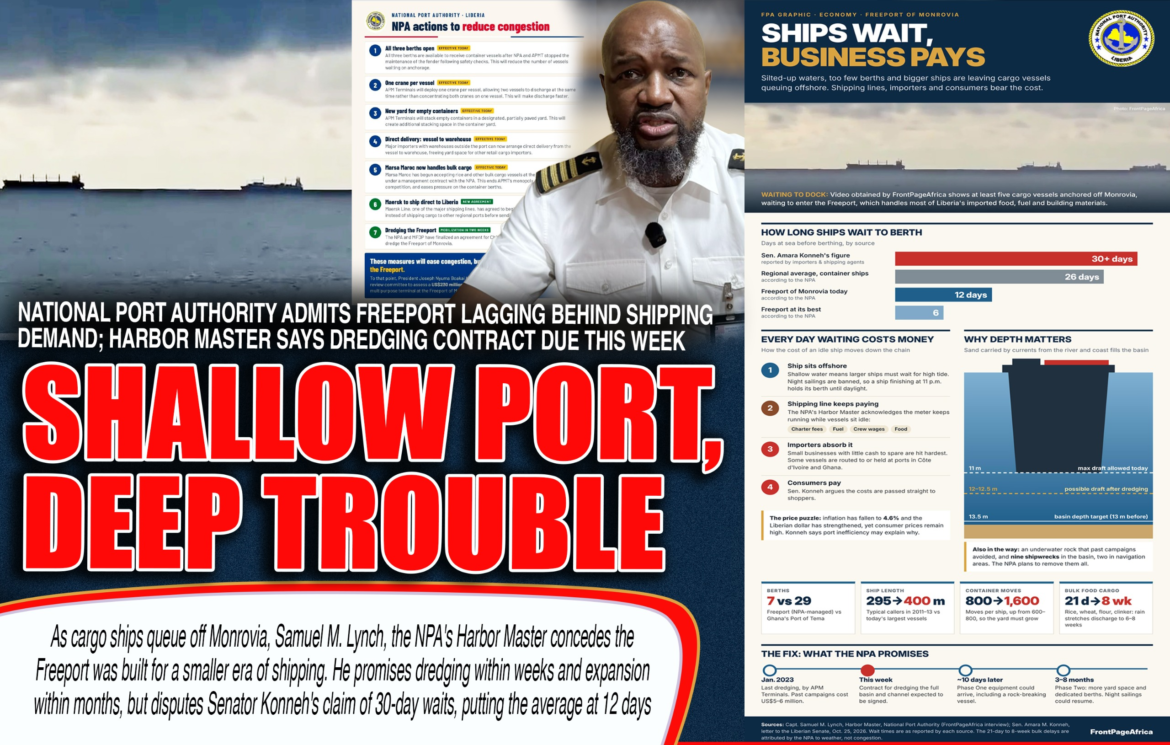
MONROVIA – The National Port Authority (NPA) has acknowledged that the Freeport of Monrovia, Liberia’s principal seaport, is struggling to keep pace with the size and number of ships now calling on it. Cargo vessels are queuing offshore, and importers are counting the cost.
In an exclusive interview with FrontPage Africa, Captain Samuel M. Lynch, the NPA’s Harbor Master and head of its Marine Department, said a contract for comprehensive dredging of the entire port basin and navigation channel is expected to be signed this week. Expansion of container yards and berths would follow within three to eight months, he said.
“The discussion now is that the time is now. The need for it is now that it can’t be pushed further down the line,” Lynch said.
Video footage obtained by FrontPage Africa shows at least five cargo vessels anchored off Monrovia’s coastline, waiting to enter the port. The Freeport handles most of the country’s imported food, fuel, construction materials and other essential goods.
Background: A Senator Sounds the Alarm
The congestion reached the National Legislature last month. In an October 25 letter to Senate President Pro-Tempore Nyonblee Karnga-Lawrence, Gbarpolu County Senator Amara M. Konneh said importers and shipping agents report that Liberia-bound containers spend an average of more than 30 days at sea before berthing in Monrovia. Some vessels, he said, are being routed to or held at ports in Côte d’Ivoire and Ghana.
Konneh, a former Minister of Finance and Development Planning, blamed insufficient container yard space and prolonged delays in dredging the port basin and channel, which he said prevent larger vessels from berthing. He also cited “a multiplicity of opaque transaction costs and fees” charged by APM Terminals, MEDTECH Scientific Limited, Global Tracking and Maritime Solutions (GTMS) and others in the supply chain.
The Senator argued that port inefficiencies may explain why consumer prices remain high even though headline inflation has fallen to 4.6 percent and the Liberian dollar has strengthened against the US dollar. He asked the Senate to summon the NPA, APM Terminals, MEDTECH, GTMS, the Liberia Revenue Authority’s Customs Department, the Ministry of Commerce and Industry and customs brokers to testify before the full Senate.
Asked about the congestion last week, NPA Managing Director Sekou Dukuly offered a one-line response: “We are working on dredging and expansion.” Lynch’s interview is the most detailed account yet of what that work involves.
The NPA says the problem is more complex than any single cause. It points to a combination of inadequate infrastructure, bigger vessels, limited berths, weather and operational constraints.
Dredging: ‘A Continuous Requirement’
Responding to criticism that successive governments have announced dredging projects without solving the problem, Lynch said dredging at the Freeport is a continuous requirement because of the port’s location and design.
Unlike naturally deep-water ports, the Freeport suffers from sedimentation. Ocean currents carry sand from the river and nearby coastal areas into the port basin, steadily reducing the depth of water available to ships.
“Naturally, the currents bring the sand from the river and from up north, the coastal areas like West Point. All those areas bring it and deposit it inside the basin,” Lynch explained.
Without regular dredging, he said, the draft available to vessels keeps shrinking, limiting the size of ships that can safely enter. Ideally, the port should be dredged every two to three years, and at least every five years, depending on how fast sediment builds up.
The last dredging was carried out in January 2023 by APM Terminals, the port’s container terminal operator, Lynch said. The new campaign will differ because it covers the entire basin rather than selected sections.
“The scope is a bit different than it was in the previous dredge campaigns,” he said.
Bigger Ships, Same Port
Beyond dredging, Lynch named inadequate container yard space and limited berths as the port’s biggest constraints.
He said the APM Terminals concession provided for the development of about 11 hectares, but discussions are under way to use the entire area to handle growing cargo volumes.
The port’s needs, he said, have changed significantly since the concession arrangement was introduced in 2013. Liberia’s population and economy have grown, imports have risen, and global shipping has moved to much larger vessels.
Ships calling on Monrovia between 2011 and 2013 were generally about 295 meters long. Some of the largest vessels in global shipping now reach about 400 meters. Bigger ships bring more containers: a vessel that once required 600 to 800 container-handling moves can now need as many as 1,600. The container yard, Lynch argued, must expand to match.
He said APM Terminals’ concession obligations include developing the terminal to reflect changing shipping requirements and the port’s growing needs.
Lynch disputed Senator Konneh’s figure of more than 30 days at sea. He said the average waiting time for container ships across the region is about 26 days, while Liberia’s is now about 12 days, up from a low of about six days at one point.
“In all fairness, let’s be realistic. In the whole region here, the average rate, we’re talking about liners now, container ships. The average wait time is 26 days. Ours is not 26. At some point, we were doing six days. We’re now at somewhere around 12,” Lynch said.
He acknowledged, however, that shallow water has contributed to delays. Because of shallow areas in the channel and basin, larger vessels sometimes have to enter at high tide. The NPA has also banned some vessels from moving at night for safety reasons, so ships that finish working late at night must wait until daylight to leave.
Lynch said no single factor explains the delays. He pointed to operational logistics, how quickly containers are cleared from the yard, and the availability of berths.
Rain Slows Bulk Cargo
The Harbor Master drew a distinction between container ships and bulk carriers bringing in rice, wheat, flour and clinker, the main raw material for cement.
These cargoes must be kept dry, so Liberia’s long rainy season frequently halts discharge. Shipping companies, vessel captains and insurers must weigh the risk of cargo damage before allowing work to continue in bad weather.
A bulk carrier with 50,000 to 55,000 metric tons can normally discharge in about 21 days in good weather, Lynch said. In the rains, the same vessel may stay at berth far longer.
“Sometimes they’re taking six weeks. Sometimes they’re taking six to eight weeks,” he said.
Lynch said such delays are caused by the weather, not by port congestion. The NPA is considering additional dedicated berths for bulk carriers so that ships carrying different commodities are not competing for the same limited space.
The Dredging Plan
Lynch said the project will be carried out in two phases. Phase One will deal with shallow areas in the navigation channel and port basin to improve access and restore safer operating conditions. The contract is expected to be signed this week, and dredging equipment could begin arriving within about 10 days, subject to regulatory and administrative arrangements.
Phase Two, expected to begin within three to eight months, will focus on expansion, including additional terminal space and dedicated berths. Lynch said Phase One would bring immediate improvements, while Phase Two would tackle the port’s longer-term limits.
The dredging will cover the area from the China Union and BMC Pier to the Liberia Maritime Corporation (LMC) Pier, the Western Cluster area, APM Terminals’ facility and the Liberia Petroleum Refining Company (LPRC) facility. The fairway from the open sea through the channel and into the breakwater is also included.
The entire basin is to be restored to a depth of 13.5 meters, compared with the 13 meters targeted in previous campaigns. The project will also remove an underwater rock, marked by an isolated danger buoy, that obstructs navigation. Past dredging campaigns avoided it because removing it requires specialized equipment. Lynch said it must now go to give larger vessels enough room to maneuver. The work will require two marine vessels, including one designed to break up underwater rock.
Nine shipwrecks have also been identified in the port basin, two of them in areas used for navigation. Lynch said the NPA intends to remove all nine now, rather than bring specialized equipment back for Phase Two.
He acknowledged that the wider scope will make this campaign more expensive than previous ones, which reportedly cost between US$5 million and US$6 million.
Toward 24-Hour Operations
If the dredging succeeds, Lynch said, the NPA could relax some of the restrictions now placed on ships. Vessels are currently limited to a maximum draft of about 11 meters. Depending on the final depth achieved, that could rise to between 12 and 12.5 meters, allowing larger and more heavily loaded ships to enter.
Deeper water could also allow night-time sailings to resume, so ships can enter and leave around the clock. Under the current rules, a vessel that finishes work at 11 p.m. may have to wait at berth until daylight, keeping the next ship waiting offshore.
But Lynch stressed that dredging alone will not solve the port’s problems without more berths and container-handling facilities.
Seven Berths Against Tema’s 29
Lynch compared the Freeport with its regional rivals. Ghana’s Port of Tema has about 29 berths, he said. The Freeport of Monrovia has seven under the NPA’s management.
APM Terminals’ quay, about 600 meters long, can take about three vessels in good conditions. But ships of different lengths, some about 200 meters and others over 225 meters, make it hard to use every meter of quay space. Some berths are also reserved for particular vessels, such as the LPRC berth for tankers. With so few berths, ships often must wait for others to finish before they can come alongside. Lynch said additional berths, including dedicated bulk berths, would significantly increase capacity and ease congestion.
Who Pays for the Wait
Ships waiting offshore are expensive. Lynch acknowledged that shipping companies keep paying charter fees, fuel, crew wages and food while their vessels sit idle.
He said, however, that the NPA does not set port tariffs on its own, as these are fixed under existing concession and tariff arrangements. The authority’s job, he said, is to use available berths efficiently and bring ships in as quickly as conditions allow.
“We are flexible in terms of using berths for different types of vessels. We move assets around … We try to accommodate as much as possible,” he said.
For importers, especially small businesses with little cash to spare, those costs remain a heavy burden. Senator Konneh argues they are passed directly to consumers.
Questions Over Long-Term Planning
The congestion raises questions about whether Liberia planned for the growth in shipping traffic and the rise of larger vessels.
Asked how the port’s problems reached this stage, Lynch said its requirements had changed considerably since the original studies and concession arrangements were drawn up. Infrastructure considered adequate in 2013, he acknowledged, may no longer meet today’s needs.
Port planning, he argued, should look beyond short-term projections and include regular reviews so that concessions and infrastructure keep up with economic and shipping realities. He said an independent third-party assessment informed the port’s current master plan, which identified the need for expansion, more berths and better operating capacity. The planned dredging, he said, is the first major step toward carrying out those recommendations.
The NPA now says container ships wait about 12 days, not 30. But Senator Konneh’s complaints and the ships visible from Monrovia’s beaches show the need for more openness about port performance, infrastructure limits and the timetable for fixing them.
The first test is whether dredging begins as promised. The second is whether expanded yards and new berths follow. Until then, the Freeport will keep trying to handle growing shipping demand with infrastructure that the NPA itself admits is no longer enough.
See more Liberia News Network stories in Google Search by adding LNN as one of your Preferred Sources.
★ Add LNN as a Preferred Source