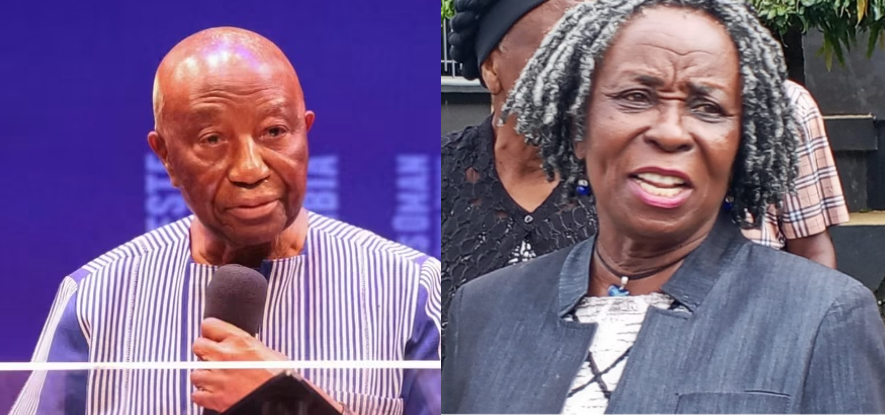
MONROVIA — President Joseph Nyuma Boakai’s name entered the courtroom record Monday as former General Services Agency (GSA) Director-General Mary T. Broh testified in the Saudi-donated rice trial, linking a letter from Boakai’s transition activities to a request for rice for young people working on a national cleanup campaign.
Broh, a subpoenaed defense witness for former Foreign Minister Dee-Maxwell Saah Kemayah and other defendants, told Criminal Court “C” that Kemayah’s intervention in the rice matter was intended to “rescue the rice” and described the indictment against her and other officials as “character assassination.”
Her testimony offered a different account from the prosecution’s theory that the movement and distribution of the Saudi-donated rice formed part of an unlawful scheme.
The remaining defendants face charges including theft of property, economic sabotage, misapplication of entrusted property, abuse of office and criminal conspiracy.
The Saudi donation consisted of 29,412 bags of 25-kilogram rice intended for disaster victims and vulnerable communities. Prosecutors allege that 25,054 bags, valued at approximately US$425,918, were unlawfully diverted or could not be accounted for.
Boakai’s Name Enters the Record
One of the most significant portions of Broh’s testimony concerned President Boakai’s transition activities.
Broh testified that John-Charuk Siafa, now Monrovia City Mayor, approached her while coordinating a cleanup campaign associated with Boakai’s inauguration.
According to Broh, Siafa told her he had been appointed by then-President-elect Boakai to coordinate the campaign and showed her his appointment letter.
She said the letter directed Siafa to contact her because she was considered a source of assistance for mobilization.
Broh testified that she later became concerned when young people participating in the cleanup complained that they had nothing to eat. She said she contacted Siafa and instructed him to write the Ministry of Internal Affairs requesting rice.
According to Broh, Siafa subsequently wrote then-Internal Affairs Minister Varney Sirleaf, after which rice was made available.
Broh’s testimony did not establish that President Boakai personally ordered the distribution of the Saudi rice. Rather, her account placed the transition-related cleanup campaign and Siafa’s appointment at the beginning of a chain of events through which rice was requested for “hungry cleanup campaign workers.”
‘Kemayah Was Rescuing the Rice’
Broh also challenged the prosecution’s characterization of Kemayah’s involvement.
She testified that Kemayah contacted her about the Saudi-funded rice and that a meeting was subsequently held at the GSA involving the Ministry of Foreign Affairs, Ministry of Internal Affairs, the National Disaster Management Agency (NDMA) and GSA.
Because of Kemayah’s official engagements and travel, Broh said he designated Deputy Foreign Minister Thelma Duncan Sawyer to participate in his place.
According to Broh, the institutions agreed to work together and minutes were taken during the meeting.
She characterized Kemayah’s intervention as an effort to “rescue” the rice.
Broh said the Ministry of Foreign Affairs became involved because the donation was connected to Liberia’s bilateral relationship with Saudi Arabia.
She maintained that the participation of Foreign Affairs, Internal Affairs, NDMA and GSA was part of an institutional effort to secure and manage the humanitarian commodity.
GSA Transfer Defended
Broh also defended the transfer of 13,895 bags of rice from NDMA to GSA, a movement that prosecutors have placed at the center of their case.
She testified that it was agreed through an interagency mandate that the remaining Saudi rice be moved to GSA for storage until further notice.
She also argued that GSA had a statutory responsibility to serve as custodian of government property and maintained warehouses for commodities and emergency supplies.
Had she known about the rice earlier, Broh testified, she would have recommended that it be stored at GSA because NDMA lacked adequate facilities for such a large quantity.
According to her, this has been the practice with several previous donations to the government. She cited, as an example, 60,000 bags of rice donated by the Government of the People’s Republic of China, which she said were stored by the GSA and subsequently distributed to beneficiaries.
She said the rice was inventoried upon arrival at GSA and that subsequent releases were subject to documentation and a gate-pass system.
According to Broh, requesting organizations were required to provide supporting documents, while information about trucks, including drivers’ names, telephone numbers and license plates, was recorded before rice could leave the warehouse.
She further testified that she and Sawyer used personal resources to facilitate the transfer, including securing trucks from the Liberia Electricity Corporation, and that no government funds were used for transportation.
‘The Indictment Is Character Assassination’
Broh stood by her earlier description of the indictment as “character assassination.”
“I sincerely mean what I said,” she told the court.
She maintained that officials were acting within their respective mandates to receive and distribute commodities based on requests.
She also pointed to documents she said she provided to investigators, questioning why she would voluntarily turn over records that could help trace the rice if she intended to steal it.
The 1,050-Bag Dispute
Broh also addressed allegations involving approximately 1,050 bags of rice, connecting the quantity to the Boakai transition cleanup campaign.
She testified that young people working long hours on the campaign complained about a lack of food. According to her, Siafa approached her for assistance after being appointed to coordinate the cleanup.
Broh said she helped facilitate communication with government institutions, after which a request was made to Internal Affairs and rice was released.
Her testimony sought to place the disputed quantity within a government-related request rather than a personal diversion.
Johnson Challenges Prosecution’s Accounting
For his part, former Deputy Minister of Internal Affairs Momolu Johnson testified Tuesday, challenging aspects of the prosecution’s accounting of the rice.
Johnson questioned how certain quantities were treated in the government’s case, including 720 bags that he argued had not been properly exhibited to support the stealing allegation.
He also cited figures he said were presented to the defense, including 12,095 bags under relevant control and 2,281 bags remaining at GSA.
His testimony formed part of the defense effort to challenge both the prosecution’s calculations and its theory of criminal intent.
The competing figures have emerged as a central issue in the trial.
The indictment states that the original donation consisted of 29,412 bags. Prosecution evidence has placed 11,200 bags at GSA initially and another 13,895 bags transferred from NDMA, producing a reported 25,095 bags in GSA custody.
The prosecution has alleged that 25,054 bags were diverted or could not be accounted for, while defense witnesses have introduced additional figures involving distributions, pre-positioned rice and quantities remaining in storage.
The defense is using those discrepancies to challenge the prosecution’s accounting and argue that the movement of the rice through government institutions does not, by itself, establish criminal intent.
The defendants have pleaded not guilty and remain presumed innocent unless proven guilty beyond a reasonable doubt.
The trial continues today, Wednesday, September 30, with the continuation of defendant Johnson’s testimony.
See more Liberia News Network stories in Google Search by adding LNN as one of your Preferred Sources.
★ Add LNN as a Preferred Source