
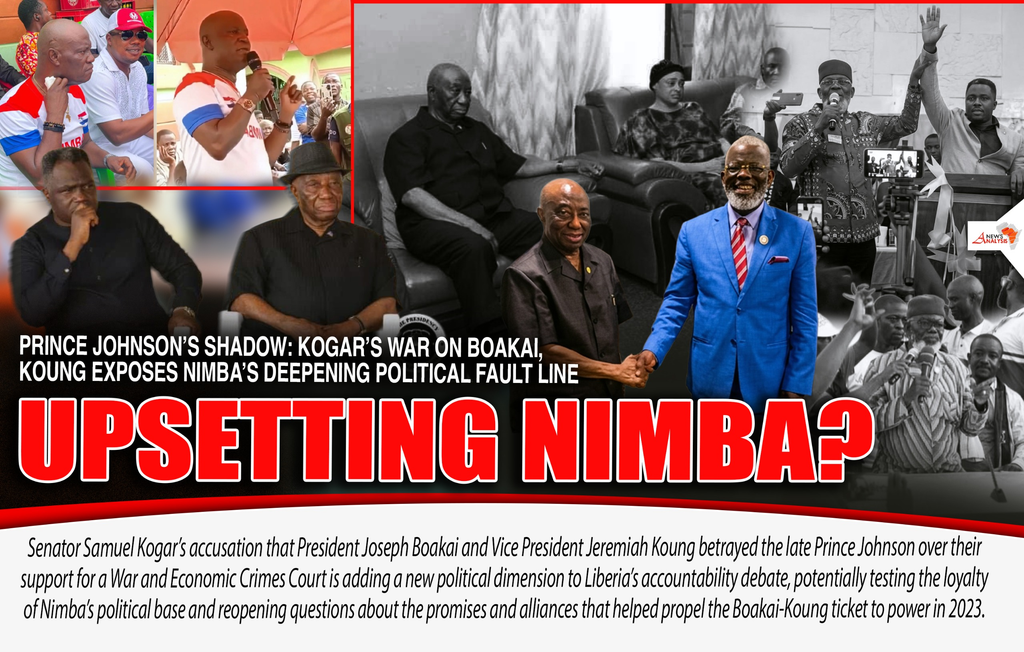
Monrovia — Senator Samuel Kogar’s latest attack on President Joseph Boakai and Vice President Jeremiah Koung is bigger than a quarrel over Liberia’s proposed War and Economic Crimes Court.
It is a warning shot over the political future of Nimba County.
Fresh from his expulsion from the Movement for Democracy and Reconstruction (MDR), Kogar has chosen one of the most politically sensitive issues in Liberia—the prosecution of those accused of atrocities during the civil war—to challenge the very administration that his former political family helped install.
And by invoking the late Senator Prince Y. Johnson, Kogar is deliberately touching a nerve that runs deep through Nimba politics.
His argument is blunt: Boakai and Koung benefited from Prince Johnson’s political machinery, but, in his view, have now abandoned the understanding that secured that support.
That accusation, whether politically sustainable or not, has the potential to resonate far beyond Kogar’s personal political dispute with the MDR.
The accusation carries particular weight because Johnson’s opposition to a war crimes tribunal was not a position he adopted late in his political career. It was a recurring feature of his political messaging and one of the issues around which he built relationships, negotiated political alliances and expressed concerns about his own political future.
Johnson had consistently complained that the proposed accountability process would disproportionately target him because of his role during Liberia’s civil conflict. His position placed him at odds with those demanding prosecution for alleged wartime atrocities, but it also became part of the political identity that helped him maintain a strong following in Nimba County.
For Johnson, politics was never simply about party labels. His alliances shifted over the years as political circumstances changed. He supported Ellen Johnson Sirleaf, later backed George Weah, and eventually became politically aligned with the Unity Party and President Boakai. Those relationships demonstrated the late senator’s ability to work with administrations across Liberia’s political spectrum while maintaining his own positions on issues he considered fundamental.
The War and Economic Crimes Court remained one of those issues. That history is important because Senator Kogar is now attempting to place himself inside that political narrative. His argument is essentially that Johnson supported political actors and administrations at different points in the country’s recent history, but ultimately felt betrayed when the issue he considered most threatening to his political legacy remained alive.
Whether that interpretation is accepted by Nimba voters is uncertain. But Kogar’s decision to raise it at a time when his relationship with the governing political establishment has sharply deteriorated gives the issue a new political dimension.
It also allows Senator Kogar to transform what might otherwise have been viewed as a party disciplinary dispute into a larger question of political loyalty.
That effort comes against the backdrop of his recent expulsion from the MDR. MDR National Chairman Cooper Kruah said the party’s decision followed complaints against Senator Kogar and a disciplinary process in which, according to him, the senator was allowed to respond. Kruah alleged that Kogar repeatedly sought excuses and ultimately failed to appear for a subsequent hearing, along with his lawyer, leading the disciplinary committee to recommend his expulsion.
But Kruah’s explanation also revealed the political dimension of the dispute. The MDR chairman said the party is working with the Unity Party and supports President Boakai, arguing that Kogar could not simultaneously benefit from membership in the governing political arrangement while publicly taking positions that appeared to undermine it.
The party therefore presented Senator Kogar’s expulsion not simply as punishment for a violation of its internal rules, but as a defense of its political relationship with the Unity Party. Senator Kogar has offered a different response, returning to Nimba and telling supporters that he was not the first politician to be expelled from a political party.
That response may be an indication that he intends to make political independence the centerpiece of his next chapter. His subsequent appearance last week at a political roundtable convened under the leadership of former President George Weah has only intensified speculation.
The meeting brought together prominent opposition figures, including several former officials of the George Weah administration and leading members of the Coalition for Democratic Change (CDC). Senator Kogar’s presence did not, by itself, amount to a formal declaration that he had joined the CDC. But politically, it was difficult to ignore the timing.
A senator expelled from a party aligned with the Unity Party was now sitting alongside some of the country’s most recognizable opposition politicians. That development inevitably raises the question of whether Senator Kogar is preparing for a political realignment.
More importantly, it raises the question of what such a realignment could mean in Nimba. For decades, Nimba’s electoral politics has demonstrated that political influence can be transferred, shared and contested — but rarely permanently owned.
Johnson’s electoral history is perhaps the clearest illustration. In the first round of the 2017 presidential election, Johnson secured 107,430 votes in Nimba, representing 53.50 percent of the county’s vote. Joseph Boakai followed with 39,964 votes, or 19.90 percent, while George Weah received 16,002 votes, equivalent to 7.97 percent.
Johnson’s influence became even more politically significant in the runoff. After supporting Weah, the former football star’s Nimba vote rose to 73,434, or 57.14 percent, while Boakai received 55,083 votes, or 42.86 percent.
Those figures helped establish the perception that Johnson could move a substantial portion of Nimba’s electorate behind a candidate he supported. But the numbers also tell a more complicated story. Johnson’s endorsement did not produce unanimous support. The same pattern appeared in the 2020 senatorial election, when Koung won the race with 37,899 votes, representing 36.12 percent. Edith Gongloe-Weh received 34,153 votes, or 32.55 percent, while Garrison Yealue secured 15,607 votes, or 14.87 percent. Other candidates divided the remaining votes.
Koung won the election, but nearly two-thirds of the electorate had voted for someone else. That election remains important to the current political debate because it demonstrates that even in a county known for powerful political personalities, voters retain the ability to make independent choices.
Three years later, however, Nimba produced a dramatically different result. In the 2023 presidential election, the ticket of Boakai and Koung received 138,070 votes, representing 59.53 percent of the county’s first-round vote. Weah received 50,427 votes, or 21.74 percent, while Tiawan Gongloe received 17,024 votes, or 7.34 percent.
The runoff was even more decisive. Boakai and Koung received 144,646 votes, representing 74.14 percent of Nimba’s valid vote, while Weah received 50,453 votes, or 25.86 percent. The figures demonstrated the enormous advantage that can be created when a national ticket contains a prominent Nimba political figure.
But once again, the numbers stopped short of suggesting complete political unanimity. Approximately one-quarter of Nimba’s voters still chose the opposing candidate. That historical pattern is now central to understanding the Kogar question.
The late Johnson’s death in November 2024 created an unusual political vacuum. Nimba had lost a politician who, regardless of one’s opinion of him, had occupied an extraordinary place in the county’s political hierarchy.
The subsequent senatorial by-election became an early test of who could command the electorate after Johnson. Kogar emerged as the winner. He received 62,136 votes, representing 52.08 percent of the vote, while Edith Gongloe-Weh received 40,506 votes, or 33.95 percent. Mack Gblinwon finished with 7,489 votes, equivalent to 6.28 percent. Unlike Koung’s 2020 victory, Kogar’s result crossed the 50-percent threshold.
That fact cannot be ignored. It provides Kogar with a legitimate electoral argument that whatever portion of the Johnson political structure may have contributed to his victory, he also demonstrated an ability to win a countywide contest decisively.
The political significance becomes greater because Kogar has subsequently been identified by chiefs and elders of Nimba as the ‘political heir’ to Johnson. That designation is more than ceremonial in a county where traditional leadership, family networks, community relationships and political organization frequently intersect.
But being named a political heir and actually inheriting a predecessor’s votes are two different things. This is where the 2029 question becomes complicated. If Kogar remains aligned with the opposition and eventually supports the CDC or another opposition presidential arrangement, can he move a meaningful portion of Nimba’s electorate away from the Unity Party?
The 2017, 2020, 2023 and 2025 elections provide evidence for both sides of the argument. They demonstrate that prominent political figures can influence large numbers of Nimba voters. But they also demonstrate that no political figure has ever achieved complete control of the county’s electorate.
Kogar therefore does not need to reproduce Johnson’s 2017 performance to become politically consequential. He would not necessarily need to win Nimba for an opposition presidential candidate.
Suppose the Unity Party enters 2029 expecting Nimba to provide another overwhelming margin because Koung remains a central figure in the administration. If Kogar succeeds in creating a substantial opposition constituency within the county, the governing ticket could still win Nimba but by a considerably smaller margin.
In a tight national contest, that difference could have consequences beyond Nimba. Conversely, if Kogar’s political influence is overstated and the majority of Nimba voters continue to identify with Koung, Boakai or the governing coalition, his opposition alignment could produce considerable political noise without significantly changing the electoral result.
The War and Economic Crimes Court could therefore become one of the issues through which those changes are expressed. For Johnson’s supporters who believed the late senator was being targeted, Kogar’s
accusation that Boakai and Koung betrayed Johnson could resonate as an emotional political grievance. For others, however, the issue may not be enough to override their support for the Unity Party or their confidence in Koung.
The political battle will therefore not necessarily be about whether Kogar can convince Nimba that Johnson was betrayed. And if Kogar can turn Johnson’s old grievance into a new political narrative, the next election in Nimba may reveal whether the late senator left behind merely a Senate seat — or a political constituency still waiting for someone to speak in its name.
See more Liberia News Network stories in Google Search by adding LNN as one of your Preferred Sources.
★ Add LNN as a Preferred Source