Liberia has unveiled an ambitious national framework aimed at transforming the role of young people in peacebuilding, economic development and national decision-making, using the 81st United Nations General Assembly to mobilize international support for a youth development agenda extending through 2035.
The launch of the PATHWAYs Framework on Friday, September 18, marked a significant step in Liberia’s effort to translate its commitments on Youth, Peace and Security into a coordinated national development strategy, as the country prepares to assume the presidency of the United Nations Security Council in December.
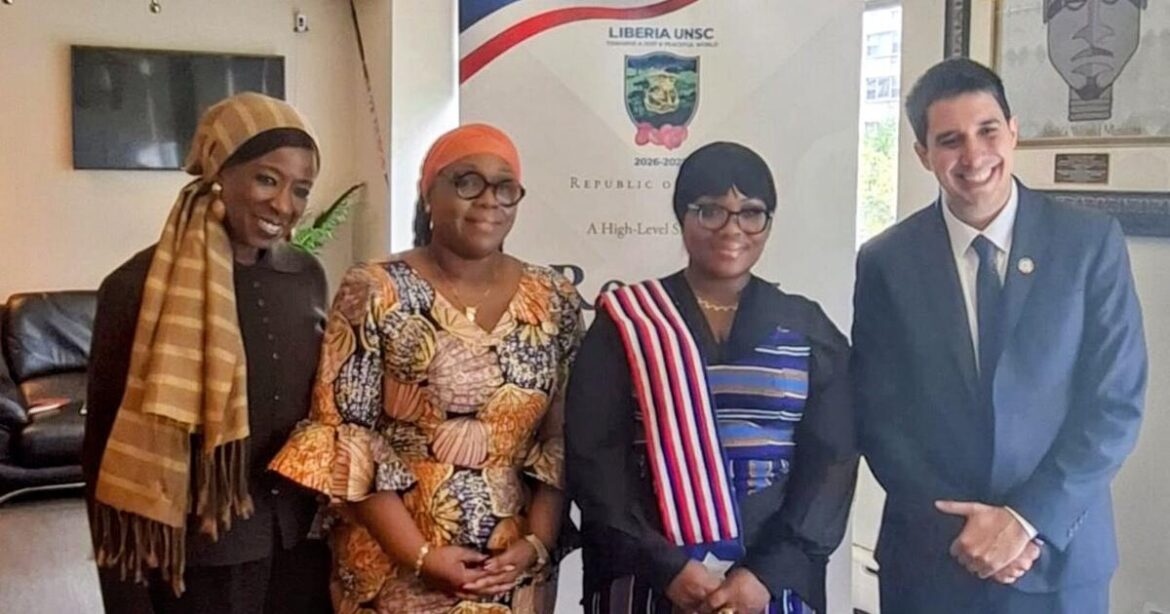
Foreign Minister Sara Beysolow Nyanti formally launched the framework during a high-level side event at the African Union Permanent Observer Mission to the United Nations in New York, bringing together senior UN officials, international development partners, youth leaders and representatives of West African governments.
But amid the international endorsements, Nobel Peace Prize laureate Leymah Gbowee delivered a challenge that could determine whether the initiative becomes another policy document or produces lasting results: Liberia must be prepared to finance its own ambitions.
Gbowee urged the government to provide 50 percent of the funding required to implement the PATHWAYs reform agenda, arguing that a substantial domestic commitment would encourage international partners to invest.
Her intervention brought into focus a central question surrounding Liberia’s growing diplomatic visibility: whether the country can match its international commitments with the resources, institutional coordination and political will necessary to deliver meaningful change at home.
From Peace Commitments to Youth Opportunities
The PATHWAYs Framework seeks to consolidate Liberia’s existing youth development initiatives into a coordinated national mandate, connecting the Ministry of Youth and Sports’ five-year strategic plan and National Youth Policy with the country’s broader peacebuilding and development priorities.
According to Foreign Minister Nyanti, the initiative is intended to establish pathways for future generations while mobilizing investments to support Liberia’s youth development vision for 2035.
She said the framework consolidates ongoing interventions for young people across Liberia’s 15 counties and seeks to strengthen their participation in shaping the country’s future.
Nyanti identified six interconnected pillars: governance, evidence, the PATHWAYs Framework, sports, the creative economy and strategic investment.
Together, she said, these elements are intended to strengthen institutions, improve evidence-based policymaking and create sustainable opportunities for young Liberians.
The Foreign Minister emphasized that Youth, Peace and Security remains among Liberia’s priorities during its two-year tenure on the UN Security Council, where the country is seeking to amplify the voices of young people in international peace and security discussions.
She called on national and international partners to join Liberia in building the institutional and economic pathways necessary to advance the next generation.
For Youth and Sports Minister Cornelia Wonkerleh Kruah, the initiative represents a commitment that should ultimately be measured by the opportunities available to young Liberians.
Kruah said the government’s ambition is that, by 2035, every young Liberian should have a pathway toward achieving their goals.
She described the framework as a public commitment to young people, development partners and future generations, emphasizing that it contains measurable targets and a timeline for evaluating progress.
Rather than asking international partners to support another collection of promises, Kruah said Liberia is presenting a reform agenda intended to be transparent, accessible and supported by evidence.
She acknowledged the contributions of UNFPA, UNDP, the United Nations Department of Political and Peacebuilding Affairs, the UN Youth Office and other institutions supporting Liberia’s youth agenda.
The Peace Dividend at Home
The framework comes at a consequential moment for Liberia, where the overwhelming majority of the population is young and the long-term sustainability of peace is increasingly tied to employment, education, economic inclusion and access to opportunity.
According to the Liberia Institute of Statistics and Geo-Information Services, the 2022 Population and Housing Census recorded approximately 5.25 million people, with nearly three-quarters of the population aged 35 or younger.
That demographic reality gives Liberia’s Youth, Peace and Security commitments considerable domestic significance.
Young Liberians at the launch of the Pathways Framework
More than two decades after the end of the civil war, a generation of Liberians has grown up without experiencing the conflict directly. Yet many continue to confront unemployment, underemployment, inadequate skills training, substance abuse and limited participation in decisions affecting their future.
Liberia’s National Youth Policy and Action Plan 2025–2029 identifies several of these challenges, while its National Action Plan on Youth, Peace and Security 2025–2030 seeks to strengthen young people’s participation in conflict prevention, peacebuilding and national security.
The PATHWAYs initiative now presents an opportunity to connect these commitments with practical interventions in education, entrepreneurship, sports, the creative economy and youth leadership.
It also creates an important benchmark for evaluating the government’s performance.
The extent to which the initiative reaches young people beyond Monrovia, attracts sustainable financing and produces measurable improvements in livelihoods will help determine whether the international enthusiasm generated in New York translates into a meaningful peace dividend at home.
UN Sees Opportunity in Liberia’s Presidency
Senior United Nations officials welcomed Liberia’s initiative, emphasizing that young people must be recognized not merely as beneficiaries of development assistance but as active participants in building peaceful and inclusive societies.
UNFPA Executive Director Diene Keita described young people as essential partners in peacebuilding and development.
“Young people are peacebuilders, they are leaders, they are essential partners,” she said, reaffirming UNFPA’s support for the Youth, Peace and Security agenda.
Keita emphasized the relationship between investments in young people, economic growth, food security and stable communities.
She praised Liberia’s long-term framework and expressed confidence in the country’s capacity to advance its peacebuilding commitments.
UN Assistant Secretary-General for Youth Affairs Felipe Paullier also welcomed Liberia’s leadership, pointing specifically to the opportunity presented by its forthcoming Security Council presidency.
Paullier said Liberia’s leadership on Youth, Peace and Security could provide an opening for a Council debate on the agenda in December.
He emphasized the importance of connecting international peacebuilding discussions to the everyday needs of young people, including opportunities in arts, culture and sports.
For Liberia, the December presidency offers a diplomatic opportunity to elevate an agenda closely connected to its own postwar experience.
Although the Security Council presidency rotates monthly and does not confer additional voting power, the presiding country helps organize the Council’s work and can promote discussions on issues of international peace and security.
Liberia’s ability to connect its domestic youth development experience with wider international peacebuilding priorities could therefore become an important feature of its presidency.
A Regional Peacebuilding Agenda
The initiative also attracted support for extending Liberia’s experience beyond its borders.
Nathalie Ndongo Seh, Director of the Western Africa Division of the United Nations Department of Political and Peacebuilding Affairs and Department of Peace Operations, emphasized the importance of aligning the National Action Plan on Youth, Peace and Security with PATHWAYs and the government’s ARREST Agenda.
She reaffirmed the commitment of the United Nations Office for West Africa and the Sahel to supporting Liberia in sharing its experience with neighboring countries, ECOWAS and the Mano River Union.
Significantly, she announced that the Department of Political and Peacebuilding Affairs would assist Liberia in bringing Youth, Peace and Security issues before the Security Council during its December presidency.
The regional dimension is particularly relevant to Liberia, Sierra Leone, Guinea and Côte d’Ivoire, whose interconnected histories and cross-border communities make youth inclusion, economic opportunity and conflict prevention matters of shared concern.
Sierra Leone’s Minister of Youth Affairs, Ibrahim Sannoh, expressed support for Liberia’s initiative, emphasizing the importance of turning experiences of conflict and fragility into foundations for lasting peace.
Sweden, which supported the development of Liberia’s first National Action Plan on Youth, Peace and Security, also reaffirmed its commitment to the agenda.
Pär Sköld, Counsellor and Civilian Adviser at Sweden’s Permanent Mission to the United Nations, commended young people for taking responsibility for implementing the Youth, Peace and Security agenda and urged government institutions to create greater space for their participation.
Gbowee: Take the Agenda to the People
While international partners welcomed Liberia’s vision, Gbowee emphasized that the framework must become familiar to the very people it is intended to serve.
Nobel Peace Laureate Leymah Gbowee (right) urged the Government of Liberia to provide 50 percent of the funding required to implement the PATHWAYs reform agenda.
The 2011 Nobel Peace Prize laureate, whose work helped mobilize women in Liberia’s peace movement, urged young people to study the PATHWAYs document and understand its implications for their future.
She recommended nationwide town hall meetings to ensure that the initiative is understood and embraced beyond government institutions and international conference rooms.
Her call for the government to finance half of the reform agenda also placed domestic ownership at the center of the discussion.
The proposal raises important questions about how Liberia intends to finance the initiative, the role of the national budget, the contributions expected from international partners and the mechanisms through which implementation will be monitored.
The Ministry’s release did not disclose the framework’s total financing requirement, the amount already committed by government or development partners, or the specific annual targets against which implementation will be measured.
Those details will be important in determining the scale and feasibility of the commitments announced in New York.
For Liberia, Friday’s launch represents an opening chapter in a broader diplomatic undertaking.
The country has secured a seat on the Security Council, established Youth, Peace and Security among its international priorities and attracted support from major UN institutions for a long-term national framework.
Its next challenge is to demonstrate that the opportunities being discussed in New York can become accessible to young people in Monrovia, Gbarnga, Buchanan, Zwedru, Voinjama and communities throughout the country.
As Liberia prepares to preside over the Security Council in December, the success of its youth agenda will depend not only on the influence it exercises internationally, but also on the investments and opportunities it creates at home.
See more Liberia News Network stories in Google Search by adding LNN as one of your Preferred Sources.
★ Add LNN as a Preferred Source