
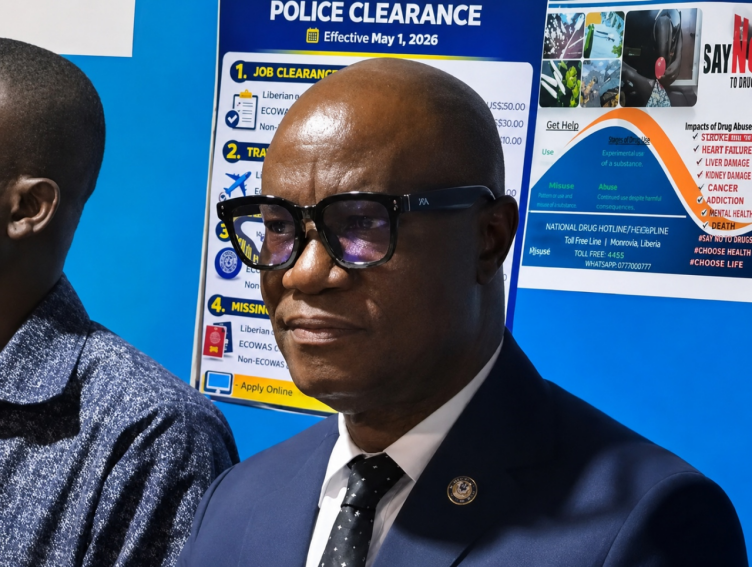
Monrovia — Nimba County Senator Samuel Kogar has sharply criticized the government’s handling of former Vice President Jewel Howard Taylor’s arrest, describing the manner in which she was taken into custody as humiliating and traumatic, while calling for the resignation of Liberia National Police Inspector General Gregory Coleman over what he described as an alleged conflict of interest.
By Gerald C. Koinyeneh, [email protected]
Kogar also called for an investigation into Joseph N. Boakai Jr., son of President Joseph Nyuma Boakai, amid continuing questions surrounding Liberia’s multimillion-dollar cocaine investigation.
The senator made the remarks Wednesday when he appeared at the Center for Intellectual Exchange in downtown Monrovia.
Kogar: Howard Taylor Was Unfairly Treated
Kogar, citing his professional background in security, argued that authorities could have handled Howard Taylor’s detention differently, particularly given her public profile, reported health condition and longstanding ties to Liberia.
“They sensationalize the whole arrest,” Kogar said, arguing that authorities had other options, including notifying immigration authorities to prevent the former vice president from leaving the country while investigators completed their work.
Howard Taylor, facing charges including drug trafficking and money laundering, was jailed at the Monrovia Central Prison on Tuesday after the Monrovia City Court denied her lawyers’ request to allow her to remain at a medical facility of her choice while receiving treatment.
During Tuesday’s proceedings, Taylor, through her lawyers, requested a preliminary examination and subsequently asked the court to permit her to remain in compassionate detention at the medical facility where she had been receiving treatment.
Her lawyers argued that her medical condition was potentially life-threatening and that she could lose her life if denied treatment by her doctor of choice.
The court, however, denied the request, ruling that it lacked jurisdiction to grant compassionate leave. According to the court, such authority rests with the Executive Branch through the Ministry of Justice.
The court cited Chapter 34, Section 34.20.1 of the relevant law, which provides that the Attorney General shall formulate rules and regulations governing compassionate leave and, under those rules, may permit a prisoner to leave an institution for a short period for compelling reasons.
The court therefore held that the authority to grant formal compassionate leave rests with the Ministry of Justice, not the Judiciary.
The court also referenced a medical report presented during the proceedings, which recommended hospital admission because of fluctuations in Taylor’s blood pressure and anxiety associated with a stressful environment. The court noted, however, that the recommended 48-hour admission period had expired and that the report indicated she was in a stable condition.
The court further noted that some of the offenses with which Taylor is charged are non-bailable.
Kogar said the former vice president should instead have been placed under house arrest while investigators completed their work.
“Due to my professional background in security, JHT should have been put under house arrest,” he said. “When you finish and gather everything, you take her to court.”
He described the current approach as resembling “custodial interrogation” and urged authorities to exercise caution in sensitive criminal investigations involving prominent individuals.
While acknowledging that drug-related offenses may carry strict bail restrictions, Kogar said investigators should also consider the circumstances of suspects, particularly individuals with established residences and property in Liberia.
“Granted, drugs are non-bailable, but we have to be careful when we are dealing with sensitive cases,” he said. “She has properties all around this country. We all know her health condition. It is not a secret here.”
Kogar warned that the manner in which Howard Taylor was arrested could generate unnecessary political and social tensions among her supporters.
“She is from a county. She has her people. They might be feeling bad,” he said.
He drew a comparison with the 2006 arrest and transfer of former President Charles Taylor, arguing that authorities at the time took steps to avoid a potentially destabilizing situation.
He argued that the handling of Charles Taylor’s arrest and subsequent transfer to the Special Court for Sierra Leone was designed to minimize potential unrest.
“Liberia is not moving in the rightful trajectory,” Kogar added.
Kogar Calls for Police IG Coleman to Resign
Kogar’s strongest criticism was directed at Police Inspector General Gregory Coleman, whom he accused of creating the appearance of a conflict of interest in the ongoing cocaine investigation.
The senator referred to previous public comments by Coleman indicating that current and former government officials were allegedly connected to the drug investigation.
Kogar questioned why those officials had not been publicly identified or arrested if investigators possessed evidence linking them to the alleged drug network.
“The police director openly said there are past and current government officials that are connected to this drug saga,” Kogar said. “Without naming them, without charges. Why has he not named them or arrested them, but [is] going after former government officials?”
He argued that the alleged discrepancy raises questions about the impartiality of the investigation.
“That’s a conflict of interest. He needs to be removed,” Kogar said, calling for Coleman’s resignation.
Coleman has previously denied allegations by activist Martin Kollie that he received money as a gift to facilitate the purchase of a fleet of police vehicles.
Coleman has maintained his innocence and said he is guided by high ethical standards. He has also stated that if he ever believes his integrity has been compromised, he would resign rather than wait to be removed.
Senator Wants Joe Boakai Jr. Investigated
Kogar also called for an investigation into Joseph N. Boakai Jr., son of President Boakai, over allegations that surfaced earlier this year linking him to international narcotics trafficking.
Boakai Jr. has denied the allegations, insisting that he has never participated in illegal drug activities or used his relationship with the Presidency to influence government decisions.
The allegations emerged after a video circulated on social media, purportedly released by individuals claiming to be members of a Colombian drug cartel. The video accused Boakai Jr. of having ties to an international drug-trafficking network and displayed what it claimed were his WhatsApp profile picture, telephone number and messages exchanged with a Colombian contact.
Boakai Jr. strongly rejected the allegations, describing narcotics trafficking as a serious threat to Liberia.
“I have never participated in discussions involving narcotics trafficking. I have never facilitated illegal drug activity. I have never accepted money in exchange for influence. I have never used my relationship to the Presidency to shield anyone from accountability,” he said in his earlier response.
According to Boakai Jr., the controversy began after he received a threatening WhatsApp message at about 3 a.m. from a number he said was identified as originating from Colombia.
He said the sender accused him of involvement in drug trafficking, prompting him to reject the allegations, block the sender, and report the incident to the Liberia National Police and the National Security Agency.
Boakai Jr. also alleged that the video later circulated online omitted his response denying the accusations, creating what he described as a false impression of his involvement.
Kogar, however, argued that Boakai Jr. should be questioned as part of a formal investigation.
He said if Boakai Jr. acknowledged communicating with a person alleged to be connected to a drug cartel, investigators should establish the nature of that communication and determine whether his account is accurate.
Kogar said investigators must apply the same standards to Liberian and foreign nationals and should not selectively pursue suspects based on political status or nationality.
Kogar Challenges Government’s Deportee Arrangement
Kogar also questioned the legality and constitutional implications of Liberia’s decision to receive deportees from the United States, arguing that the arrangement raises questions about the extent of executive authority.
He cited Article 57 of the 1986 Liberian Constitution, which gives the President authority over the foreign affairs of the Republic, while noting that certain international agreements require legislative concurrence.
Kogar rejected comparisons between the deportee arrangement and conventional extradition proceedings.
“One of my colleagues said I was in error and cited the extradition treaty,” he said. “The refugee situation is not extradition.”
He explained that extradition generally involves one country requesting another country to surrender an individual accused or convicted of a crime who has fled abroad.
“Extradition is when a country requests a foreign country to turn over its citizens who committed crimes at home and fled to that country for safety,” he said.
Kogar maintained that although the Constitution grants the President broad executive powers, those powers are subject to constitutional limitations.
“The Constitution outlines several provisions that give the President certain executive powers and also limit that power,” he said.
He questioned the government’s decision to receive foreign nationals whose legal status in Liberia, he argued, requires greater clarification.
“But you brought them here; why did you bring them? We have not approved their coming. Where are they going to be lodged?” he asked.
Kogar also warned that fear of possible retaliation could discourage Liberians from publicly questioning the arrangement.
“Some people will be afraid not to talk because of fear of retaliation,” he said, adding that he was prepared to speak regardless of the consequences.
“I don’t care. We are here for history,” Kogar said.
Invoking the legacies of Nelson Mandela and Mahatma Gandhi, the senator said public officials should consider how their decisions will be judged by future generations.
“Nelson Mandela is dead, but today he is respected. Mahatma Gandhi is dead and gone, but still respected,” he said.
See more Liberia News Network stories in Google Search by adding LNN as one of your Preferred Sources.
★ Add LNN as a Preferred Source