
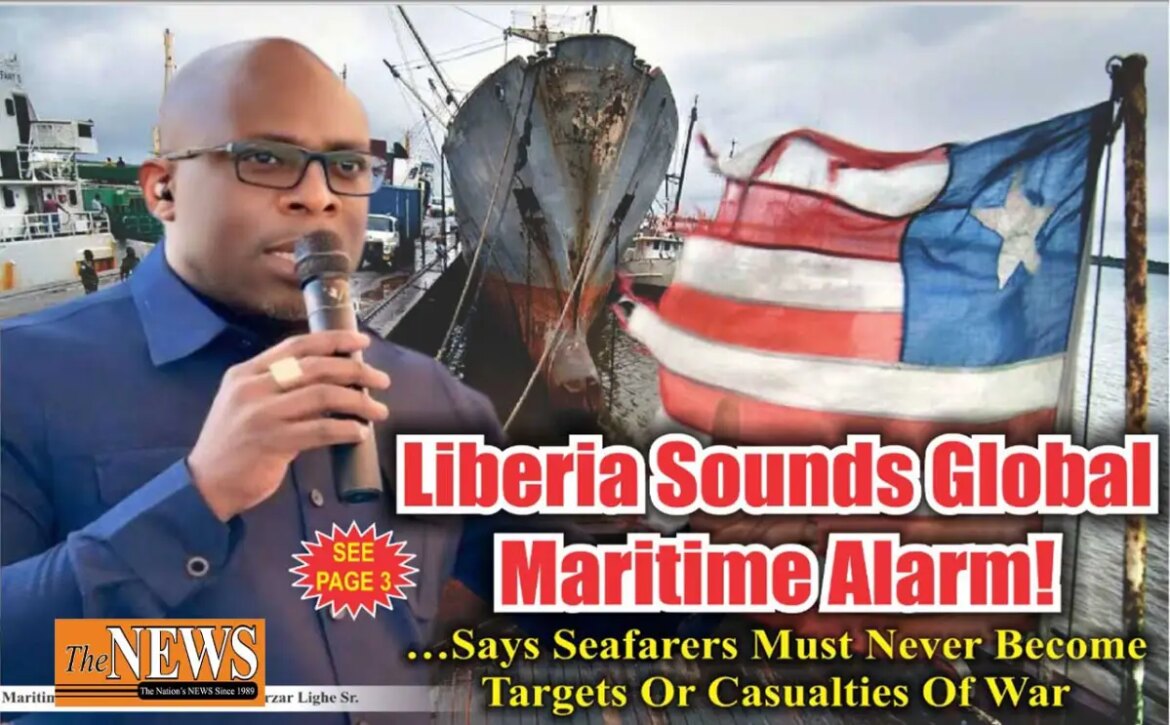
Liberia has delivered a powerful message to the international maritime community, warning that innocent seafarers must never become victims of military conflicts, escalating geopolitical tensions, or attacks along some of the world’s busiest commercial shipping routes.
In its communication to the International Maritime Organization (IMO), Liberia emphasized that seafarers are civilian maritime professionals whose primary responsibility is to transport goods, connect economies, and sustain international commerce. They are not combatants, military personnel, or participants in the political and territorial disputes that continue to threaten global peace and security.
The Liberian position sends a clear message to governments, military authorities, and armed groups: the lives of innocent maritime workers must be respected and protected, regardless of the location or intensity of armed conflict.
“Growing Maritime Insecurity raises international concern,” the statement was delivered on November 3, 2026, by Liberia’s Maritime Commissioner and Chief Executive Officer, Cllr. Neto Zarzar Lighe Sr., during the 138th Session of the IMO Council in London, under Agenda Item C138/11.
Commissioner Lighe highlighted the growing security threats affecting several strategically important maritime corridors, including the Black Sea and Sea of Azov, the Arabian Sea and Gulf of Oman, the Red Sea and Bab el-Mandeb Strait and the Strait of Hormuz.
These waterways are critical arteries of international commerce. They facilitate the movement of petroleum, food supplies, industrial materials, manufactured products, and other essential commodities across continents. However, escalating military confrontations and attacks against commercial vessels have transformed some of these shipping corridors into increasingly dangerous environments for civilian maritime workers.
The consequences extend far beyond the immediate conflict zones. Disruptions to shipping operations can increase transportation costs, destabilize supply chains, delay essential deliveries, and place additional economic pressure on developing countries, including those heavily dependent on imported goods.
Liberia’s Maritime responsibility and international leadership: Liberia’s intervention carries considerable international significance because the country is one of the world’s leading maritime nations and operates the world’s largest ship registry by gross tonnage. Its position on the IMO Council also gives it an important platform to contribute to international maritime policy, security cooperation, and the protection of shipping activities.
The government is therefore calling for more than expressions of concern. It wants meaningful international cooperation, respect for maritime law, and practical guarantees that commercial vessels and their crews can safely navigate conflict-affected waters.
Liberia has reaffirmed the importance of the United Nations Convention on the Law of the Sea (UNCLOS), particularly the principles of freedom of navigation and innocent passage. It has also called on parties involved in armed conflicts to exercise maximum restraint, end hostilities, and embrace diplomatic engagement as the pathway toward lasting peace.
A humanitarian appeal that demands global attention: At the heart of Liberia’s message is a fundamental humanitarian principle: innocent workers should never pay with their lives for conflicts they did not create.
“Seafarers come from different countries, cultures, and backgrounds. They leave their families behind to work aboard commercial vessels, ensuring that international trade continues and essential commodities reach millions of people around the world. Targeting these workers or exposing them to unnecessary military danger is unacceptable,” the statement noted.
Liberia has also extended condolences to families who have lost loved ones in maritime attacks and commended the IMO Secretary-General, Arsenio Dominguez, and international partners working to protect endangered seafarers.
In conclusion, the statement noted, “The world’s oceans must remain pathways to peace, not battlefields.” Liberia’s message at the IMO represents an important diplomatic intervention at a time when international maritime security is facing serious challenges.
The international community must recognize that protecting commercial shipping is not simply an economic responsibility; it is also a humanitarian obligation and an essential requirement for global stability.
Governments, international organizations, maritime authorities, and parties involved in armed conflicts must work collectively to prevent further attacks, protect civilian crews, and preserve the security of international shipping routes. For Liberia, whose maritime industry plays a significant role in its international economic standing, the protection of ships and seafarers is both a national priority and a global.
See more Liberia News Network stories in Google Search by adding LNN as one of your Preferred Sources.
★ Add LNN as a Preferred Source