
Published: November 10, 2026
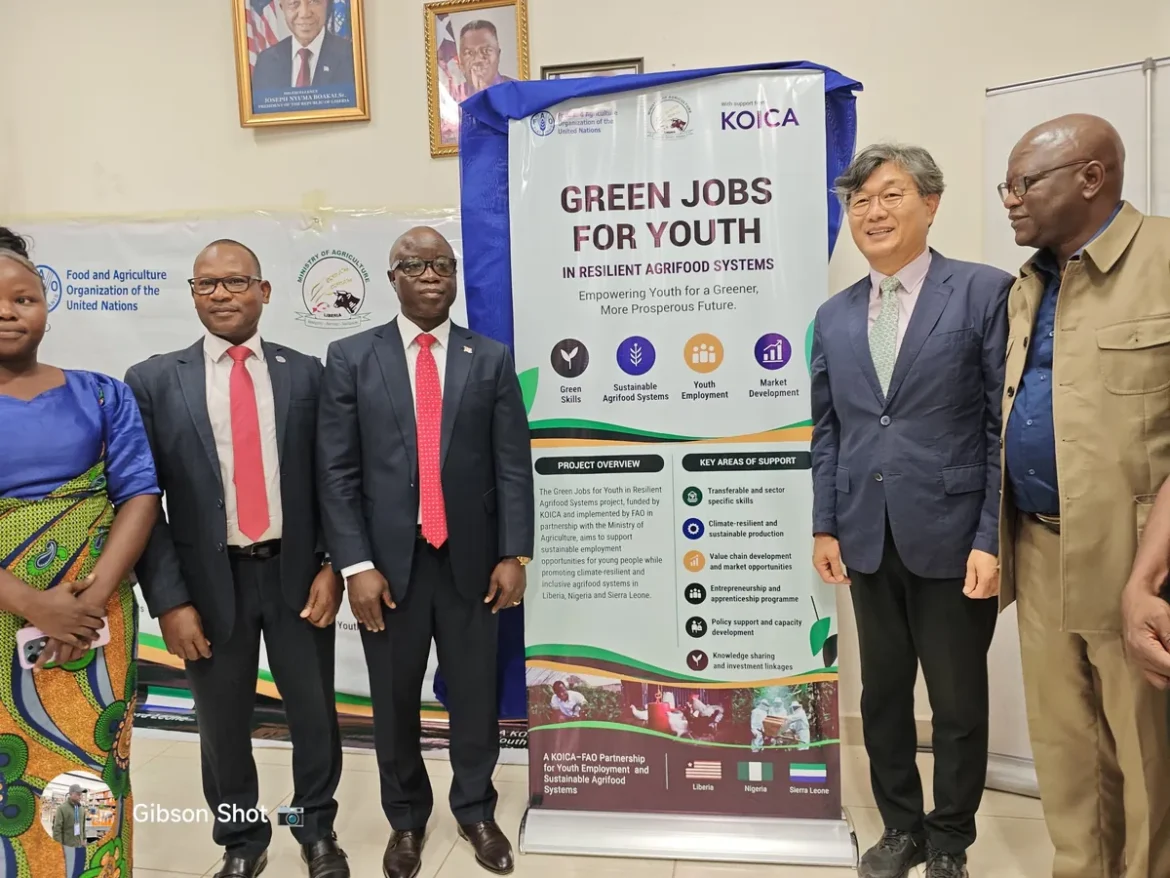
MONROVIA — Agriculture Minister J. Alexander Nuetah says a new project to create farm jobs for 150 young Liberians should be judged by the businesses it produces, not the number of people it trains. He warned that past programs left participants with skills but no money to use them.
“We’ve seen people get trained. They got the skills. They want to scale up, but they cannot scale up because they do not even have the startup capital,” Nuetah said Monday at the launch of the Green Jobs for Youth in Resilient Agrifood Systems Project in Monrovia.
The project runs from 2026 to 2030 across Liberia, Sierra Leone and Nigeria, with US$13 million from the South Korean government through the Korea International Cooperation Agency. The Food and Agriculture Organization of the United Nations is implementing it with the Ministry of Agriculture. Bong County is the pilot location in Liberia, and the target is 150 young people.
Nuetah urged the partners to make sure participants get real chances to start businesses across the agricultural value chain. He said that should go beyond farming to include aggregation, input distribution, processing and other commercial work that creates jobs and income. He said graduates should be able to show measurable gains in their livelihoods and productive capacity, and he hoped the pilot would produce results strong enough to justify a larger program nationwide.
Saeed Bancie, the FAO representative, called the project an investment in opportunity, dignity and economic prospects for young Liberians.
“Training alone does not create transformation,” Bancie said. He said success should show up in businesses established, higher incomes, decent jobs and changed communities.
Bancie said nearly 75 percent of Liberia’s population is under 35. He said agriculture employs more than 68 percent of the population and contributes about 28.5 percent of gross domestic product. Young people, he said, are held back by limited access to land, finance, modern technology, farm inputs and profitable markets.
He said the project aims to move young people beyond subsistence farming into agribusiness, mechanization, processing, digital innovation and value addition. He said green jobs should also promote environmental sustainability, climate resilience and responsible use of natural resources. He also called for deliberate efforts to make sure young women get access to skills, productive resources, technology, financing, markets and leadership roles.
Kim Eunsub, the KOICA country representative, said Liberia was the first of the three countries to sign the Record of Discussions that lays the foundation for implementing the project. He urged the project steering committee to give priority to implementation arrangements, institutional responsibilities, monitoring, reporting and sustainability. He said the real test would be whether young people gain relevant skills, start viable enterprises, reach markets and find meaningful work.
Saylawayee Henry-Zinnah, chairperson of the World Food Forum Liberia Chapter, pledged the organization’s support. She said the forum works with more than 40 organizations and more than 9,000 farmers and is ready to help make sure local farmers benefit. She called for transparency, accountability and effective implementation.
The project will focus on transferable and sector-specific skills, climate-resilient production, value chain development, market access, entrepreneurship, apprenticeships, policy support and links to investment.
See more Liberia News Network stories in Google Search by adding LNN as one of your Preferred Sources.
★ Add LNN as a Preferred Source