
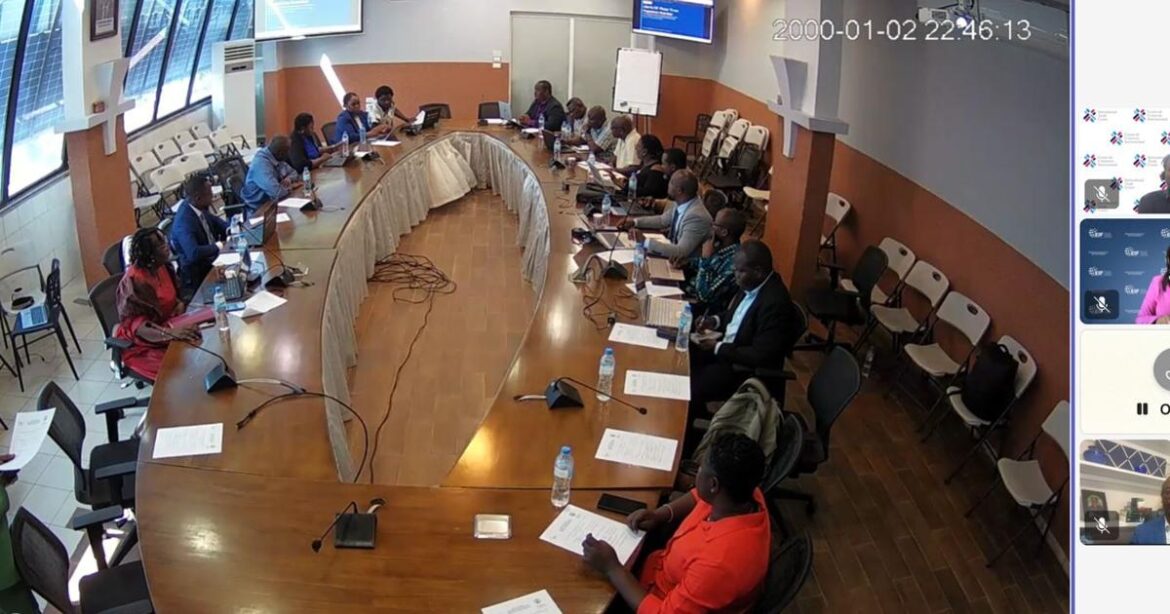
The Government of Liberia, through the Ministry of Commerce and Industry, in partnership with the Enhanced Integrated Framework and the International Trade Centre, has officially validated the EIF Phase Three Country Programme Document (CPD) for 2026–2031.
The validation took place during a high-level EIF/ITC–MoCI/SPIU Steering Committee meeting in Monrovia, marking a significant step toward strengthening Liberia’s trade competitiveness and accelerating economic diversification.
The newly endorsed programme aligns with Liberia’s ARREST Agenda for Inclusive Development (AAID) 2025–2029 and is designed to expand investment opportunities while promoting sustainable, trade-led growth.
Speaking at the event, EIF Executive Director Aissatou Diallo described the validation as a turning point for Liberia’s economic future.
“The validation of this EIF Phase Three Country Programme Document marks a decisive step forward, where strategic vision is translated into concrete action. Liberia is not only shaping its trade future but positioning itself to attract and scale investment that drives sustainable growth,” she said.
Deputy Minister for Commerce and Trade Wilmot A. Reeves emphasized the broader national significance of the initiative.
“The validation of Liberia’s EIF Phase Three Country Programme Document is more than a milestone — it is a national commitment to economic transformation and inclusive prosperity. Through trade-led growth, investment attraction, and stronger competitiveness, we are building a diversified economy that creates jobs, empowers our people, and improves lives. This is Liberia’s path forward — bold, inclusive, and globally connected,” Reeves noted.
The validation workshop brought together a wide range of public institutions and development partners, including the Liberia National Tourism Authority, Ministry of Finance and Development Planning, Central Bank of Liberia, Liberia Special Economic Zones Authority, National Investment Commission, and the Standards Laboratory.
Providing technical insight, Senior Trade Advisor Axel Addy highlighted the urgency of implementing catalytic programmes such as EIF Phase Three. He noted that Liberia currently faces a trade deficit estimated at about 14 percent of GDP, with exports still heavily dependent on gold, rubber, and iron ore.
The Country Programme Document builds on more than 15 years of trade-related reforms, including Liberia’s 2008 Diagnostic Trade Integration Study (DTIS), its 2015 update, and reforms tied to the country’s accession to the World Trade Organization.
The programme is structured around five key strategic outcomes: strengthening institutional capacity and trade governance, improving trade facilitation and regional market access, developing agriculture value chains and the rural economy, advancing Special Economic Zones and industrial growth, and enhancing the investment climate and private sector development.
Key priority interventions include modernization of trade statistics systems, digital trade reforms, implementation of a National Single Window, development of cocoa and cotton value chains, operationalization of Special Economic Zones, establishment of the Monrovia Industrial Park, and expanded investment promotion initiatives.
In total, the validated framework outlines 16 priority actions supported by 11 CPD documents and collaboration with 65 mapped institutions.
The financing package includes US$3.5 million in EIF support, US$505,000 in Government of Liberia co-financing, and more than US$15 million in targeted external catalytic investment.
The EIF Phase Three Country Programme (2026–2031) is a nationally driven trade and investment framework aimed at strengthening governance, improving market access, supporting export diversification, and promoting private sector growth — key pillars expected to drive inclusive and sustainable economic development across Liberia over the next five years.
With a strong focus on export diversification, digital trade, and private sector growth, the initiative is expected to drive inclusive and sustainable economic development across Liberia over the next five years.
