
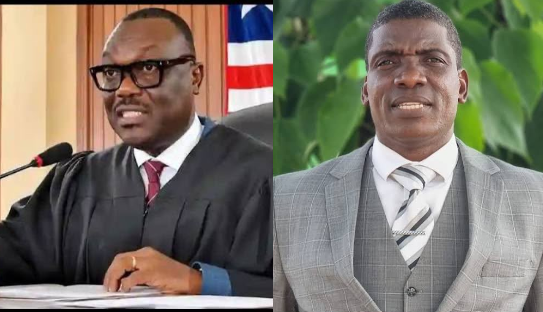
MONROVIA – Judge Ousman F. Feika of Criminal Court “C” did not suspend Atty. Gbawou Kowou’s law license. That distinction matters.
In a ruling dated October 9, Judge Feika dismissed a complaint in which Kowou accused the State’s prosecutors of tampering with defense witnesses. He then referred Kowou to the Supreme Court’s Grievance and Ethics Committee, “with a strong recommendation that his law license be suspended for one calendar year for unethical and unprofessional conduct unbefitting of a lawyer.”
Kowou remains a licensed lawyer. Whether he stays one is now a question for the Committee and, ultimately, the full bench of the Supreme Court.
How it started
The dispute grows out of the economic sabotage prosecution of former officials including Varney Sirleaf and Dee Maxwell Saah Kemayah. The case is brought by the Assets Recovery and Property Retrieval Task Force (AREPT), chaired by Cllr. Edwin K. Martin. Kowou represents co-defendant Wayfa Ciafa.
On Sunday, October 4, members of the Group of 77 went to AREPT’s offices. Some of them had already testified for the defense. That night, Kowou went live on Facebook and called in to the Spoon Talk Show. He alleged that AREPT had summoned his witnesses to intimidate them into recanting.
The next day he filed a Bill of Information asking the court to investigate. The court halted the trial, sent the jury back to quarters and opened an inquiry that afternoon.
What the court found
The ruling rejects Kowou’s account on almost every point:
• Why the witnesses went. The witnesses went at the instance of Raymond K. Zarby, the Group’s senior administrator. Zarby testified that he misread AREPT’s invitation, which was meant for rebuttal witnesses.
• What happened when they arrived. AREPT asked them to leave once it realized some had already testified for the defense. Witnesses for both sides said no one was threatened, though their phones were taken at the door. AREPT described that as routine for all visitors.
• Kowou’s prior knowledge. Kowou knew of the visit in advance. A witness had called him, and he advised them to go. That undercut his claim that they went without his knowledge.
• Martin’s whereabouts. Martin was not on the premises. Kowou had testified that Martin ordered him beaten and dragged out.
• The scuffle. The video showed a scuffle that began when AREPT staff tried to stop Kowou from filming and live-streaming inside the compound.
The court called the tampering allegation “absolutely false and misleading.”
The real charge: going public
The ruling says plainly that raising witness tampering is not misconduct. Counsel who has credible information, the court said, “should promptly bring the matter before the Court.”
The court’s objection is to the order of events: the Facebook live stream and the talk show came first, and the formal filing came after. It also points to a gag order issued at the start of the trial, barring lawyers from discussing the case with the media.
The judge found that Kowou breached Rules 1, 18, 20 and 22 of the Code of Moral and Professional Ethics. Those rules cover:
• Rule 1: undermining the courts
• Rule 20: publicity about pending litigation
• Rule 22: asserting unproven matters as fact
“Criticism of a judicial decision and denigration of the judicial institution are not synonymous,” the ruling says.
Where the ruling is on firm ground
On procedure, Judge Feika did what the law asks. Article 75 of the Constitution gives the Supreme Court authority over the legal profession. The Judiciary Law gives it the power to censure, suspend, or remove lawyers. Judicial Canon 21, which the ruling cites, tells trial judges to correct unprofessional conduct and, where necessary, refer it to the Grievance and Ethics Committee.
A trial judge who believes a lawyer has misbehaved before him is expected to make that referral. Feika did.
The questions it leaves open
The ruling still raises issues the Committee and the public will weigh.
Proportionality. A one-year suspension is a severe penalty. It would take Kowou out of every case he handles, not just this one. The conduct the ruling describes is publicity during a gag order and an allegation the court found unproven. Breach of a court’s own gag order is ordinarily a matter for contempt, and the ruling does not say why the court went straight to recommending a year off the roll.
Who judged the complaint? Kowou’s complaint was against the prosecuting party in a case the same court is trying. Courts routinely rule on such Bills of Information. Still, when a defense complaint against the prosecution is dismissed, and the complaining lawyer is then recommended for suspension, it raises a concern. Other defense lawyers may hesitate before raising similar complaints.
The “extreme circumstances” exception. By the ruling’s own account, Rule 20 allows that extreme circumstances may justify a public statement. Kowou will likely argue that a lawyer who believes his witnesses are being pressured faces exactly such circumstances. The court found the belief unfounded. The Committee will decide whether that makes the conduct sanctionable.
Where the ruling and Kowou agree. The ruling confirms that the witnesses’ phones were taken at AREPT’s door. It also confirms that AREPT staff physically tried to stop Kowou from filming. Neither amounts to tampering, but both help explain why a defense lawyer might have feared the worst.
What comes next
The Grievance and Ethics Committee must now conduct its own investigation, with Kowou entitled to be heard. Its recommendation then goes to the full bench of the Supreme Court. Judge Feika’s recommendation does not bind the Committee, and the Supreme Court is not bound by the Committee’s.
Kowou is also on the defense team for former Vice President Jewel Howard-Taylor in a separate case before the same court. How the Supreme Court handles his referral will be watched closely by lawyers on both sides of Liberia’s most politically charged prosecutions.
See more Liberia News Network stories in Google Search by adding LNN as one of your Preferred Sources.
★ Add LNN as a Preferred Source