
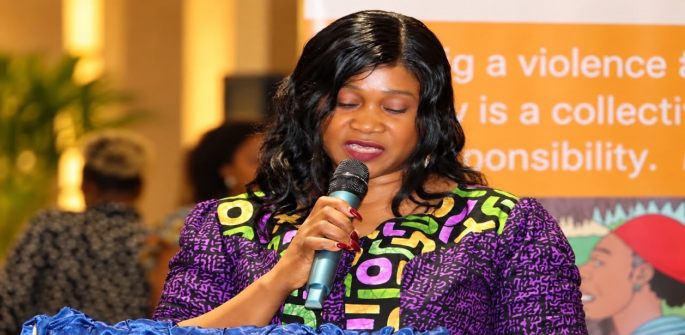
MONROVIA — The Women NGOs Secretariat of Liberia (WONGOSOL) has called for stronger inter-ministerial coordination, increased government funding, and stricter data protection measures as Liberia launches its first Gender-Based Violence Information Management System (GBVIMS), warning that fragmented reporting and inadequate resources could undermine efforts to protect survivors and hold perpetrators accountable.
The system, launched by the Ministry of Gender, Children and Social Protection under the leadership of Minister Gbeme Horace-Kollie, is expected to strengthen the collection and management of gender-based violence (GBV) data, providing a foundation for evidence-based policies and improved responses to survivors.
WONGOSOL Executive Director Esther S. Davis Yango, who participated in the launch, stressed that the system’s effectiveness will depend on how well government institutions coordinate their reporting and establish a reliable national dataset on gender-based violence.
During her remarks, Yango highlighted concerns over inconsistencies in GBV figures received by civil society organizations from different government institutions, including the ministries responsible for gender, justice, and health.
She called for stronger collaboration among the three ministries to harmonize reporting, protect data integrity and ensure that institutions work from one reliable set of national figures.
The concern underscores the importance of establishing a coordinated system through which accurate and consistent information can guide national interventions, resource allocation and accountability in addressing gender-based violence.
FUNDING GAPS COULD UNDERMINE DATA COLLECTION
Beyond coordination, WONGOSOL raised concerns about whether existing resources will be sufficient to support effective data collection across Liberia, particularly in remote and hard-to-reach communities where survivors often face significant barriers to reporting abuse and accessing services.
Yango urged the Government of Liberia to complement development partners’ contributions by allocating adequate funding in the Ministry of Gender’s national budget to provide additional data collection equipment across the counties.
Although the provision of two tablets per county represents an initial step toward strengthening data collection, she cautioned that the equipment may not be sufficient to support comprehensive reporting nationwide.
Without adequate tools and resources, communities with limited access to services risk remaining underrepresented in national GBV statistics, potentially weakening the evidence needed to identify gaps, direct interventions and improve support for survivors.
WONGOSOL maintained that the successful implementation of the system must extend beyond its launch to include sustained government investment, adequate equipment and the capacity to collect reliable information throughout the country.
SURVIVOR CONFIDENTIALITY MUST BE PROTECTED
WONGOSOL also emphasized the need to involve civil society organizations and frontline service providers in implementing the system, given their roles in supporting survivors and responding to cases of gender-based violence.
The organization stressed that the collection and management of GBV information must strictly adhere to confidentiality, data protection, informed consent, and survivor-centered principles.
These safeguards are critical to ensuring that sensitive information is handled responsibly and that survivors’ privacy and dignity are protected throughout the reporting process.
For WONGOSOL, the system must not only improve the availability of GBV statistics but also strengthen the institutions and services responsible for responding to violence against women and girls.
CALL FOR SUSTAINED GOVERNMENT OWNERSHIP
WONGOSOL congratulated Minister Gbeme Horace-Kollie and the Ministry of Gender, Children and Social Protection, alongside development partners, technical teams, civil society organizations, and other stakeholders whose collaboration contributed to the launch.
However, the organization stressed that the milestone must be followed by sustained government ownership, adequate financing, and stronger institutional coordination to ensure the system delivers meaningful results.
Reliable data, it argued, must translate into evidence-based policies, improved services, stronger accountability, and access to justice for survivors of gender-based violence.
The launch of Liberia’s first GBV Information Management System marks an important step toward strengthening the country’s response to gender-based violence. Its long-term impact, however, will depend on whether the government and its partners can address gaps in coordination, financing, data collection, and survivor protection.
For WONGOSOL, the ultimate measure of success will not simply be the establishment of a national information system, but whether the information it generates leads to more effective interventions, better protection, and greater accountability for gender-based violence in Liberia.
See more Liberia News Network stories in Google Search by adding LNN as one of your Preferred Sources.
★ Add LNN as a Preferred Source