
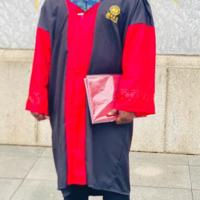
A distinguished Liberian researcher and technology specialist, Dr. Sonkarlay J. Y. Weamie, has been awarded a Doctor of Engineering degree in Computer Science and Technology from Hunan University in China, marking a major milestone in his academic and professional journey.
Dr. Weamie described the achievement as the result of years of intensive research, discipline, and personal sacrifice, noting that his doctoral studies focused on cybersecurity, artificial intelligence, and advanced computing systems.
Announcing the achievement, Dr. Weamie said the accomplishment represents far more than the completion of a doctoral program, but rather a transformative journey shaped by perseverance and commitment to advancing knowledge in cybersecurity, artificial intelligence (AI), and computer science.
“Today marks the successful completion of one of the most significant milestones of my academic journey, the award of my Doctor of Engineering degree in Computer Science and Technology,” he said.
He reflected on the challenges and demands of doctoral research, noting that the process required long hours of experimentation, academic writing, and problem-solving under difficult conditions.
“This achievement represents far more than the completion of a research program,” he stated. “It reflects years of perseverance, discipline, sacrifice, continuous learning, and an unwavering commitment to advancing knowledge in the field of cybersecurity, Artificial Intelligence (AI), and computer science in general.”
Dr. Weamie emphasized that his journey reinforced his belief in persistence and resilience as key drivers of success.
“From countless hours of research, experimentation, and writing to overcoming challenges along the way, this journey has strengthened my belief that determination, faith, and hard work can transform ambitious goals into reality,” he added.
He expressed deep gratitude to God for what he described as divine guidance throughout his academic pursuit, and acknowledged the key institutions and individuals who supported his success.
“I am deeply grateful to Almighty God for His grace, guidance, protection, and strength throughout this journey,” he said. “My sincere appreciation goes to my supervisor, Professor Chen Hao, whose mentorship, encouragement, and scholarly guidance were instrumental in shaping this work.”
Dr. Weamie also extended thanks to Hunan University, the Chinese Scholarship Council, and the Government of Liberia for their support, alongside colleagues, friends, and family members who encouraged him throughout his studies.
He further noted that education should be viewed as a tool for societal transformation rather than personal achievement alone.
“As I reflect on this moment, I am reminded that education is not merely about earning degrees but about acquiring the knowledge, skills, and responsibility to contribute meaningfully to society,” he said. “This achievement is therefore not the end of a journey, but the beginning of a new chapter dedicated to research, innovation, public service, and the advancement of solutions that address real-world challenges.”
Encouraging young scholars and professionals, he urged persistence in the pursuit of academic and professional goals.
“To every student, researcher, and professional pursuing a dream, remain focused, stay resilient, and trust the process,” he advised. “The path may be difficult, but persistence and dedication will always yield positive results.”
Dr. Weamie holds a Bachelor of Science in Economics from A.M.E. Zion University, a Master of Engineering in Computer Science and Technology from Hunan University in 2016, and now a Doctor of Engineering in Computer Science and Electronic Engineering from the same institution in Changsha, China.
His research focuses on intelligent systems, deep learning, explainable artificial intelligence, cybersecurity analytics, and secure information systems. He has authored and co-authored several peer-reviewed publications and presented at international conferences, contributing to advancements in artificial intelligence and cybersecurity.
Beyond academia, Dr. Weamie has served in senior technology and public administration roles within Liberia’s Civil Service Agency, including Assistant Director, Deputy Director for Information Technology Services, and Director of the Human Resource Management Information System (HRMIS). He also served as Component Two Manager of the World Bank-supported Public Sector Modernization Project, where he led biometric-driven reforms aimed at improving public sector efficiency.
He is also a co-inventor of a patented artificial intelligence-based brain disease monitoring device, reflecting his continued interest in applying research to real-world health and technological challenges.
As he enters a new phase of his professional journey, Dr. Weamie says he remains committed to bridging research, innovation, and public service to support both national and global development.
