
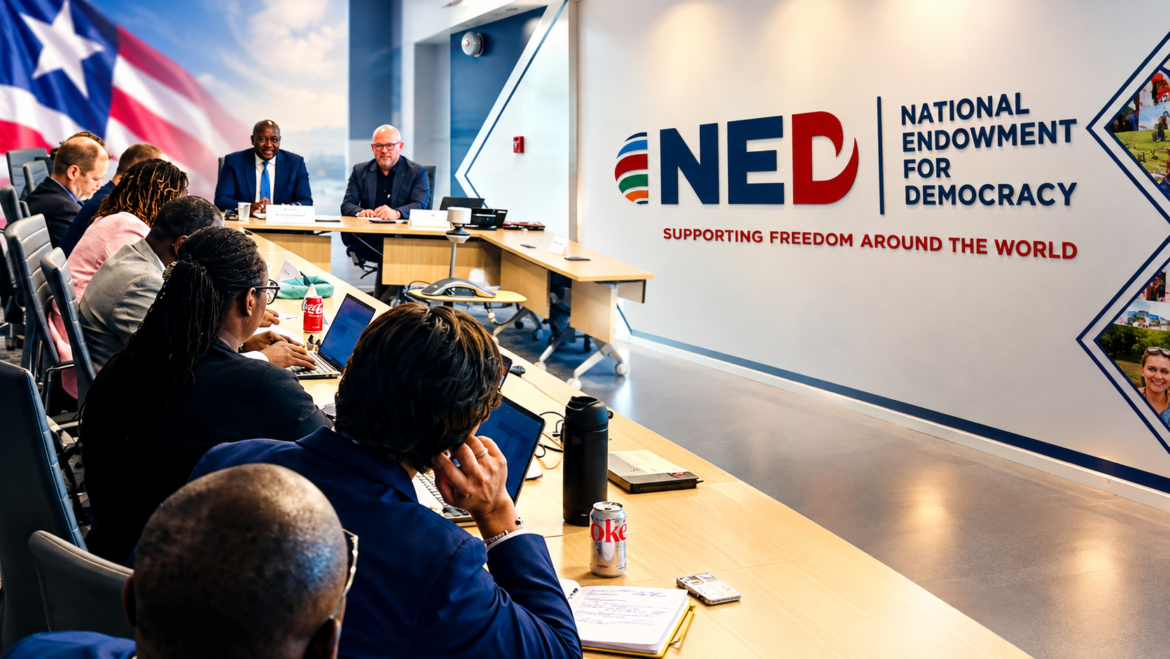
WASHINGTON, DC — A Liberian senator has told American democracy advocates that his country faces two threats at once: multinational mining companies working through legal deals, and drug cartels working through bribes. He said either one could hollow out Liberia’s democracy from within if it is left unchecked.
Senator Amara M. Konneh is an independent lawmaker from Gbarpolu County in northwestern Liberia and chairs the Senate’s Public Accounts and Audit Committee. He spoke at a private roundtable hosted this month by the National Endowment for Democracy (NED), a U.S.-funded
organization that supports democratic institutions abroad. His remarks are drawn from talking points prepared for the session and reviewed by FrontPageAfrica.
“Liberia is not yet a captured state,” Konneh said, “but we are at the most dangerous point since the war and Ebola.”
The West African nation of about 5.5 million people was founded in 1847 with the backing of freed American slaves. It is still recovering from a civil war that ended in 2003 and from the 2014–2016 Ebola epidemic that killed nearly 5,000 Liberians.
‘Legal, so it’s harder’
Konneh said mining makes up 12 percent of Liberia’s gross domestic product and 65 percent of its export earnings. Yet less than 3 percent of that wealth reaches communities directly.
The problem, he argued, starts with the way concessions are negotiated. Liberian law gives the executive branch wide discretion over Mineral Development Agreements. These 25-year contracts are ratified by the legislature and are very hard to amend later. “Companies negotiate with three or four people in Monrovia, not with the country,” he said.
He pointed out that several major operators are renegotiating rail, port and royalty terms at the same time: steelmaker ArcelorMittal, gold miner Bea Mountain, Hummingbird and Bao Chico. On paper Liberia keeps 48 percent of mining value, he said, but stabilization clauses, tax holidays and transfer pricing push the real share far lower.
He also described a system of off-budget signature bonuses and “social contributions,” often paid around elections. He said legislators from mining districts are offered jobs, scholarships and “facilitation fees” of $5,000 to $20,000 to vote for ratification. “This is legalized state capture,” he said. He did not tie any particular company to these payments.
He also warned that private security forces at some concessions are larger and better equipped than the county police. And he said community activists who protested environmental damage have been charged with “economic sabotage.” His examples included Kinjor in Grand Cape Mount County, the community most affected by Bea Mountain’s gold concession, as well as communities in Grand Bassa and Nimba.
‘Illegal, so it’s faster’
The drug trade follows “the same playbook, different commodity,” Konneh said. Traffickers don’t need to buy the whole state, only key people: “an airport baggage handler, an evidence clerk, a police crime services officer, and a port scanner operator.”
He cited two seizures this year. In June, 237 kilograms of cocaine worth an estimated $19.2 million were seized at Roberts International Airport, the country’s main airport. In July, 3.9 metric tons worth about $317 million were seized in Duazon, outside the capital, Monrovia. He said the July haul had links to Spain, Colombia, Serbia, Croatia and Ukraine, and that its value was four times Liberia’s national health budget.
He also pointed to cases inside the country’s own anti-drug agency. On September 29, a court in Margibi County convicted Joe Logan and Lovette Flowers, two agents of the Liberia Drug Enforcement Agency (LDEA), of colluding with traffickers, and sentenced each to the maximum 20 years. They had resold cocaine seized at the airport. Konneh said a police Commissioner for Crime Services was also dismissed after admitting to taking a $10,000 bribe in the same network.
Konneh also raised the most politically sensitive case. Former Vice President Jewel Howard-Taylor was arrested at the airport and charged on August 19 with conspiracy, facilitation and money laundering. She denies the charges. Konneh criticized the government for destroying the 3.9 tons of cocaine before trial. He predicted the case could collapse over constitutional warrant defects or chain-of-custody problems. If it does, he said, “the public will conclude it’s politics, not justice.”
He placed Liberia within a wider regional crisis. According to the UN Office on Drugs and Crime (UNODC), 126.4 metric tons of cocaine were seized in or through West Africa between 2019 and 2024, including 30.8 tons in the Gulf of Guinea corridor along Liberia’s coast. The region has become “a destination market, not just a transit zone,” he said. He also described kush, a cheap synthetic drug blend that first spread in Sierra Leone and now reaches Liberia, Guinea, Guinea-Bissau, The Gambia and Senegal, mostly among unemployed young people.
Why Washington should care
Konneh framed the issue as a test of American credibility. He said Liberia voted with the United States 89 percent of the time at the United Nations last year and hosts the largest U.S. diplomatic presence in West Africa.
“If Liberians conclude that America only cares when there’s a big drug bust but stays silent when a $2 billion mining deal is signed behind closed doors, we lose credibility for democracy,” he said. “China and Russia don’t ask about beneficial ownership. Cartels don’t ask about human rights.”
He noted that Sweden closed its embassy in Monrovia last month. He also urged the European Union to keep its delegation in Liberia fully staffed rather than move its functions to Abidjan in neighboring Côte d’Ivoire.
The asks
At home, Konneh said, the Senate is working on several measures. On mining, it wants to require that all mining agreements, amendments, beneficial owners and payments be published before ratification. It also proposes independent valuation of iron ore transfer pricing, modeled on Botswana’s approach to diamonds, and sending 20 percent of royalties directly to district development funds.
On drugs, the proposals would require that seized evidence be kept until final judgment. Officers at the airport, the Freeport of Monrovia and the security agencies would face polygraphs, lifestyle audits and drug tests. An unexplained-wealth law would allow assets to be seized without a criminal conviction.
From Washington, he asked for help that is “practical, not preachy”:
- Funding to monitor Liberia’s drug court and commercial court
- Forensic audits of the ArcelorMittal rail and port concession and of Bea Mountain’s royalties
- Resumed mentoring of vetted Liberian drug units by the U.S. Drug Enforcement Administration, with oversight
- Equipment for scanners and sniffer dogs, including maintenance
- Help from the Treasury Department’s Financial Crimes Enforcement Network (FinCEN) in tracing money in three or four specific cases
- A $10 million pilot program to track large cash donations ahead of the 2029 elections
He also urged that Global Magnitsky sanctions, the U.S. tool for penalizing corrupt officials and human rights abusers, be used “surgically.” Their targets should include enablers in mining licensing who move money into U.S. real estate, he said, and Washington should state publicly why it acts.
“Help us establish transparent regulations before finalizing agreements,” Konneh said, “and support impartial enforcement of laws after confiscation — whether the suspect is an airport baggage handler, a police crimes services director, a former Vice President, or a multinational corporation.”
See more Liberia News Network stories in Google Search by adding LNN as one of your Preferred Sources.
★ Add LNN as a Preferred Source