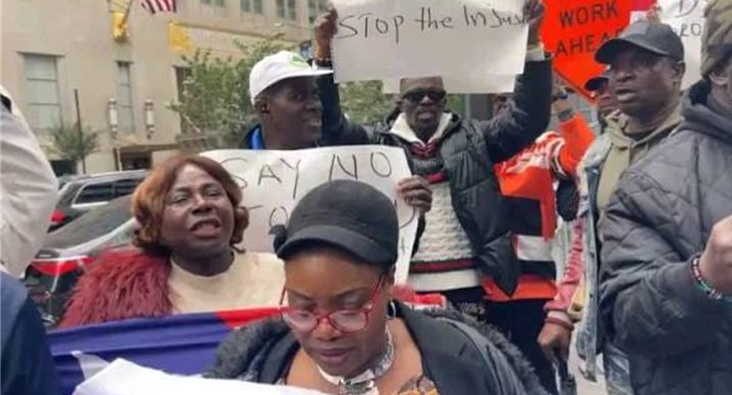
NEW YORK — Liberia’s deepening debate over narcotics, police accountability and alleged selective justice followed President Joseph Nyuma Boakai to the heart of the international community this week, as Liberians gathered in New York to protest outside the hotel where the President was staying and later near the United Nations Headquarters.
The demonstration came as President Boakai traveled to New York for the 81st Session of the United Nations General Assembly, where he delivered Liberia’s national address on September 24 under the theme “Restoring Trust, Managing Transformation: A United Nations that Delivers for All.”
For the protesters, however, the issue was whether the government is restoring trust at home.
Dozens of Liberians gathered outside the President’s hotel and later at the United Nations, raising concerns over Liberia’s drug crisis, alleged selective justice, police conduct and accountability within the security sector.
Their message was direct:
“We want justice.”
“No to drugs.”
“Gregory must go.”
The demonstrators specifically demanded the removal of Liberia’s Inspector General of Police, Gregory Coleman, while making a series of allegations against government officials and questioning what they described as unequal application of the law.
Those allegations remain claims by the protesters. No evidence establishing the accusations against President Boakai, members of his family or Coleman was publicly presented during the demonstration, and they should not be treated as established facts.
THE PROTEST MOVES THE DRUG DEBATE TO THE UN
The location of the demonstration was significant.
Rather than limiting their grievances to Liberia, the protesters deliberately brought them to New York during the United Nations General Assembly, placing Liberia’s domestic drug and accountability debate before an international audience.
They argued that the country’s narcotics crisis has become too serious to be treated solely as a domestic political matter.
“Our children are dying every day. We say no to drugs. We need justice. Let the United Nations hear our cry,” protesters were reported chanting outside the President’s hotel.
The protesters also accused the government of pursuing what they described as selective justice, questioning why some people have been arrested while others whom they believe should face investigation remain free.
One organizer questioned why unnamed senior officials allegedly connected by protesters to drug trafficking had not been arrested.
Again, those accusations were made by demonstrators and were not substantiated with evidence at the protest.
WHY COLEMAN BECAME A CENTRAL TARGET
Coleman became one of the most prominent targets of the demonstration.
Protesters called for his removal from office and accused him of involvement in the country’s drug crisis.
Those allegations are unproven.
But the demand for Coleman’s removal comes against the backdrop of a much wider cocaine investigation that has already ensnared several law-enforcement and security personnel.
President Boakai has previously ordered the dismissal of senior officials connected to the narcotics investigations, including former LNP Commissioner for Criminal Investigation, Intelligence and INTERPOL Johnny Bolar Dean; RIA Deputy Director for Operations Mark Egon Kuiah; and two police officers, Anthony T. Blaye and Wadell W. Kwarbo, whom the government said had used official vehicles in connection with the transportation of a narcotics consignment.
The government’s actions demonstrate that the controversy has reached beyond suspected traffickers and into Liberia’s security institutions.
That is precisely why Coleman’s critics are asking whether the police leadership itself should face greater scrutiny.
THE QUESTION OF PUBLIC CONFIDENCE
The protesters’ demands raise a broader institutional question:
Can Liberia maintain public confidence in its anti-drug campaign when allegations and investigations increasingly involve personnel within the security establishment?
The government has repeatedly said it is committed to fighting narcotics trafficking and holding public officials accountable.
In July, President Boakai ordered multiple dismissals, suspensions and investigations in connection with the cocaine cases, stating that no public official or government employee found involved in criminal conduct should remain in public service.
In another case, the President ordered the Justice Ministry to conduct what he described as a comprehensive and impartial investigation after allegations involving the LDEA leadership, emphasizing that the investigation should be guided by facts and designed to preserve public trust.
The New York demonstrators are effectively asking the government to apply that same standard across the entire security chain.
FROM MONROVIA TO NEW YORK
The protesters also used the demonstration to raise concerns about police treatment of citizens in Liberia.
They contrasted their experience in New York with what they described as the treatment of protesters in Liberia, arguing that citizens should be able to assemble and criticize government without intimidation.
The New York demonstration remained peaceful, according to reports.
That contrast became part of the protesters’ broader message:
They want justice, accountability and freedom to criticize government without fear.
A PRESIDENT SPEAKING ABOUT TRUST AS PROTESTERS DEMAND IT
The timing could hardly have been more striking.
President Boakai’s UN address was built around the theme of restoring trust and managing transformation.
At almost the same time, Liberians were outside demanding answers over drugs, policing and justice.
That does not establish that the protesters’ allegations are true.
But it demonstrates that questions of institutional trust remain politically significant among some Liberians at home and in the diaspora.
And the message from New York was unmistakable:
International speeches about good governance, accountability and the rule of law must ultimately be matched by what citizens experience inside Liberia.
THE BIGGER STORY
The New York demonstration should not be viewed simply as another protest against a sitting president.
It reflects a growing struggle over who should be held accountable for Liberia’s drug crisis and how far the government is prepared to go in investigating allegations involving powerful individuals and security institutions.
The cocaine investigations have already resulted in arrests, dismissals, suspensions and further investigations. The government says it is pursuing those cases in accordance with due process.
The protesters, however, want more.
They want what they describe as equal justice.
They want greater scrutiny of senior officials.
They want the Police Inspector General removed.
And they want the international community to hear their concerns.
Whether their allegations withstand independent investigation is another matter entirely.
That is where evidence must replace slogans.
Telephone records, financial transactions, vehicle movements, official communications, witness testimony and other documentary evidence—not demonstrations—must ultimately determine who bears responsibility for Liberia’s narcotics crisis.
But the political message from New York is already clear:
Liberia’s drug crisis has become an international accountability issue—not merely a Monrovia conversation.
As President Boakai takes Liberia’s message to the world, Liberians in New York have taken their own message back to the world:
They want the fight against drugs to be credible, the law to be applied equally, and those entrusted with protecting Liberia to be held accountable.
The demonstration may have ended peacefully.
The questions it raised have not.
See more Liberia News Network stories in Google Search by adding LNN as one of your Preferred Sources.
★ Add LNN as a Preferred Source