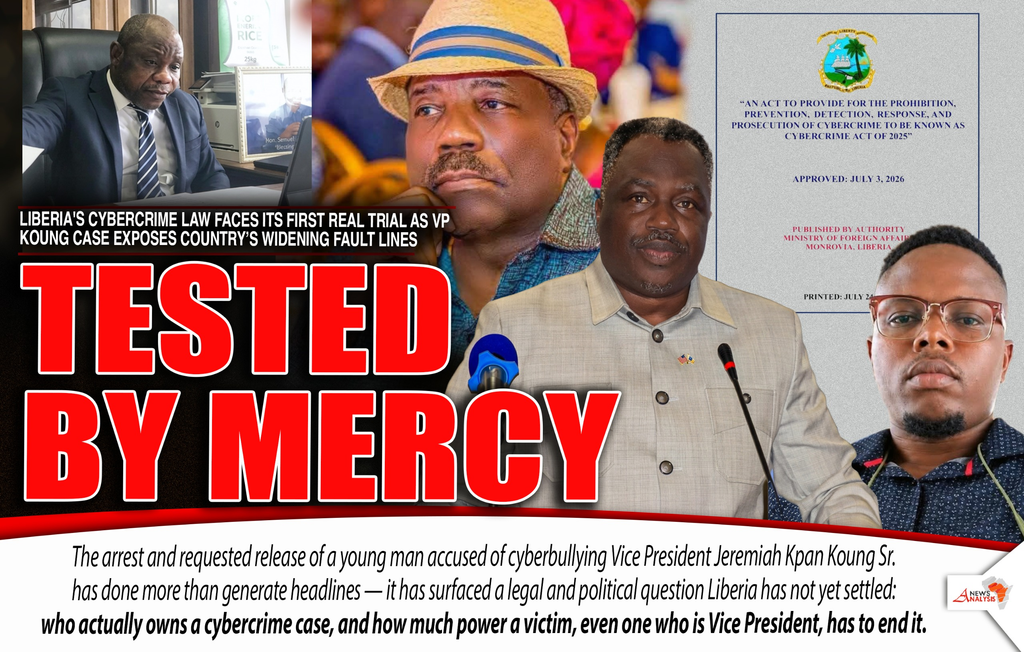
Monrovia – The arrest of Jerry Nyantee Wrotto, a young man accused of cyberbullying Vice President Jeremiah Kpan Koung Sr., and the Vice President’s subsequent request for his release have thrust Liberia’s year-old Cybercrime Act into its first major public test, exposing competing views over free speech, criminal prosecution and the limits of executive mercy.
At the center of the controversy is a question with implications beyond the Vice President’s office: Can an alleged victim withdraw a cybercrime complaint and end a prosecution, or does the state retain the authority to pursue the case in the public interest?
The debate has drawn sharply contrasting responses from Executive Protection Service (EPS) Director Sam Gaye, who defended applying the law to digitally manipulated content, and former Finance Minister Samuel D. Tweah Jr., who argues that Wrotto’s arrest infringes on free expression.
Koung, meanwhile, has called for the suspect’s release, framing his intervention as an expression of tolerance and restraint befitting public office.
“Criminal cases are prosecuted in the name of the Republic, not the complainant,” Garpue K. Wonlue, an Assigned City Solicitor and Prosecutor at the Ministry of Justice, wrote in an open letter challenging the legal effect of the Vice President’s request.
The competing positions have transformed Wrotto’s case into a broader debate over how Liberia should enforce its new cybercrime legislation without undermining constitutional protections for speech and political criticism.
A Law Barely a Year Old, Already Being Tested
Liberia’s Cybercrime Act of 2025 was passed by the Senate in November 2025 and signed into law, filling a gap left by the country’s 1978 Penal Code, which contained no specific cybercrime provisions.
The legislation criminalizes several forms of digital misconduct, including unauthorized computer access, online fraud, identity theft and electronic harassment. Its passage was intended, in part, to strengthen the country’s response to cyber-enabled offenses.
But the Koung controversy is pushing the law into contentious territory involving artificial intelligence, political expression and the boundaries of permissible criticism.
The Act does not explicitly reference artificial intelligence or deepfakes, raising questions about how its provisions should apply to AI-generated material and the circumstances under which such content constitutes a criminal offense.
The controversy also follows an earlier incident involving a manipulated video of the Vice President at Brussels Airport. Wrotto had allegedly posted nude AI-generated photos and video of VP Koung, claiming he was subjected to screening at Brussels Airport.
Before Wrotto’s arrest, EPS Director Sam Gaye publicly defended the police response to the alleged creation of the video, warning that digitally manipulated material intended to humiliate or harass individuals could attract criminal liability under the new law.
“To those making noise about why the police arrested the individual who created the fake, humiliating video footage of the VP at Brussels airport—it is a crime under the new Cybercrime Act of 2025/2026,” Gaye wrote.
He said the law was signed by President Joseph Boakai on August 19, 2026, and criminalizes cyber-harassment and cyberbullying.
“Creating and sharing a fake image to insult, humiliate, or threaten someone constitutes a cybercrime,” Gaye declared, warning that cyber detectives would identify, arrest and prosecute individuals engaged in such conduct.
Gaye’s remarks, made before Wrotto’s arrest, reflected the EPS’s position that the creation and circulation of humiliating AI-generated material could warrant law enforcement intervention.
The Vice President’s subsequent call for Wrotto’s release, however, has raised a separate question: whether the alleged victim’s willingness to forgive should affect the state’s decision to continue a criminal case.
Tweah Challenges Arrest, Calls for Repeal
Former Finance and Development Planning Minister Samuel D. Tweah Jr. has taken a sharply different position, welcoming Koung’s intervention while arguing that the Vice President should never have had to request the release of a citizen accused of online speech-related conduct.
“Mr. Vice President, thanks for calling for the release of the young man Jerry Nyantee Wrotto who was illegally imprisoned for free speech. But the Americans would say No Thanks,” Tweah wrote. “That you have to call for his release is the problem. He should not be behind bars for free speech in the first place.”
Tweah described the cyberbullying law as draconian and predicted that it would be struck down after the Unity Party leaves power. He argued that the legislation conflicts with Liberia’s history of press freedom reforms, including the Kamara Abdullah Kamara (KAK) Act, which decriminalized several speech-related offenses.
He also cited Liberia’s approval of the Table Mountain Declaration under former President Ellen Johnson Sirleaf, presenting the cybercrime legislation as a departure from the country’s previous commitments to press freedom.
“If politicians do not want to be cyber bullied let them leave politics and go to private life,” Tweah wrote, arguing that ordinary Liberians must be able to criticize political leaders.
“The only power ordinary Liberians have is to bully their leaders so that they deliver the desired change.”
Tweah further called on Koung to press President Boakai to repeal the cyberbullying law, while also urging him to address what he characterized as judicial interference and politically motivated pressure on the opposition under the current administration.
He thanked Koung for his intervention on Wrotto’s behalf but maintained that the Vice President’s request for release did not address the underlying problem.
“Thank you for your stand on the jailed political activist, but no thanks sir,” Tweah concluded.
His intervention has broadened the dispute from the circumstances of Wrotto’s arrest to the law’s legitimacy, its potential implications for political discourse and the government’s broader record on civil liberties.
A Deeper Fight: Who Controls Speech Online?
The Koung controversy comes amid a wider debate over the reach of Liberia’s digital laws and the safeguards protecting speech.
The 2019 KAK Act decriminalized speech offenses such as sedition and criminal libel against the President, marking a significant press-freedom reform.
However, a proposed 2026 amendment, the draft Protection from Gender-Based Online Abuse and Harassment Act, has raised concerns among press freedom advocates.
Press Union of Liberia President Julius Kanubah has warned that reopening the KAK Act could erode protections won by journalists and ordinary citizens. The Union has argued that online harassment should be addressed through the Cybercrime Act rather than by revisiting the KAK Act.
The judiciary has also weighed in on the boundaries of online expression. In February 2026, the Supreme Court ruled in the “Prophet Key” contempt case arising from social media commentary directed at the bench that constitutional free speech protections do not extend to vulgar or abusive attacks on individuals.
The ruling adds another dimension to the debate, as authorities and citizens grapple with distinguishing protected criticism from conduct that may lawfully attract criminal sanctions.
For Tweah, the central concern is the potential chilling effect of the cyberbullying law on citizens’ ability to hold public officials accountable. Gaye’s position, by contrast, emphasizes the criminal consequences of creating and distributing digitally manipulated material intended to humiliate or harass another person.
The distinction between political criticism and conduct prohibited by law is likely to remain central to the controversy.
Mercy vs. the Machinery of Prosecution
While Gaye and Tweah have focused on the law’s enforcement and implications for free expression, Wonlue’s intervention centers on the independence of criminal prosecution and whether the Vice President’s request can legally terminate the case.
In his open letter, Wonlue argued that criminal proceedings belong to the Republic of Liberia, not the individual who reports an alleged offense.
“Under Liberian criminal jurisprudence, all crimes are captioned as Republic of Liberia vs. Defendant. The victim — you — is only a witness,” he wrote.
Wonlue contended that the alleged offense is a matter for the state and cannot simply be withdrawn because the complainant has chosen to forgive the accused.
“The Inspector General of Police does not take instructions from a witness on whether to prosecute,” he added, warning that police compliance with the Vice President’s request could amount to interference and an abuse of power.
He also rejected the notion that the case should be treated solely as an issue of personal offense, arguing that the state has a responsibility to protect individuals who may lack the influence or public standing of the Vice President.
“Today it is the Vice President; tomorrow it could be a private citizen who does not have your power to forgive,” Wonlue wrote.
He questioned what message the state would send to ordinary Liberians, particularly women and girls, whose AI-generated intimate images might be circulated online without their consent.
“If the Police release this young man because he targeted a tolerant Vice President, what message do we send to the ordinary Liberian girl in West Point or Sanniquellie whose nude AI images are being shared?” he asked. “That she has no protection?”
Wonlue’s argument underscores the distinction between a complainant’s willingness to forgive and the state’s authority to determine whether a criminal prosecution should proceed.
Yet the competing interventions from Gaye, Tweah and Wonlue expose the unresolved tensions surrounding the law: the need to address online abuse, the protection of political expression and the limits of prosecutorial discretion.
What’s Actually at Stake
The Wrotto case has brought three overlapping issues into sharp focus: the Cybercrime Act’s application to AI-generated content, concerns that expanding online speech restrictions could undermine press freedom, and the question of whether an alleged victim’s request for mercy should influence the state’s prosecution of a criminal case.
For Gaye, the controversy is a reminder that digitally manipulated content can carry legal consequences. For Tweah, it is evidence of a law that threatens political expression and should be repealed. For Wonlue, the central concern is whether the Republic can independently enforce its laws, even when the alleged victim is willing to forgive.
Koung’s intervention has added a human dimension to the dispute, but it has not resolved the legal questions surrounding the prosecution.
Whether Wrotto is released, prosecuted or granted some other legal relief, the case is likely to shape public expectations about how Liberia enforces its cybercrime legislation.
The test is not only whether the law can punish alleged online abuse, but whether its enforcement can withstand scrutiny over due process, free expression and equal protection — particularly when the complainant is one of the country’s most powerful public officials.
See more Liberia News Network stories in Google Search by adding LNN as one of your Preferred Sources.
★ Add LNN as a Preferred Source