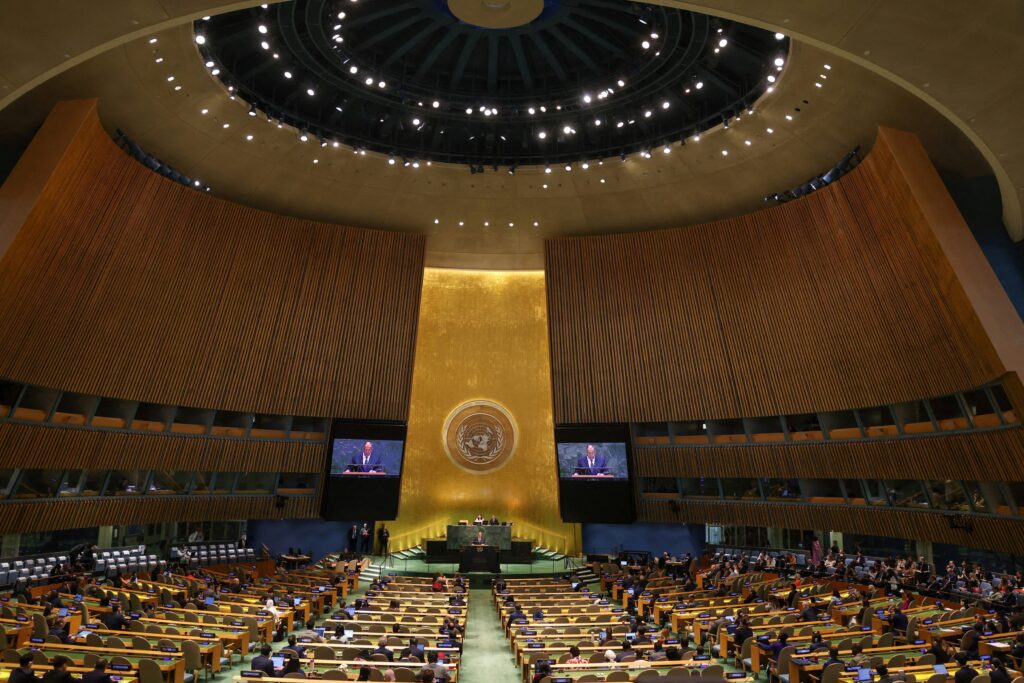
NEW YORK/MONROVIA — Liberia’s decision to join dozens of countries whose seats were empty when Israeli Prime Minister Benjamin Netanyahu addressed the 81st United Nations General Assembly has revived an old question about Monrovia’s foreign policy: Is Liberia moving closer to the African/Palestinian position on Israel at a potential cost to its traditionally close relationship with the United States?
The issue is particularly sensitive because Liberia’s Permanent Representative to the United Nations, Ambassador Lewis G. Brown II, has previously been at the center of controversy over Liberia’s position on Israel and Jerusalem.
Reports following Netanyahu’s September 24 address indicate that Liberia was among 77 countries listed by Israeli officials as either absent from the chamber or having walked out at the beginning of the speech. International reports described a large-scale protest as Netanyahu took the podium.
However, an important distinction should be made: the available reporting confirms Liberia’s seat was among those listed as absent/walkout, but it does not independently establish that Brown personally led or ordered the walkout.
That distinction matters because the Liberian ambassador represents the government and its foreign-policy instructions; he does not ordinarily determine Liberia’s foreign policy by himself.
The Brown-Israel controversy
Brown’s history on the Israel-Palestine question goes back several years.
In 2017, Liberia voted against the U.S.-backed effort concerning recognition of Jerusalem as Israel’s capital. Brown later explained that the Liberian position reflected instructions from Monrovia and an African Union position supporting a two-state solution.
In a 2022 response to criticism from then-President George Weah, Brown said that the controversial Jerusalem vote had actually originated under the Ellen Johnson Sirleaf administration and that Liberia’s UN representatives were expected to follow instructions from the Liberian government.
He argued that the African Union had reaffirmed a position under which Israel and Palestine should exist as two states and Jerusalem should remain accessible to both sides.
That episode became politically explosive because Weah publicly accused Brown of having embarrassed Liberia by voting against America’s interests.
Brown rejected that characterization, saying he had never independently voted against the United States and that UN ambassadors act on instructions from their governments.
But Brown’s record is not simply anti-Israel
This is where the political narrative surrounding Brown becomes more complicated.
There is evidence that Brown has advocated positions sharply critical of Israeli policy, particularly regarding Palestinian rights. Liberia’s official UN position under Brown has supported the two-state solution and criticized developments affecting Palestinians.
In April 2026, Brown told the Security Council that Liberia supported the political rights and statehood aspirations of Palestinians alongside Israel’s right to security. Liberia’s statement therefore cannot accurately be reduced to a rejection of Israel’s existence.
Liberia also stated in its 2025 General Assembly remarks that it supported a two-state solution in which Israel and Palestine live side by side in peace and security in accordance with international law and relevant UN resolutions.
There is another important piece of evidence: Brown has previously participated in Israel-Africa diplomatic engagement and spoken positively about expanding Israel’s relationship with Africa.
Consequently, calling Brown simply “anti-Israel” would go beyond what the documented record establishes.
A more accurate description is that Brown has represented a strong pro-two-state and Palestinian-rights position, including positions that have sometimes placed Liberia on the opposite side of the United States and the Israeli government on specific UN questions.
What does the Netanyahu walkout mean?
The larger question is not necessarily Brown himself.
It is what Liberia’s diplomatic posture signals.
The mass walkout was much larger than Liberia. Reports indicate that African, Arab, Asian, European and Latin American delegations were among those absent or leaving as Netanyahu began speaking. The protest therefore cannot automatically be interpreted as an exclusively anti-Israel or anti-American action by Liberia.
Nevertheless, Liberia’s inclusion is diplomatically significant.
Liberia has historically maintained an unusually close relationship with the United States. Washington played an important role in Liberia’s post-war reconstruction, security sector reform, development assistance and democratic institutions
The United States also remains an important economic and diplomatic partner.
At the same time, Liberia is an African country and increasingly operates within the collective positions of the African Union and African Group at the United Nations.
That creates a delicate balancing act for Monrovia.
The question Washington may ask is not simply, “Is Liberia against Israel?”
It may be:
“Where does Liberia stand when African multilateral positions conflict with American foreign-policy priorities?”
That is the more consequential question.
Is Lewis Brown anti-American?
There is not sufficient evidence to establish that Brown is anti-American.
Indeed, his own explanation of the Jerusalem controversy cuts against that conclusion. Brown has consistently argued that Liberia’s vote was a government-directed diplomatic position and an African Union position—not an expression of personal hostility toward the United States.
His political history, however, makes the question understandable.
Brown was a senior official under former President Charles Taylor, serving as national security adviser and later foreign minister. The Truth and Reconciliation Commission records his testimony concerning his role in the former National Patriotic Front of Liberia and Taylor government.
His association with Taylor has subsequently been a major source of controversy. Human-rights organizations and critics have questioned his appointment to diplomatic positions because of his past government service and allegations concerning economic crimes; Brown has rejected wrongdoing and supported the establishment of war and economic crimes courts.
But working for Charles Taylor does not, by itself, establish that Brown is anti-American.
Nor does supporting Palestinian statehood establish that he is anti-American.
The relevant question is his documented record of policy positions and diplomatic conduct, not assumptions based on political association.
The bigger issue for President Boakai
The controversy ultimately reaches President Joseph Nyuma Boakai.
Brown is not operating as an independent foreign-policy actor. He is Liberia’s ambassador.
His statements and diplomatic positions therefore raise questions about the government’s foreign-policy direction.
Liberia currently holds an elected seat on the UN Security Council, and its Permanent Mission says Brown has been coordinating with other elected Council members and African partners through the A3 framework.
That makes Liberia’s UN diplomacy more consequential than it was several years ago.
Monrovia must simultaneously maintain its relationship with Washington, cooperate with the African Union, engage Israel, defend Palestinian rights as it understands them, and protect Liberia’s interests at the Security Council.
That is a diplomatic balancing act—not necessarily an ideological alignment.
A history that refuses to disappear
Brown’s career makes the current debate unusually complicated.
He was associated with Charles Taylor’s government.
He later became an official under Ellen Johnson Sirleaf.
He became Liberia’s UN ambassador.
He clashed publicly with George Weah over Liberia’s UN vote concerning Jerusalem and America’s interests.
He subsequently became politically aligned with the opposition to Weah.
And under President Boakai, he has returned to the UN at a time when Israel-Palestine has become one of the most divisive questions in international diplomacy.
The historical irony is difficult to ignore.
The same Lewis Brown once accused by Weah of voting against America’s interests is now representing Liberia at the United Nations during one of the most consequential periods in U.S.-Israel relations.
But the evidence does not justify turning that irony into a conclusion that Brown is anti-American.
What can legitimately be examined is whether Liberia’s current foreign-policy choices are gradually producing greater distance from Washington on Middle Eastern issues, and whether that divergence carries diplomatic, economic or strategic consequences for Liberia.
That is a question President Boakai’s administration—and Ambassador Brown—may increasingly have to answer.
And with Liberia now playing a more visible role at the UN Security Council, the world is watching not only what Lewis Brown says, but what Liberia chooses to stand for.
See more Liberia News Network stories in Google Search by adding LNN as one of your Preferred Sources.
★ Add LNN as a Preferred Source