
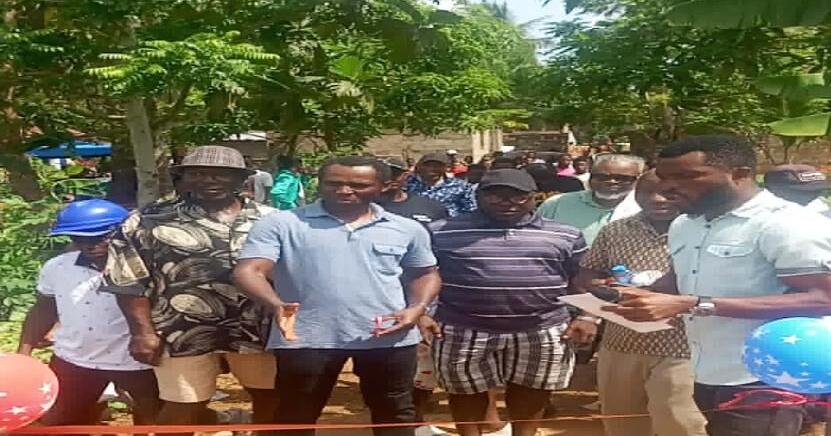
Elders, women, youth, and other residents of Wood Camp gathered recently in a mood of celebration and relief for the official dedication of a newly constructed bridge aimed at easing long-standing transportation difficulties, particularly during the rainy season when swamp flooding has historically cut off access to neighboring communities.
The bridge, valued at US$15,450, was constructed and funded by Wood Camp native Jupiter G. Thornes, who said the project was motivated by his personal experience growing up in the area and witnessing the daily hardship residents endure when attempting to cross the swamp.
Addressing the dedication ceremony, Thornes emphasized that the project was not intended for personal recognition but for community benefit.
“Today’s dedication is not about me, but rather about the people in this community,” he said. “I was born right here. I have my house here. I grew up here as a boy. Pa Matthew’s son and I used to fish in this swamp. We took papay canoes as far as Pipeline Swamp. I know this place.”
He explained that his familiarity with the terrain made it difficult to ignore the recurring struggles faced by residents, especially during periods of heavy rainfall when movement becomes hazardous and time-consuming.
“I know how people suffer when the rains come and they have to cross over to the next community. It is not easy,” Thornes said. “Students and families have had to take long detours because of the road conditions. I have lived it myself, so I decided to act.”
Thornes further clarified that the bridge project was financed through personal contributions and assistance from friends and was not driven by political interests.
“Let me be clear: this project is not about political gains. It is a humanitarian gesture,” he stated. “I built this bridge after witnessing the struggle people face during the rainy season. I want to help in my own way so that when I am gone, people will remember the good things I did.”
He also reflected on advice he received earlier in life, which he said continues to guide his commitment to community service.
“Someone once told me that when God blesses you, you should be a help to others. That is exactly what I am doing,” Thornes said. “I may not be the one using it every day, but because I benefited from someone else’s help, others should benefit from mine.”
During the ceremony, Thornes publicly acknowledged those who supported the completion of the project, particularly a close associate identified as Muhammad, whom he praised for consistent assistance throughout the construction process.
The project engineer, who also addressed residents at the event, confirmed that the total cost of the bridge amounted to US$15,450. He described the initiative as a humanitarian intervention and commended Thornes for his commitment to improving infrastructure in the community.
Residents in attendance expressed strong appreciation for the project, noting that the bridge would significantly reduce travel risks and improve access for daily activities.
“The support is massive,” one resident said, while others pointed out that schoolchildren and commuters who previously had to walk long distances or risk crossing the swamp would now have a safer and shorter route.
Community elders also welcomed the development, stating that the bridge would help reduce accidents during the rainy season and improve access to essential services such as schools, markets, and health facilities. Many described it as a long-awaited solution to a persistent problem affecting the community.
For many residents, the structure represents more than physical infrastructure—it symbolizes hope, local initiative, and the impact of individual efforts in addressing community challenges.
The ceremony concluded with songs, prayers, and a communal meal as residents marked what they described as a turning point in the development of Wood Camp and improved connectivity for surrounding areas.
