
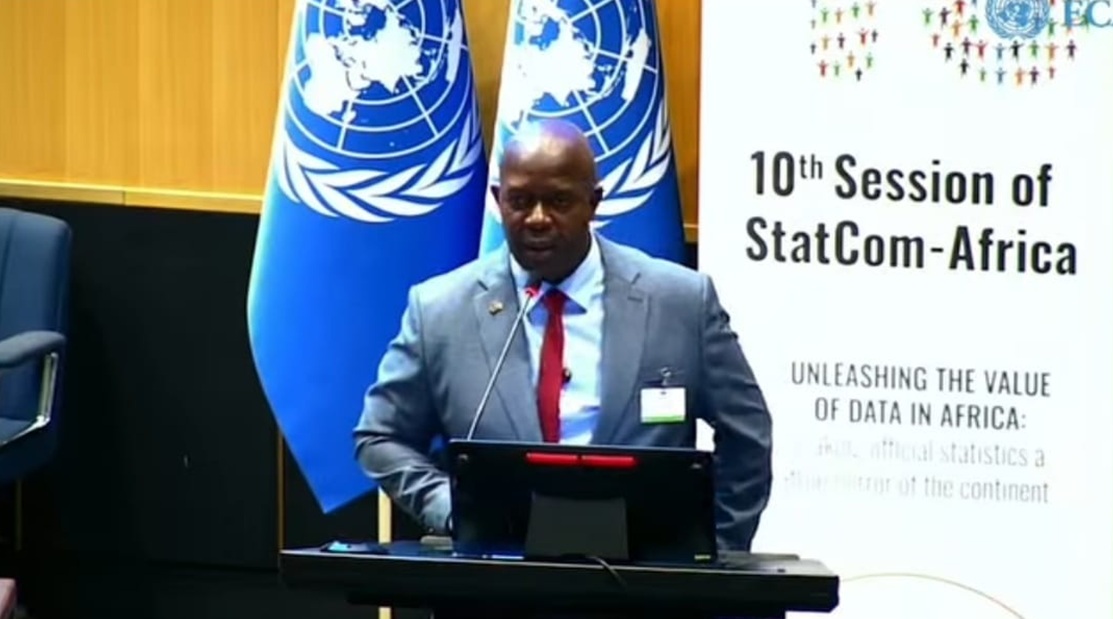
ADDIS ABABA, ETHIOPIA — Africa’s ability to plan effectively, allocate public resources responsibly, and measure development progress depends on the quality and credibility of the information available to its decision-makers, Richard Fatorma Ngafuan, Director General of the Liberia Institute of Statistics and Geo-Information Services (LISGIS), has emphasized.
\n
Speaking at the 10th Session of the Statistical Commission for Africa (StatCom-Africa) on Wednesday, October 21, 2026, Ngafuan called for stronger statistical institutions, greater cooperation among African countries, and renewed commitment to the principles of professionalism, independence, quality, and trust in the production of official statistics.
His remarks at the United Nations Economic Commission for Africa (UNECA) headquarters in Addis Ababa, Ethiopia, placed the practical value of data at the centre of discussions about Africa’s development priorities.
\n
The session is being held under the theme “Unleashing the Value of Data in Africa: Making Official Statistics a True Mirror of the Continent,” highlighting the need for information systems that accurately represent African realities and provide a sound foundation for policy decisions.
Ngafuan’s address also coincided with the conclusion of his two-year tenure as Chairman of the Bureau of StatCom-Africa, a regional body responsible for providing strategic direction for statistical development and establishing statistical standards across the continent.
\n
The importance of official statistics extends well beyond the collection and publication of figures. Reliable data enables governments to understand the needs of their populations, determine development priorities, evaluate programmes, and measure whether public policies are producing their intended results.
Population statistics, for example, help governments estimate the demand for schools, health facilities, housing, roads, and other essential services. Employment and economic data provide information needed to assess labour-market conditions, productivity, and household welfare. Health statistics help identify disease patterns and service gaps, while education data can reveal differences in enrolment, attendance, and learning opportunities.
\n
When these figures are incomplete, outdated, inconsistent, or difficult to access, governments face greater challenges in determining where resources are most urgently needed.
This is why the work of StatCom-Africa is central to the continent’s development agenda.
\n
According to UNECA, the Commission is Africa’s highest decision-making body for statistics. Its responsibilities include setting statistical standards, developing concepts and methodologies, promoting comparable statistics, and providing strategic direction for the development of national statistical systems.
The Commission also helps African countries engage with international statistical initiatives and provides a forum for sharing experiences and addressing common challenges.
\n
Through this mandate, StatCom-Africa supports the development of statistical systems capable of producing information that is credible, comparable, relevant, and useful for national and continental decision-making.
Ngafuan’s central message was that the success of a statistical system should not be judged solely by the quantity of information it produces.
\n
He said the theme of the session reminds the statistical community that its responsibility is to ensure that the realities of African countries are adequately and accurately reflected, understood, and translated into actions that improve people’s lives.
That distinction is important. A country may collect large volumes of information without necessarily producing the evidence required to address its most pressing development challenges.
\n
For statistics to become useful, the information must be collected through credible methods, processed according to sound standards, made accessible to relevant users, and connected to the decisions that shape public policy.
Statistical institutions must also pay attention to the differences that exist within national populations. National averages can conceal disparities between urban and rural communities, between women and men, among age groups, and between people with different levels of income or access to public services.
\n
Disaggregated data can help reveal these differences and give policymakers a clearer understanding of which communities are being reached and which remain underserved.
The African Centre for Statistics at UNECA supports efforts to strengthen national statistical capacity, improve the availability of harmonized and comparable information, advance modern data collection methods, and promote the production and use of data for evidence-based policymaking and development monitoring.
\n
These objectives align with the need for African governments to make decisions based on verifiable conditions rather than assumptions or incomplete information.
A central point in Ngafuan’s remarks was the need to preserve professionalism, independence, quality, and trust in official statistics.
\n
These principles are essential because statistics influence decisions involving public expenditure, economic management, social programmes, and national development priorities.
Statistical independence helps protect the integrity of the production and presentation of official information. Professional standards provide a basis for consistent methods, while quality assurance helps ensure that published figures are accurate and fit for their intended purposes.
\n
Public trust is equally important. Citizens, businesses, researchers, development partners, and policymakers must have confidence that official figures are produced transparently and are not manipulated to support particular interests.
When statistical information is credible, it can strengthen public understanding, improve policy debate, and make it easier to assess government performance. When confidence in the information is weakened, the ability of institutions to support informed decisions is also diminished.
\n
Ngafuan’s emphasis on these principles therefore speaks to an institutional responsibility shared by national statistical offices throughout Africa.
It also highlights the need for sustained investment in professional staff, modern statistical infrastructure, appropriate technology, and the institutional safeguards required to preserve the credibility of official information.
\n
Ngafuan also highlighted the growing importance of integrating statistical and geospatial information, particularly as the 10th session is being held jointly with the 12th meeting of the Regional Committee of the United Nations Global Geospatial Information Management for Africa.
The integration of these two forms of information can improve how governments identify development needs and understand the geographic distribution of people, services, infrastructure, and resources.
\n
Statistical data can show the number of people without access to health services, for instance, while geographic information can help identify where those people live and how far they must travel to reach a facility.
Similarly, information on population growth can be combined with geographic data to support decisions about where new schools, roads, water systems, and other public infrastructure may be required.
\n
Such applications can improve development planning, disaster preparedness, environmental monitoring, and the targeting of social services.
For Liberia, the discussion is relevant to the responsibilities of LISGIS, whose statistical and geospatial functions can support a more detailed understanding of the country’s population, communities, natural resources, and development needs.
\n
Realizing these benefits, however, requires coordination between institutions, compatible information systems, technical expertise, adequate resources, and appropriate safeguards for data privacy and confidentiality.
The objective is not simply to collect more information but to make different forms of reliable information work together in support of better decisions.
\n
Ngafuan noted that statistical institutions are operating in a rapidly changing environment characterized by technological transformation, new data sources, and increasing demand for timely information.
Digital tools can improve data collection, processing, storage, analysis, and dissemination. Modern communications technology can also help statistical institutions reach respondents and users more efficiently.
\n
However, technological change must be accompanied by appropriate professional standards and safeguards. New sources of information must be assessed for accuracy, relevance, consistency, and suitability before they are used to support official statistics.
Statistical agencies must also consider confidentiality, data protection, cybersecurity, and the need to maintain public confidence in the collection and use of information.
\n
The challenge facing Africa’s statistical institutions is therefore to embrace innovation while protecting the principles that make official statistics dependable.
This calls for continuous professional development, stronger technical capacity, institutional collaboration, and practical approaches that allow national statistical offices to respond to changing information needs.
\n
Ngafuan urged delegates at the Addis Ababa meeting to share their experiences openly, including the difficulties facing their institutions, and to focus on practical recommendations that would strengthen statistical systems and increase the value of data.
His appeal reflects the importance of translating regional discussions into improvements that can be implemented within individual countries.
\n
For Liberia, the effectiveness of statistical development will depend on the ability to produce timely and reliable information, improve access to official data, strengthen coordination among data-producing institutions, and ensure that policymakers use evidence when preparing plans and assessing results.
The value of statistical information is most clearly demonstrated when it helps answer practical questions about people’s lives. Are public services reaching the communities that need them? Are development programmes achieving their intended objectives? Are economic opportunities improving? Which groups are being left behind? What changes are required to improve outcomes?
\n
Answering these questions requires more than data collection. It requires reliable methods, appropriate analysis, accessible information, and a commitment to using evidence responsibly.
The work of StatCom-Africa provides a continental framework for advancing these priorities through shared standards, institutional cooperation, and the development of stronger national statistical systems.
\n
As Ngafuan concludes his two-year tenure as Chairman of the Commission’s Bureau, his remarks place renewed attention on a challenge facing governments throughout Africa: ensuring that statistical information becomes a practical instrument for development.
The Commission’s work connects national statistical institutions with a wider continental effort to improve the quality, comparability, and use of official data.
\n
Its mandate is especially relevant as African countries pursue the objectives of the United Nations 2030 Agenda for Sustainable Development and the African Union’s Agenda 2063, both of which require dependable information to monitor progress and assess development outcomes.
Ngafuan expressed confidence that the Commission would continue providing leadership in advancing the African Statistical System and ensuring that statistics and geospatial information remain central to the continent’s development agenda.
His message was clear that statistics must do more than describe conditions. They must help governments understand those conditions, make informed choices, direct resources responsibly, and evaluate whether their decisions are improving people’s lives.
For Liberia and other African countries, strengthening the institutions that produce official statistics remains an important part of building credible public administration and more effective development planning.
See more Liberia News Network stories in Google Search by adding LNN as one of your Preferred Sources.
★ Add LNN as a Preferred Source