
By Contributing Writer
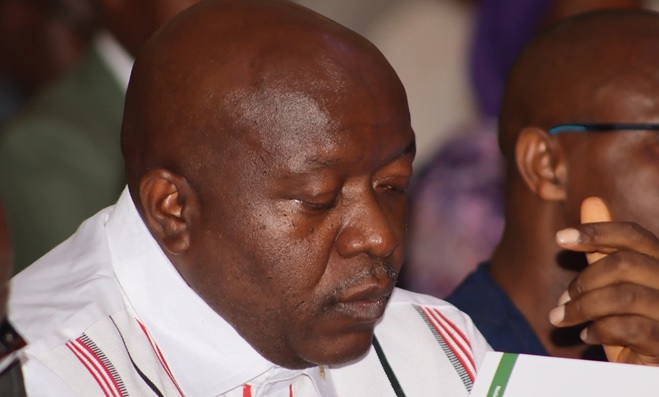
MONROVIA – The debate over Liberia’s public financial management has taken a sharper political and technical turn following fresh allegations by former Assistant Minister for Development Planning at the Ministry of Finance and Development Planning, Benedict Kolubah, who insists that Finance Minister Augustine Ngafuan must be held criminally accountable over what he describes as unconstitutional budget practices.
Kolubah, writing in a strongly worded public statement, accused critics of his earlier position of misinterpreting fiscal data and defending what he calls serious breaches of Liberia’s Public Financial Management (PFM) framework.
“Fellow Liberians, I called for Minister Ngafuan’s arrest for unconstitutionally re-appropriating US$40 million and overspending US$2.11 million above the approved 2025 budget,” Kolubah stated, reigniting a debate that has already stirred political tension and public interest.
He further argued that attempts by government supporters to justify the figures were based on what he described as “flawed interpretations” of budget documents and accounting entries.
According to Kolubah, some defenders of the Ministry’s position have claimed that reported overspending was not actual overspending, citing the use of US$75.1 million to settle outstanding commitments from the 2024 fiscal year.
He specifically referenced comments attributed to individuals identified as Buku Wolobah and Carolyn Myers, whom he accused of attempting to rationalize the fiscal reporting.
“Some ‘Rescue missionaries’ attacked me with derogatory remarks,” Kolubah wrote, adding that their arguments were not supported by a proper understanding of the budget framework.
Kolubah maintained that if the government’s justification is accepted at face value, it creates what he describes as a deeper contradiction within Liberia’s financial records.
He explained that the fiscal adjustments being defended would, in effect, distort the actual revenue and expenditure structure of the 2024 and 2025 budgets.
“If we accept their argument and move all FY2024 window transactions back into the FY2024 budget, the numbers collapse,” he asserted.
Kolubah claimed that the 2024 fiscal report already recorded US$748.16 million in revenue and US$735.65 million in expenditure, meaning that reassigning additional “window” transactions would significantly alter the official financial balance.
He argued that adding the US$50 million revenue window back into FY2024 would raise revenue figures to US$798.16 million, while also pushing expenditures to US$810 million when the US$75 million is included.
According to him, this adjustment would create what he described as an impossible fiscal outcome, including a deficit situation that contradicts the principles of lawful budget execution.
Kolubah insisted that such inconsistencies amount to double counting and double reporting of public funds across fiscal years.
He further alleged that the same transactions were recorded twice, referencing what he described as consolidated entries in both the FY2024 and FY2025 financial reports.
Kolubah pointed to what he claims are overlapping figures in official documents, arguing that US$50.10 million in revenue and US$75.09 million in expenditure were recorded in both fiscal cycles, resulting in what he estimates as US$125 million in duplicated reporting.
“This is not a minor error but a breach of accounting principles and an admission of US$125 million in double reporting,” he stated.
He warned that such practices, if left unaddressed, could distort Liberia’s fiscal credibility, inflate performance indicators, and misrepresent the actual financial position of the state.
Kolubah went further to argue that the situation may constitute a violation of Section 64 of Liberia’s Public Financial Management Law, which he believes provides grounds for legal accountability.
He called on government officials and critics, including those he named in his statement, to publicly review the relevant sections of the FY2024 and FY2025 financial reports.
“I will encourage Buku, Carolyn, Daniel, and all in the debate to please go read the FY2024 financial statement pages 1-2 alongside the FY 2025 financial statement pages 12-16 and engage me in a public debate,” he wrote.
Kolubah concluded his remarks by maintaining that the inconsistencies he identified amount to what he considers an admission of wrongdoing.
He insisted that, based on his interpretation of the fiscal data, the matter is not merely political but legal, adding that accountability must follow if the allegations are proven accurate.
His comments are expected to further intensify public debate over Liberia’s budget transparency, fiscal discipline, and the broader integrity of government financial reporting under the current administration.
