
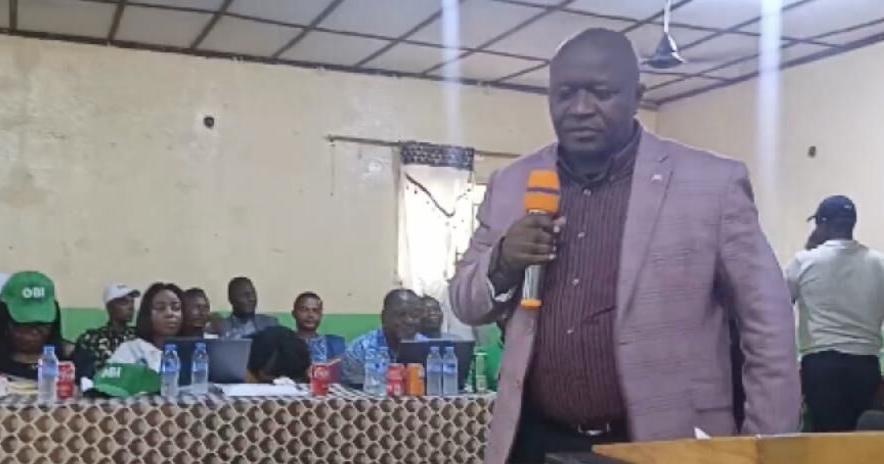
Finance and Development Planning Minister Augustine Kpehe Ngafuan has officially launched the Government of Liberia’s FY2026 Open Budget Outreach, taking the national budget conversation directly to citizens and urging them to actively shape how public resources are allocated.
Speaking Friday, May 8, 2026, at the launch in Kakata, Margibi County, Minister Ngafuan described the national budget as “an instrument where the hopes, the dreams, and aspirations of our people are captured,” emphasizing that public participation is critical to national development.
“This is my second coming,” Ngafuan said, reflecting on his earlier role in government. “This building… is a product of the government of Liberia. It’s a product of the budget.” He pointed to ongoing development initiatives, including improvements to Kakata city streets and other infrastructure projects, stressing repeatedly: “A product of the budget.”
The nationwide outreach, led by the Ministry of Finance and Development Planning, is designed to break what officials described as the “layer of secrecy” traditionally associated with the budget process by engaging citizens through town hall meetings and radio programs across all counties.
Ngafuan highlighted the growth of Liberia’s national budget, noting that the long-standing ambition of achieving a billion-dollar budget has already been surpassed under President Joseph Nyuma Boakai.
“A few years ago, the biggest ambition… was that the budget should be a billion dollars,” he said. “But President Boakai has given a billion-dollar budget and more… We now have 1.3 billion.”
Despite the increase, the Minister cautioned that resources remain insufficient to meet all national demands.
“But do we say that all the aspirations… have been addressed by this 1.3-billion-dollar budget? No,” he stressed. “Even when we reach two billion, three billion, will we have the resources to solve all the problems? No. But we must keep pushing.”
Ngafuan described intense competition among government institutions for limited resources, recounting recent Cabinet discussions where ministers pressed for increased funding for roads, agriculture, education, and local government services.
“The minister of public works wants more for roads. The minister of agriculture wants more. The minister of education wants more… and your minister of local government, he wants more because he hears you,” Ngafuan said. “So all of you—push us. It is your duty to push for your interests.”
He underscored that expanding the national budget depends heavily on domestic revenue generation, praising the efforts of the Liberia Revenue Authority and other institutions for strengthening revenue collection.
At the same time, he emphasized the importance of legislative and citizen involvement in the budget process. “The Constitution provides for citizen participation,” he noted. “We are here to inform you about the budget we have, and we are also here to listen to you.”
Ngafuan explained that feedback gathered during the outreach will inform the preparation of the next fiscal budget, especially in areas where current allocations fall short.
“We are taking notes for the preparation of the new budget. Some issues we have not solved… we take notes,” he said.
Reflecting on Liberia’s development trajectory, Ngafuan acknowledged ongoing challenges but insisted the country is making measurable progress.
“Today, Liberia versus yesterday Liberia, there is a material difference. Today is better than yesterday, and tomorrow will be better than today,” he declared.
He pointed to investments in infrastructure, electricity, education, and human capacity development, while also noting efforts to manage national debt responsibly.
“We are dealing with debt service… so that we remain credible,” he said, revealing that Liberia recently secured $237 million in additional financing to refinance expensive debts and redirect savings toward development projects such as roads and electricity.
“We will use some of this money to buy off expensive debts, so we don’t pay high interest. The savings will go into projects,” Ngafuan explained.
Deputy Minister for Budget Tanneh G. Brunson, in her overview, said the outreach reflects the government’s commitment to transparency, accountability, and inclusive governance.
“The national budget is the most powerful tool we have to interpret the development priorities of this country,” Brunson said. “However, for the budget to truly serve its purpose, citizens must be fully involved.”
She emphasized that the initiative would bring budget discussions beyond Monrovia, creating space for dialogue and public understanding.
“Through this nationwide outreach, we are taking the budget beyond Monrovia into communities across the country,” she said. “We will engage citizens through town hall meetings and interactive radio programs.”
Brunson also announced the introduction of a Citizen’s Guide to the National Budget to simplify complex financial information for ordinary Liberians.
“When people understand the budget, they are better empowered to hold us accountable,” she added.
Earlier, Margibi County Superintendent Ojay Godfavor Morris welcomed the initiative, describing the Minister as “the man who is stabilizing the country’s economy” and praising the government’s commitment to decentralization.
“We see it as a blessing that he has come to our county… for the purpose of launching the Open Budget Initiative,” Morris said, adding that Margibi is increasingly becoming a hub for national activities and development programs.
A representative of the Civil Society Council in Margibi welcomed the outreach but called for earlier citizen involvement in the budget process.
“The budget has already been passed. Citizen representation now will make zero impact,” the representative said. “We want the next budget to reach citizens before it is submitted to the Legislature.”
The group also raised concerns about delays in implementing the revenue-sharing law, urging the government to ensure counties benefit directly from national resources.
Meanwhile, Chief Edwin Nyuma, representing the traditional council, welcomed the Minister and called for greater inclusion of local leaders in national development efforts, stressing that “this country belongs to all of us.”
As the outreach began, Ngafuan assured citizens that the government remains committed to listening—even to criticism.
“We are a democratic country. We listen—even to those who are unfair,” he said. “We separate the unfairness from what makes sense, and we take it.”
He concluded with a message of shared responsibility and national progress:
“We will ensure that the country remains on the right path… Margibi will move forward. All counties will move forward. Liberia will move forward.”
