
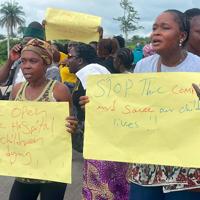
Hundreds of women in Suakoko District on Wednesday staged a peaceful protest demanding the immediate reopening of Phebe Hospital and calling for the removal of its Medical Director, Dr. Minnie Sankawulo-Ricks, as an ongoing strike by health workers continues to disrupt services at one of Liberia’s most important referral facilities.
Carrying placards and chanting slogans, members of the Concerned Women of Suakoko District marched through the hospital compound and surrounding communities, appealing to the Government of Liberia and the Lutheran authorities overseeing the institution to intervene before the crisis leads to further loss of lives.
Phebe Hospital, considered the largest referral hospital in central Liberia, has remained largely paralyzed since health workers began an indefinite go-slow action earlier this week.
The workers say they are protesting deteriorating working conditions and unresolved administrative concerns, which they claim have affected the hospital’s ability to provide quality healthcare services.
The disruption has left thousands of residents in Bong County and neighboring counties struggling to access essential medical care, with many patients reportedly seeking treatment at other facilities.
Speaking during Wednesday’s protest, Lucia Lammie, one of the organizers, said residents could no longer remain silent while families continue to suffer.
“We are here because our people are dying,” she said. “Phebe is the only referral hospital we have in this part of the country, and today it is completely shut down. We are calling on the government and the church authorities to act immediately.”
Another protest leader, Kumbah Sackilah, expressed similar concerns, warning that prolonged disruption of healthcare services could have serious consequences for communities that depend heavily on the hospital.
“Our children, our mothers, and our relatives are suffering,” she said. “We cannot continue to watch people die from illnesses that can be treated simply because the hospital is closed.”
Throughout the protest, demonstrators carried placards with messages including “Reopen Phebe Hospital Now,” “Save Our Families,” and “Healthcare Is Our Right.” Others called for urgent government intervention to restore medical services and address the concerns raised by health workers.
The demonstration reflects growing frustration among residents, many of whom say the healthcare situation has reached a critical point.
One woman who recently underwent surgery at the hospital described the difficulties patients are experiencing amid the strike.
“I was operated on, but I had to leave the hospital before completing my treatment because there was nobody to care for me or dress my wounds,” she said.
The woman further alleged that several patients died during her admission because of a shortage of nurses and other medical personnel.
“More than ten people died while I was there because there were no nurses to take care of them,” she claimed. “We fear that more people will die if this situation continues.”
The reported deaths could not be independently verified, and hospital authorities had not publicly responded to the allegations as of Wednesday evening.
However, the claims have intensified concerns among residents, who say the shutdown has left communities vulnerable at a time when access to healthcare remains limited.
Phebe Hospital serves not only Bong County but also residents from surrounding counties in central Liberia. For decades, the institution has operated as a critical referral center, providing specialized medical services unavailable at smaller health facilities.
The ongoing industrial action has therefore raised concerns beyond Suakoko District, with patients reportedly travelling long distances in search of medical attention.
Several residents who participated in the protest accused hospital management of failing to resolve workers’ concerns before the dispute escalated.
The protesters are also demanding the immediate removal of Medical Director Dr. Minnie Sankawulo-Ricks, whom some demonstrators blame for the worsening tensions.
“The administration has failed us,” one protester said. “We need new leadership and immediate action to reopen the hospital.”
The call for Dr. Ricks’ removal comes amid rising tensions between hospital administrators and health workers, who have cited welfare concerns and administrative grievances as reasons for their industrial action.
Health workers involved in the go-slow say they are seeking urgent reforms to improve conditions at the hospital. Their demands reportedly include changes within the hospital’s leadership structure, including the resignation of some senior administrators.
As pressure mounted on Wednesday, the Suakoko District Youth Association joined the protest movement.
Martin Yarkpawolo, president of the association, pledged the group’s support and said young people across the district would stand with the women in seeking a resolution.
“The people of Suakoko deserve uninterrupted access to quality healthcare,” Yarkpawolo said. “We will work with the concerned women to present our petition to the government because this crisis affects every family in our district.”
He warned that the prolonged closure of the hospital could deepen the suffering of vulnerable communities and urged national authorities to act quickly.
The protest marks the latest development in an escalating dispute that has attracted growing public attention in Bong County. What began as a labor disagreement between health workers and hospital administrators has evolved into a broader community movement demanding accountability and immediate intervention.
The shutdown has become more than an administrative dispute; it has emerged as a public health concern with potentially far-reaching consequences.
Community leaders say pregnant women, children, elderly patients, and people living with chronic illnesses are among those most affected by the disruption of services.
Health experts have repeatedly warned that interruptions in essential healthcare can result in delayed treatment, increased complications, and preventable deaths, particularly in rural areas where alternative medical facilities are limited.
Despite mounting public pressure, it remains unclear when normal operations at Phebe Hospital will resume.
The protesters have submitted a petition to the Government of Liberia and Lutheran authorities, urging decisive intervention to restore services and address the concerns of both health workers and patients.
As the crisis continues, residents say their main concern remains the safety and wellbeing of their families and the future of healthcare delivery in central Liberia.
Standing among dozens of demonstrators outside the hospital gates, one elderly woman captured the sentiment of many protesters.
“We are not protesting because we enjoy it,” she said. “We are protesting because our lives depend on this hospital.”
For now, uncertainty surrounds Phebe Hospital, while communities across Bong County await a resolution to a crisis that has brought one of Liberia’s most important healthcare institutions to a standstill.
