
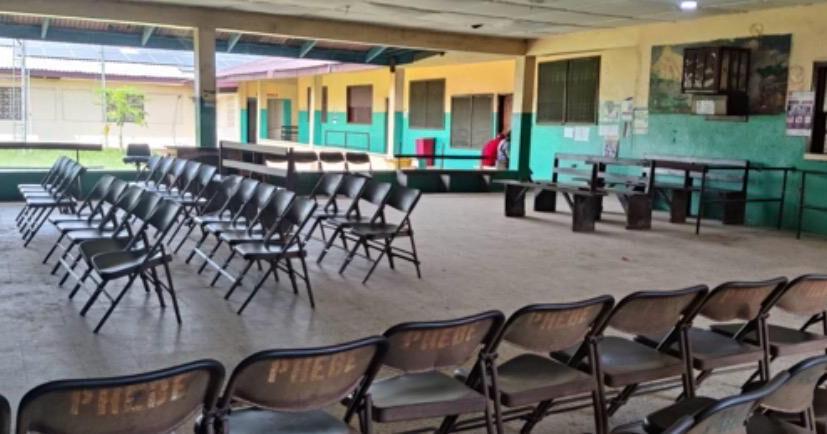
Phebe Hospital, one of the nation’s most critical referral health facilities has descended into chaos as workers shut down the facility on Monday, July 6, over unpaid arrears and other labor related grievances. Officers of the Police Detachment of the Liberia National Police arrested leaders of the protesters–allegedly placing some in jail.
What began as a labour disagreement has now escalated into a full-scale institutional crisis, exposing deep fractures in leadership, governance, labour relations and the country’s fragile healthcare system.
The shutdown of services at Phebe Hospital by aggrieved workers, coupled with the arrest of three union members by the Liberia National Police, has transformed an internal workplace dispute into a national concern with potentially life-threatening consequences.
The protest, led by the Phebe Hospital Aggrieved Workers Union, has effectively brought healthcare delivery at the hospital to a standstill.
Hundreds of patients seeking treatment have reportedly been left stranded as emergency services, surgeries and routine medical care face severe disruption. For a hospital that serves Bong County and several neighbouring counties, the implications extend far beyond employment grievances—they touch directly on the constitutional right of Liberians to access essential healthcare.
The latest developments came despite repeated appeals from Bong County Senator Prince Kermue Moye, religious leaders and other stakeholders urging workers to suspend their planned strike while negotiations continued. Instead, workers proceeded with what they described as their final course of action after months of unsuccessful mediation efforts.
Contrary to suggestions that the shutdown was a spontaneous reaction, statements from the workers indicate that the dispute has been developing since January. According to Union President Moses D.N. Davis, employees exhausted what they described as every available institutional channel before resorting to industrial action.
The workers say they engaged hospital management, church authorities overseeing the institution, county leadership, the Ministry of Health, the Civil Service Agency and the National Health Workers Union without obtaining what they consider meaningful solutions.
The central issue, according to the union, is no longer simply salaries, operational funding or hospital resources. Rather, they argue that confidence in the hospital’s leadership has completely broken down.
The union is demanding the removal of three senior officials, including Medical Director Dr. Minnie Sankawulo-Ricks, Acting Human Resource Officer Peter Gbelarwo and Acting Administrator Jonathan Pewu.
According to Davis, workers have unanimously concluded they can no longer work under the current administration.
In remarks made to journalists before his subsequent arrest, Davis maintained that discussions about budgets or future development projects cannot succeed while what he described as a “leadership crisis” remains unresolved.
”Our minds are made up,” he explained. “These people cannot continue to work with us.”
Such statements reveal that the dispute has evolved beyond ordinary labour negotiations into a crisis of trust—a far more difficult conflict to resolve.
One of the most troubling aspects of the dispute is the number of respected institutions that have reportedly attempted mediation without success.
According to the workers, intervention efforts have included the leadership of the Lutheran, Methodist and Episcopal Churches, which jointly oversee Phebe Hospital; a special investigative committee established by the churches, Bong County Superintendent Loileyah Hawa Norris, Senator Prince Kermue Moye, the Ministry of Health, the Civil Service Agency; and the National Health Workers Union.
Yet none of these efforts produced an agreement acceptable to both sides.
The union has also rejected recommendations made by the churches’ special committee, arguing that they fail to address the root causes of the conflict.
This repeated failure raises important questions about Liberia’s mechanisms for resolving labour disputes in critical public institutions.
When mediation repeatedly fails, confidence in institutional dispute resolution inevitably weakens.
Workers Want Presidential Intervention
Perhaps the most striking aspect of the workers’ position is their insistence that only President Joseph Nyuma Boakai or Vice President Jeremiah Kpan Koung can now resolve the dispute.
According to Davis, every other authority has already attempted intervention without success.
His argument is that only a direct policy decision from Liberia’s highest executive offices can restore confidence among employees.
Whether that assessment proves correct remains uncertain.
However, the demand reflects a complete erosion of confidence in intermediate structures that ordinarily handle employment disputes.
For any government, such a situation presents a difficult dilemma. Direct presidential intervention risks encouraging future workers in other sectors to bypass institutional channels.
Yet refusing to intervene could allow an already dangerous healthcare shutdown to continue.
The dispute took another dramatic turn when officers of the Liberia National Police arrested three union members.
Those reportedly taken into custody include Moses D.N. Davis, Workers Union President, Peter Yallah, a mortician; andJames Sumo, a hospital driver.
Police have also increased security around the hospital, with officers deployed throughout the facility.
As of Monday, authorities had not publicly disclosed the specific charges against those arrested.
Without official clarification, the arrests have inevitably generated speculation. Were the arrests connected directly to the strike?
Did authorities allege criminal offences unrelated to protest action?
Or were they preventive measures aimed at maintaining public order?
Until police publicly explain the legal basis for the arrests, uncertainty will continue to fuel public concern.
Transparency is therefore essential—not only for public confidence but also for protecting the rights of all parties involved.
Patients Are the Biggest Victims
While public attention has focused on management, workers and police, the greatest burden continues to fall upon patients.
Phebe Hospital is not merely another healthcare facility.
It is among Liberia’s principal referral hospitals, serving thousands across Bong County and neighboring regions.
Every day that services remain suspended increases risks for pregnant women requiring emergency obstetric care, accident victims, surgical patients, children requiring urgent treatment and chronically ill patients dependent on continuous care.
Unlike many employment disputes, healthcare strikes create immediate humanitarian consequences. Illness does not pause during negotiations.
Medical emergencies cannot simply wait for administrative disagreements to be resolved.
This reality places extraordinary responsibility upon every stakeholder involved. The allegations directed at senior hospital management remain precisely that—allegations.
As of Monday, neither the hospital administration nor the Ministry of Health had publicly responded to the workers’ latest claims.
Without hearing from management, the public has only one side of an increasingly complex dispute.
Basic principles of fairness require that those accused of poor leadership or administrative misconduct be given an opportunity to respond.
Equally, workers deserve serious consideration when they collectively express sustained concerns regarding workplace conditions.
An independent, transparent assessment may therefore be necessary to restore confidence on all sides.
Because Phebe Hospital operates under the oversight of the Lutheran, Methodist and Episcopal Churches, the crisis also presents a significant governance challenge for Liberia’s faith-based healthcare system.
Religious institutions have historically played indispensable roles in delivering healthcare across Liberia, particularly during periods of conflict and public health emergencies.
However, overseeing modern hospitals requires balancing spiritual stewardship with professional management, financial accountability and labour relations.
The apparent rejection of the churches’ investigative committee by workers suggests that rebuilding trust will require more than moral authority.
It may require structural reforms that reassure employees that their concerns receive impartial consideration.
Another notable feature of the crisis has been the absence of immediate public statements from either hospital management or the Ministry of Health following the shutdown.
During rapidly developing crises affecting essential services, communication becomes almost as important as operational response.
Patients need reassurance. Healthcare workers require clarity. The wider public deserves accurate information.
Silence, however understandable during sensitive negotiations, often creates space for rumours and misinformation. Timely official communication could help reduce tensions while negotiations continue.
The Phebe dispute also reflects wider questions confronting Liberia’s public sector.
Across government institutions, workers increasingly demand greater accountability, transparency and responsiveness from management.
At the same time, governments must balance employee rights with uninterrupted delivery of essential public services.
Healthcare represents perhaps the most difficult sector in which to strike that balance.
International labour standards generally recognize workers’ rights to organize and engage in collective bargaining.
Yet governments also bear responsibility for ensuring citizens retain access to life-saving medical services.
Reconciling those competing obligations requires careful negotiation—not confrontation.
Resolving the crisis will almost certainly require compromise from every party.
Government authorities should urgently facilitate credible dialogue involving workers, hospital management, church leadership and independent mediators acceptable to all participants.
Hospital administrators should publicly address the allegations raised against them while remaining open to independent review if necessary.
Workers, meanwhile, should carefully consider humanitarian arrangements that protect emergency patients while negotiations continue.
Police should also ensure that any enforcement actions remain fully consistent with Liberian law and transparent legal procedures.
Above all, patients must not become collateral damage in an administrative conflict.
