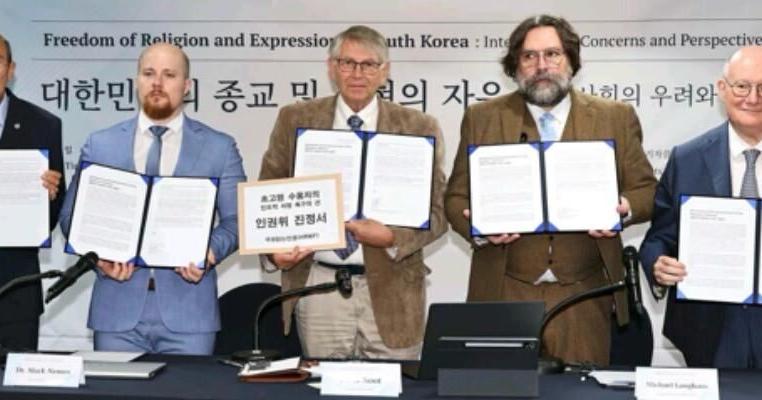
A coalition of leading international human rights and religious freedom organizations has raised fresh concerns over what it describes as an erosion of freedom of religion and freedom of expression in South Korea, warning that the treatment of elderly religious leaders and minority faith communities could have broader implications for democratic governance and the protection of fundamental rights.
The concerns were outlined during an international press conference hosted at the Seoul Foreign Correspondents’ Club on Friday, August 7, where Human Rights Without Frontiers (HRWF), CAP Liberté de Conscience (CAP-LC), FOREF Europe, CESNUR, and Bitter Winter appealed to governments, journalists, and international institutions to closely monitor developments in South Korea and ensure that international human rights standards are upheld.
The virtual briefing, attended by journalists from Africa, Europe, Asia and North America—including this newspaper—focused primarily on the continued pretrial detention of 95-year-old Shincheonji Chairman Lee Man-hee and concerns involving 83-year-old Hak-ja Han Moon of the Family Federation, while placing these cases within what the organizations described as a wider pattern of challenges facing religious minorities in South Korea.
At the close of the conference, participating scholars signed a formal letter urging the Government of the Republic of Korea to immediately release Chairman Lee from custody.
Although much of the discussion centered on Chairman Lee’s detention, speakers repeatedly emphasized that the issue extends beyond the legal circumstances of a single individual or religious movement.
Rather, they argued, it raises broader questions about whether democratic societies can protect religious freedom while simultaneously enforcing criminal laws without discrimination or prejudice against minority faiths.
Opening the conference, Hans Noot, Associate Director of Human Rights Without Frontiers, said the issues under discussion strike at the heart of democratic governance.
“When religious communities are stigmatized, peaceful gatherings are restricted, and dissent is treated as a problem to be contained, the consequences extend far beyond any single group or case,” Noot said.
He stressed that the organizations were not advocating for any particular religious doctrine but rather defending the universal principle that fundamental rights should apply equally to every individual, regardless of religious affiliation.
“This conference is not about defending one theology or one movement. It is about defending a principle—that fundamental rights apply equally to all.”
Much of the legal discussion focused on whether placing a 95-year-old religious leader in pretrial detention is proportionate under international human rights law.
Thierry Valle, President of CAP Liberté de Conscience, pointed to South Korea’s obligations under the International Covenant on Civil and Political Rights (ICCPR) and the Convention against Torture, both of which the country has ratified.
Valle argued that democratic societies possess alternative legal measures capable of protecting judicial proceedings without resorting to detention in cases involving elderly, non-violent defendants.
He cited examples including the release on bail of Hong Kong Cardinal Joseph Zen and Vietnam’s decision to place Buddhist Patriarch Thich Quang Do under house arrest rather than imprisonment.
According to Valle, the presumption of innocence must remain central to every criminal proceeding.
Legal concerns were further expanded by Michael Langhans, Executive Director of FOREF Germany.
Langhans questioned whether prosecutors had demonstrated sufficient necessity for continued pretrial detention after an indictment had already been secured.
He also raised broader concerns regarding whether investigations involving minority religious organizations can remain entirely neutral when public narratives frequently describe such communities using labels such as “sects” or “cults.”
According to him, democratic legal systems must ensure that election laws and public-order legislation do not unintentionally undermine constitutional protections for religious freedom.
The conference also highlighted the international dimensions of the controversy.
Márk Nemes, Deputy Director of CESNUR, argued that the effects extend well beyond South Korea because Shincheonji has established congregations across numerous countries.
He referenced recent academic studies conducted in Europe, Argentina and Australia which, according to him, documented increasing hostility toward Shincheonji members.
Nemes warned that developments in South Korea could influence public attitudes toward adherents abroad, potentially affecting their ability to practice and express their faith freely.
Perhaps the strongest remarks came from Massimo Introvigne, Managing Director of CESNUR and Editor-in-Chief of Bitter Winter.
He argued that South Korea had crossed what he described as “a worrying line.”
According to Introvigne, international standards—including the United Nations’ Mandela Rules governing the treatment of prisoners—would favor alternatives such as house arrest rather than detention for a 95-year-old accused of a non-violent offense.
He also questioned whether the criminal charges represented an overly broad application of election-related laws.
The organizations argued that the Lee case forms part of wider concerns surrounding freedom of religion or belief in South Korea.
Among the issues highlighted were reported official scrutiny involving Segero Church in Busan; continuing debates surrounding conscientious objection and compulsory military service; public opposition to the construction of a mosque in Daegu; and questions regarding religious accommodation within educational institutions.
The organizations also noted that hundreds of Jehovah’s Witnesses had historically been imprisoned in South Korea as conscientious objectors before the introduction of alternative civilian service.
While acknowledging subsequent legal reforms, speakers argued that the current alternative service system remains unusually lengthy and, in their view, punitive.
The issues discussed illustrate an enduring tension within international human rights law.
On one hand, sovereign governments possess legitimate authority to investigate alleged criminal conduct and enforce domestic laws.
On the other, international human rights instruments require that such enforcement remain consistent with principles including due process, proportionality, equality before the law, and freedom of religion.
Human rights organizations argue that these protections become especially important where minority religious communities are involved because prejudice or public misunderstanding may inadvertently influence legal processes.
South Korean authorities, for their part, have generally maintained that legal proceedings are conducted independently under domestic law, although the conference itself focused primarily on concerns raised by the participating organizations.
While the discussion centered on South Korea, participants noted that the issues resonate far beyond Asia.
For countries such as Liberia—with a constitution that guarantees freedom of religion, freedom of conscience, and freedom of expression—the debate serves as a reminder that protecting minority rights remains an essential component of democratic governance.
Liberia has historically been recognized for broad religious tolerance, with Christian, Muslim and traditional religious communities generally coexisting peacefully despite occasional localized tensions. The country has also experienced public debates over the rights of minority groups and the balance between public order and constitutional freedoms.
Human rights advocates say such discussions underscore the importance of ensuring that legal institutions remain independent, impartial and guided by evidence rather than public sentiment or religious bias.
They argue that the protection of minority rights ultimately strengthens democratic institutions because rights guaranteed to unpopular groups today may safeguard the freedoms of the broader population tomorrow.
At the conclusion of the conference, the participating organizations urged governments, media institutions and international human rights bodies to continue monitoring developments in South Korea.
They called for careful attention to due process, proportionality and equal protection under the law, arguing that these principles should remain the foundation of democratic societies regardless of the religious affiliation of those involved.
For the organizations behind the initiative, the debate is ultimately not about defending one religious movement over another, but about ensuring that fundamental freedoms—including freedom of religion and freedom of expression—remain protected for all.
See more Liberia News Network stories in Google Search by adding LNN as one of your Preferred Sources.
★ Add LNN as a Preferred Source