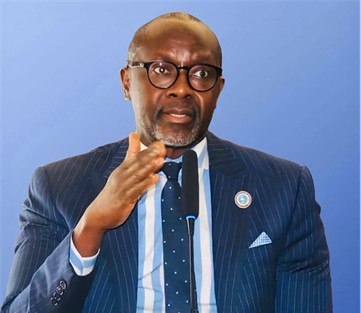
MONROVIA – Gbarpolu County Senator Amara M. Konneh voted for Liberia’s Cybercrime Act. Now he is drawing a line around how it is used. The law now faces its first major test. He says satire, parody and criticism of officials are protected speech, even when made with artificial intelligence. If enforcement targets journalists, comedians or opposition voices, he warns, he will push for an amendment. Yet he refuses to abandon the law’s victims, including girls driven from school by leaked explicit images. His proposed formula rests on three pillars: due process, proportionality and public education. The real question is whether police and prosecutors will read the law as narrowly as he does. THE ANALYST reports.
Gbarpolu County Senator Amara M. Konneh has declared that Liberia’s recently passed Cybercrime Act was never meant to silence free speech, while insisting that the law must still protect victims of online abuse.
The former Finance Minister, who voted for the law, set out his position in a statement posted on his Facebook page during United Nations General Assembly (UNGA) week.
Konneh said he has followed the public reaction to the first enforcement actions under the law, describing the debate as loud, passionate and divided, as it should be in a democracy.
“This is a test case for Liberia, and how we handle it matters,” he wrote.
Konneh did not name the case, but his statement follows the arrest of Jerry Nyantee Wrato over AI-generated images and videos depicting Vice President Jeremiah Kpan Koung.
The Vice President has called for Wrato’s release, while the Liberia National Police (LNP) has said he will be forwarded to court on four counts under the Cybercrime Act of 2025. The charges have yet to be tested in court.
Speech Must Stay Free
Konneh said he voted for the law to protect Liberians from real harm, including fraud, identity theft, hacking, the nonconsensual sharing of intimate images and “the weaponization of the internet to destroy people’s lives.”
Article 15 of the Constitution, he stressed, guarantees freedom of expression. “That is nonnegotiable. No law we pass can or should override it,” he wrote.
He said AI-generated content is speech, including satire, parody and political commentary. “We must not criminalize jokes, criticism, or creativity. Legitimate criticism of public officials, including me, is not a cybercrime. It is democracy at work,” Konneh wrote.
The senator also issued a warning to enforcement authorities. “If enforcement targets journalists, comedians, opposition voices, or citizens expressing their views, then we have failed—and I will be the first to speak out and push for an amendment,” he said.
Protecting Victims Too
At the same time, Konneh argued that free speech is not a license to harm others. “Our cybercrime law was not passed to silence critics. It was passed to protect victims,” he wrote.
He said he has spoken with Liberians who were shamed or harassed online, and with parents whose daughters dropped out of school after explicit photos were shared on the internet.
AI-generated content crosses the line into punishable cybercrime, he argued, when it is used to create nude or sexual images of a real person without consent, to knowingly defame someone by falsely depicting them committing a crime, to defraud the public, or to systematically bully, harass and threaten others, especially women and young people. “The law, though imperfect, must protect them,” he wrote.
Three Principles for Enforcement
Konneh said the test case must be handled according to three principles. The first is due process, meaning warrants, evidence and open court rather than intimidation, and the second is proportionality, so that the punishment fits the crime.
The third is public education. He called on the Ministry of Justice and the Liberia Telecommunications Authority (LTA) to explain clearly to the public what is and is not prohibited under the law.
“The same internet that gives a market woman a voice to complain about the government must not become a weapon to destroy her reputation with lies,” Konneh wrote. Liberia, he said, can and must protect both free speech and citizens from online bullying, describing that as the balance every democracy is trying to strike.
The Global Dimension
Noting that Liberia’s delegation is at the UN this week, Konneh pointed out that the United Nations Convention against Cybercrime, adopted by the General Assembly in December 2024, is the first comprehensive, legally binding global treaty aimed at preventing and combating cybercrime and facilitating the cross-border sharing of electronic evidence.
Liberia, he said, joined the spirit of that effort when it passed its own cybercrime provisions.
“We must now work together to ensure we implement this correctly,” Konneh wrote. He invited public feedback on how the law is being implemented.
His intervention adds to a widening national debate over the law. Former Finance Minister Samuel D. Tweah, Jr. has called the law “draconian,” while Cllr. Tiawan Saye Gongloe has warned against using it to punish citizens for criticizing public officials.
See more Liberia News Network stories in Google Search by adding LNN as one of your Preferred Sources.
★ Add LNN as a Preferred Source