
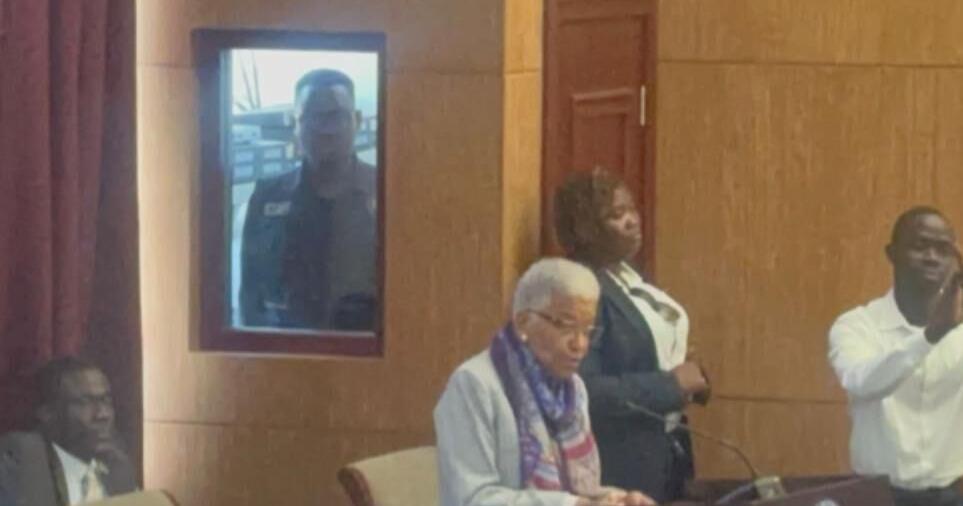
A renewed national debate over citizenship and identity has emerged after former Liberian President Ellen Johnson Sirleaf urged lawmakers to amend a controversial constitutional provision that restricts citizenship to people of “Negro descent,” a clause critics say is both outdated and inconsistent with modern democratic principles.
Speaking before the House of Representatives during its 16th day sitting, the former president called on legislators to reconsider Article 27(b) of the Constitution, arguing that the restriction undermines the country’s commitment to equality and international norms.
Her remarks were delivered during a rare and historic appearance before the Legislature, where she also addressed broader national issues including economic policy, women’s representation in government, urban renewal in Monrovia, and land governance.
At the conclusion of her visit, Speaker Richard Nagbe Koon presented the former president with a Special Legislative Citation of Distinguished Honor, recognizing her historic leadership as Africa’s first democratically elected female president and her contributions to global peace and democracy.
But beyond the ceremony, Sirleaf’s proposal has revived one of Liberia’s most sensitive constitutional debates — whether a clause rooted in the country’s 19th-century origins still has a place in the 21st century.
The controversial provision dates back to the founding of the Liberian state in 1847 by freed Black slaves from the United States under the auspices of the American Colonization Society. At the time, the country was envisioned as a homeland for people of African descent, a refuge from racial discrimination in America.
Article 27(b) of the Constitution therefore restricts citizenship to “persons who are Negroes or of Negro descent.”
Supporters of the clause historically argued that it was designed to protect the sovereignty and political control of Black people in a world where colonial domination by European powers was widespread.
However, critics increasingly contend that the provision now contradicts the very ideals of liberty and equality that Liberia was founded to promote.
Sirleaf’s remarks appeared to reflect that view.
Legal experts supporting reform argue that “all persons, regardless of race, color, or creed, should be equal before the law,” a principle embedded in many modern constitutions but seemingly at odds with Liberia’s racial citizenship restriction.
The Economic Argument for Reform
One of the strongest arguments for removing the clause centers on economic development.
Many believe that the restriction prevents many long-term foreign residents and investors — including Lebanese, Indian, and other non-African communities who have lived in Liberia for generations — from becoming citizens despite their contributions to the economy.
Proponents of reform argue that granting citizenship opportunities could encourage greater long-term investment in the country, allow skilled professionals to fully participate in national development, strengthen tax contributions and business expansion, and foster deeper integration of communities already living in the country.
Many economists believe the clause indirectly discourages diaspora investment and limits the pool of talent that could help modernize the economy.
In practical terms, individuals who cannot obtain citizenship often face restrictions in property ownership, business participation, and political engagement.
Critics therefore argue that the clause deprives Liberia of “good-intentioned people” who may otherwise contribute to national growth.
Former President George Weah attempted a similar reform in 2018 when his administration proposed constitutional amendments that included changes to citizenship provisions, but the proposal encountered strong public resistance.
Despite these arguments, opposition to reform remains strong among some Liberians who view the clause as a protective safeguard rather than a discriminatory relic.
Critics of the amendment raise several concerns.
Fear of Economic Suppression
Many Liberians worry that allowing non-Black foreigners to become citizens could give wealthy investors disproportionate economic power.
Given Liberia’s high poverty rate, opponents argue that expanded citizenship might enable foreign nationals to dominate business sectors, acquire land, and outcompete local entrepreneurs.
For them, the clause serves as a protective barrier for an already economically vulnerable population.
Others view the restriction as central to Liberia’s historical identity as Africa’s first Black republic.
Removing it, they argue, could dilute the symbolic purpose of the nation — which was founded as a homeland for people of African descent escaping racial oppression.
Liberia’s history of economic dependence on foreign capital has also fueled skepticism. Some fear that granting citizenship to wealthy foreigners could lead to economic exploitation or political influence over national affairs.
These concerns resonate strongly in rural communities and among nationalist political groups.
Yet many scholars believe the clause no longer reflects modern era’s realities.
The country today is a multicultural society with long-established communities of Lebanese, Indian, and other non-African residents who have lived in Liberia for generations but remain legally classified as foreigners.
Human rights advocates argue that a citizenship policy based on race conflicts with international conventions on equality and non-discrimination.
Globally, very few modern constitutions still restrict citizenship based on race.
As Liberia continues to seek foreign investment and international partnerships, some believe the clause sends a contradictory message to the outside world.
Amending the provision would not be simple.
Under Articles 91 and 92 of the Constitution, any amendment must first be approved by a two-thirds majority in both the House of Representatives and the Senate before being submitted to a national referendum for approval by voters.
This means that even if lawmakers support the change, the final decision would rest with the Liberian electorate.
Given the strong emotions surrounding the issue, legal experts say a referendum could spark one of the most intense constitutional debates in recent years.
Former President Sirleaf’s appearance before lawmakers also touched on several other national concerns, including the preservation and expansion of Liberia’s liberalization business policy, urban renewal and redevelopment of Monrovia, land governance reforms, and increased political participation for women.
These issues reflect broader governance challenges that Liberia continues to face more than two decades after the end of its civil wars.
Ultimately, the controversy surrounding Article 27(b) goes beyond legal reform.
It touches on fundamental questions about Liberia’s identity, history, and future direction.
For reform advocates, removing the clause would signal that Liberia is embracing a modern vision of equality and openness.
For opponents, maintaining it protects the historical mission of a nation founded as a sanctuary for people of African descent.
As the debate unfolds, Liberia once again finds itself balancing its unique past with the demands of a rapidly changing world.
Whether lawmakers move forward with Sirleaf’s proposal — and whether citizens ultimately approve it in a referendum — may shape the country’s constitutional identity for generations to come.
