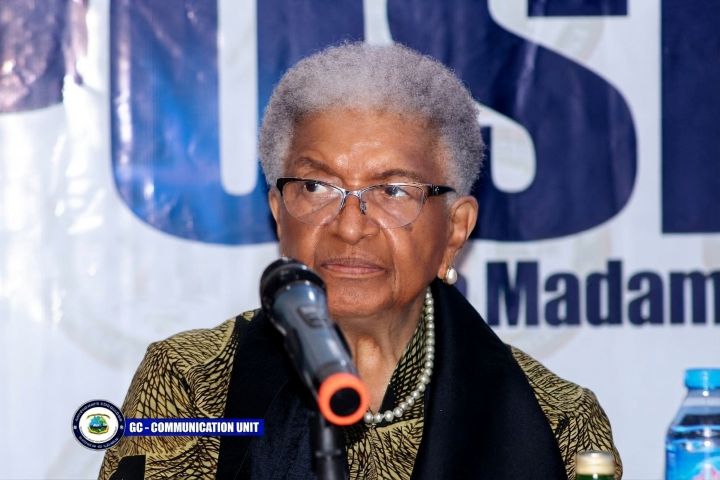
MONROVIA — Former President Ellen Johnson Sirleaf has urged Liberia to stop following the United States and instead pay attention to what she described as a new era of sovereignty and respectability being pursued across Africa as the continent and world undergo significant changes.
Sirleaf made the statement Tuesday after delivering the keynote address at a one-day symposium organized by the Governance Commission in Monrovia as part of activities marking Good Governance Month.
“We have to stop following the United States of America. Let’s join a new era of sovereignty and respectability that Africa is pushing,” Sirleaf told reporters shortly after her keynote address.
The former Liberian leader did not specify which U.S. policies or actions she believes Liberia should stop following. She also did not say Liberia should end or reduce its longstanding diplomatic relationship with Washington.
Instead, Sirleaf emphasized the need for change in Liberia as other African countries reconsider aspects of their political, economic and international relationships.
According to her, Liberia has continued to do the same things repeatedly, including maintaining the same structures, policies, attitudes and mindsets.
“It’s time for change,” she emphasized. “Africa is changing. The world is changing. Liberia cannot be left behind. But it will not happen until we agree that we’re going to change our country.”
Her remarks come as several African countries are pursuing different approaches aimed at strengthening national control over economic, security and foreign policy decisions while diversifying their international partnerships.
In Senegal, President Bassirou Diomaye Faye’s administration has emphasized sovereignty and greater national control over the country’s affairs, including reviewing aspects of its relationships with foreign partners. France completed the withdrawal of its military forces from Senegal in 2025 after Dakar called for an end to the permanent presence of foreign troops.
South Africa has continued to maintain relations with the United States and European countries while also strengthening cooperation with emerging economies through BRICS, which includes Brazil, Russia, India, China, South Africa and other members.
South Africa has described its foreign policy as one based on national interests and engagement with multiple international partners rather than exclusive alignment with one global bloc.
In the Sahel, Mali, Burkina Faso and Niger have taken a different approach. The three military-led countries withdrew from the Economic Community of West African States, or ECOWAS, and established the Alliance of Sahel States. They have also reduced longstanding security ties with France while strengthening cooperation with other international partners, including Russia.
The political circumstances in those countries differ significantly from Liberia’s democratic system, particularly because Mali, Burkina Faso and Niger are governed by military authorities following coups.
Across other parts of the continent, African governments have also expanded economic and diplomatic engagements with China, India, Turkey, Gulf states, European countries and other international partners while continuing various levels of cooperation with the United States.
Liberia, meanwhile, maintains longstanding diplomatic relations with the United States dating to the 19th century. The United States remains one of Liberia’s major international partners in areas including development assistance, health, education, security and governance.
Sirleaf herself maintained close relations with the United States during her presidency from 2006 to 2018.
Her comments were made under the administration of President Joseph Nyuma Boakai, who served as her vice president throughout her two terms in office.
Boakai’s government has continued Liberia’s traditional relationship with the United States while also pursuing diplomatic and economic engagements with other countries.
Sirleaf’s statement also came as President Boakai returned to Liberia through Roberts International Airport following his participation in the 81st session of the United Nations General Assembly in New York.
The Governance Commission symposium brought together former leaders, senior government officials, civil society representatives, citizens, heads and representatives of diplomatic missions and development partners.
The event followed President Boakai’s proclamation of October as Good Governance Month in Liberia.
During her remarks, Sirleaf repeatedly stressed the need for Liberia to change the way it approaches national development and governance as conditions change across Africa and internationally.
She said continuing with the same structures, policies and attitudes would not provide the change the country needs.
“It’s time for change,” Sirleaf said. “Africa is changing. The world is changing. Liberia cannot be left behind.”
See more Liberia News Network stories in Google Search by adding LNN as one of your Preferred Sources.
★ Add LNN as a Preferred Source